

Following a group of young people carrying out the "From Do Paper" project to the Yen Thai Do paper-making village (Tay Ho ward, Hanoi ), we were astonished to find that almost all traces of the once-famous Do paper-making village have disappeared. The only remaining pieces of Yen Thai Do paper can be found at the Do Paper Museum (189 Trich Sai Street), a project under the Zó Project. In addition, there is a small shop in Hanoi that sells this special type of paper, at 42 Hang Can Street.
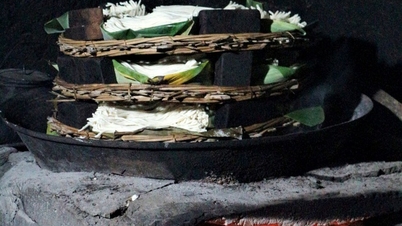
Driven by a desire to witness firsthand the process of making dó paper and hear stories from those in the trade, we continued our journey to Phong Khê paper-making village, Võ Cường ward, Bắc Ninh province. Finding families still practicing the craft here wasn't easy, as the traditional dó paper-making craft is gradually fading away in modern life with many new materials. The moment we found the house of Mr. Nguyễn Trọng Chắc and Mrs. Nguyễn Thị Đào, who still make traditional dó paper, moved us deeply.
 |
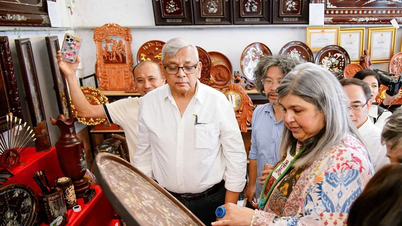
Foreign tourists visit the exhibition space showcasing the materials used to make Do paper. |
But what troubled us even more came from the heartfelt confession of the artisan who has dedicated his life to preserving the traditional dó paper craft. “My family has preserved the traditional dó paper making craft for four generations. This craft is not easy to learn; if there are no successors, it will be lost. We are very worried that when we get old and pass away, the craft will also disappear. Now, dó paper is mainly made by the elderly and those who cannot do heavy labor. I also hope that the younger generation will follow the craft, but dó paper making has low wages and is difficult to make money from. It's a pity…” Mr. Chắc lamented.
Mr. Chac's heartfelt sharing served as a reminder and encouragement for the younger generation. It was from this that the "From Do Paper" project gained further motivation, not only to tell the story of Do paper but also to find ways to bring this traditional material closer to young people. Nguyen Trung Kien, the project leader, said: "We were born in the modern era, so we are almost completely unfamiliar with Do paper. This project aims not only to communicate and spread the image of Do paper to everyone, but also to give us the opportunity to learn and understand the value of this type of paper."
According to Nguyen Trung Kien, the true value of Do paper cannot be fully appreciated by simply looking at it. Only by touching its rough yet resilient surface can one truly understand the difference between Do paper and industrial paper. Do paper may be thin, but it is very durable, retaining ink well over time, which is why it was once used in folk paintings, royal decrees, and ancient letters. Furthermore, due to its elaborate and labor-intensive handcrafted production process, Do paper is quite expensive, causing it to gradually disappear from everyday life.
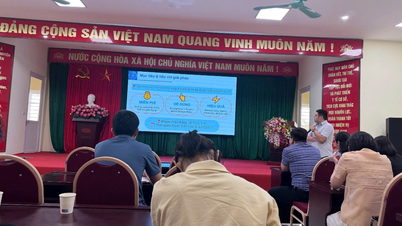
Driven by creativity and a desire to preserve and spread the story of dó paper, a group of young people decided to choose a storytelling approach that resonates with the modern era, from digital media to creating an experiential space where young people can truly touch dó paper. At the experiential event, dó paper was creatively applied to everyday items such as notebooks, bookmarks, playing cards, chess boards, and checkers. In particular, the hands-on dó paper-making activity always attracts the attention of visitors, leaving many positive impressions and feedback.
Flipping through the pages of the diaries left by tourists after experiencing the Do paper of the "From Do Paper" Project, we were moved by the handwritten entries: "Every grain of the paper, every stroke of the pen, reminds us of the enduring nature of a long-standing craft. Even as society becomes increasingly modern, I hope that Do paper will continue to be preserved and passed on to future generations."
Source: https://www.qdnd.vn/van-hoa/doi-song/tam-huyet-giu-nghe-lam-giay-do-truyen-thong-1020488


![[Photo] General Secretary and President To Lam presides over a meeting on preparations for the review of one year of operation of the three-tiered government system.](https://vphoto.vietnam.vn/thumb/1200x675/vietnam/resource/IMAGE/2026/06/02/1780391821195_a1-bnd-4595-9717-jpg.webp)



























































Comment (0)