
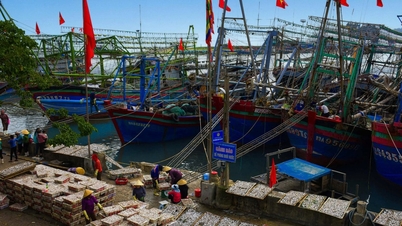
A view of Duy Hai coastal village. Photo: Huynh Thach Ha
Living amidst the vast ocean, fishermen believe that every action and every word carries a good or bad omen, affecting the luck of their fishing trips. Therefore, taboos have become a way of life, even an "unwritten law" within the community.
Before setting sail, people usually choose an auspicious day and time, avoiding days considered unlucky, and offer prayers at the shrine of Ông Nam Hải for a safe and successful journey.
Fishermen also believe that when holding a hat, it should be tucked under the armpit to prevent it from being overturned by the wind, because "a hat overturning a boat" is a bad omen. On the boat, all items are placed face up, not face down.
The bow of the boat, in particular, is considered a sacred place where spirits reside, and is forbidden for women to enter. Each ship and boat is seen as a "mobile home" with its own soul, so before the first voyage of the year, the boat owner performs a ritual to "open the bow" and "launch the boat" to pray for safety.
Once at sea, people avoid dropping objects, especially knives, for fear of offending "the Water Goddess." If a knife is accidentally dropped, the boat owner must return to shore, invite a shaman to perform a ritual of apology, and only then dare to go out to sea again.
Onboard, whoever is assigned to cook does so automatically; no one is allowed to order around or complain. When gutting fish, the tails must not be cut off, because "fish need tails to reproduce," and the guts and heads of the fish must not be thrown into the sea for fear of "cutting off the fish supply."
In their speech, they avoid words with unlucky meanings: instead of saying "big waves," they use "tố" (storm); instead of "fishing," they say "scooping fish"; instead of "full hold," they say "full" or "slowed down." Words like "upside down," "falling," "monkey," "deer," and "turtle" are all avoided because they are considered unlucky.
In the fishing industry using gillnets or trawls, if they encounter a school of dolphins swimming alongside their boat, they use a chopstick to point in a different direction; if the dolphins still follow, they consider it "fate chasing them," and are forced to turn back.
Conversely, when encountering a whale, people stop their boats, bow down, and offer prayers, as it is considered a "lifesaver." Almost every fishing village in Da Nang has a shrine dedicated to the whale, worshipping it as a sea god who protects fishermen amidst storms and rough seas.
One little-known taboo is that when setting sail, the person at the bow of the boat must face the sea and never look back at land. They believe that turning back is a sign of "separation" or "abandoning a relationship," leading to a failed voyage.
When dropping or raising anchor, everyone must keep the area clean and refrain from urinating or spitting around the bow of the boat, as that area is guarded by the "anchor spirit," and any offense will result in punishment.
The story of a wife's fidelity at home is also considered an important taboo. They believe that if the wife "keeps her heart pure," her husband at sea will be safe. Therefore, women in coastal areas are always conscious of "protecting" their husbands' spirits, living honestly and virtuously, as a silent form of protection in their daily lives.
In the midst of modern life, where steel-hulled ships, radar, and GPS have replaced ocean currents, waves, wind, and stars, many superstitions still quietly persist. They are no longer strictly observed as in the past, but remain a part of the cultural memory of fishermen in coastal villages, helping the community to be virtuous, maintain harmony, and respect the sea.
In the coastal fishing villages of Da Nang, from Tam Hai to Nam O and even to Cu Lao Cham, the annual Fishing Prayer Ceremony, marking the beginning of the fishing season, is still held with great solemnity. The younger generation may not fully understand the meaning of each taboo, but through the ritual, they feel the sacred connection between humanity and the ocean, a place that both sustains and tests the courage of generations.
Source: https://baodanang.vn/tam-linh-tren-song-nuoc-3321563.html



![[Photo] The heat at the fireworks display site on the opening night of the Da Nang International Fireworks Festival 2026](https://vphoto.vietnam.vn/thumb/1200x675/vietnam/resource/IMAGE/2026/05/27/1779889741485_ndo_br_z7872039145157-fecaba5112f39e8352544099d7ef4738-5140-jpg.webp)
![[Photo] The courage of new recruits of Brigade 144 on the training ground.](https://vphoto.vietnam.vn/thumb/1200x675/vietnam/resource/IMAGE/2026/05/27/1779881651341_anh-man-hinh-2026-05-27-luc-18-32-52.png)















































![[Photo] The courage of new recruits of Brigade 144 on the training ground.](https://vphoto.vietnam.vn/thumb/402x226/vietnam/resource/IMAGE/2026/05/27/1779881651341_anh-man-hinh-2026-05-27-luc-18-32-52.png)


























Comment (0)