

One morning in May, as scheduled, we traveled to Tri Phai commune, Ca Mau province, to meet Mrs. Do Thi Cu, the seventh daughter of Mrs. Le Thi Sanh, who had sent a sapodilla tree from the South to President Ho Chi Minh in 1954. Her small house nestled beside a tranquil canal. At over 80 years old, Mrs. Cu was still sharp-minded. Her memories of that farewell to the group of cadres departing for the North seemed vivid. She recounted that day, along the Chac Bang canal, many people gathered to see off the soldiers and cadres heading north. Everyone was reluctant to part, unsure when they would see each other again. Amidst that tearful farewell, her mother quietly chose a small sapodilla tree from the garden to send with the group of cadres as a gift to President Ho Chi Minh. This simple gift from the countryside held immense affection from the people of the South for the leader in whom they placed their unwavering faith. “I was very young back then, and my mother told me to go down to the garden to find a beautiful sapodilla tree to send to Uncle Ho. Just hearing that it was a gift for him made me so happy. All the adults loved Uncle Ho,” Mrs. Cu recounted, her voice still full of emotion.

According to Mrs. Cu, back then in the rural areas of the Mekong Delta, few people had ever seen a clear picture of President Ho Chi Minh. People only heard about him through the words of officials and stories about a leader who dedicated his life to caring for the poor and ensuring the country's independence and freedom. But that alone was enough for the people to place their complete trust in him and cherish him like a close family member. "My mother used to say that thanks to Uncle Ho, our people would no longer suffer, and our children and grandchildren would be able to live in peace. That simple belief stayed with many people throughout the war years," Mrs. Cu confided.
In the Mekong Delta, people cherish President Ho Chi Minh in their own unique way. Not with grandiose words, but with quiet loyalty, like keeping a flame burning in their hearts through countless upheavals. In his house in Ca Mau, Mr. Nguyen Huu Thanh, former Deputy Head of the Propaganda Department of the Ca Mau Provincial Party Committee (now the Propaganda and Mass Mobilization Department), still carefully keeps the faded mourning armband. It was the armband he wore at President Ho Chi Minh's memorial service in 1969 amidst the mangrove forest of Nam Can. At that time, he was a student at the Western Region Teacher Training College. In the midst of a base area still riddled with bombs and bullets, the teachers and students erected a simple altar made of forest wood to hold the memorial service for President Ho Chi Minh.
“That day, the whole base fell silent. We hugged each other and cried. To us at that time, Uncle Ho was like our father. No one said anything, but everyone felt they had to continue fighting, they had to achieve what Uncle Ho wished for: the reunification of the country,” Mr. Thanh recounted, pausing for a long time. He later carried that mourning armband with him throughout his years of revolutionary activity. For Mr. Thanh, it was not just a memento, but also a reminder of the faith that Uncle Ho had instilled in the people of the South during the most difficult period.
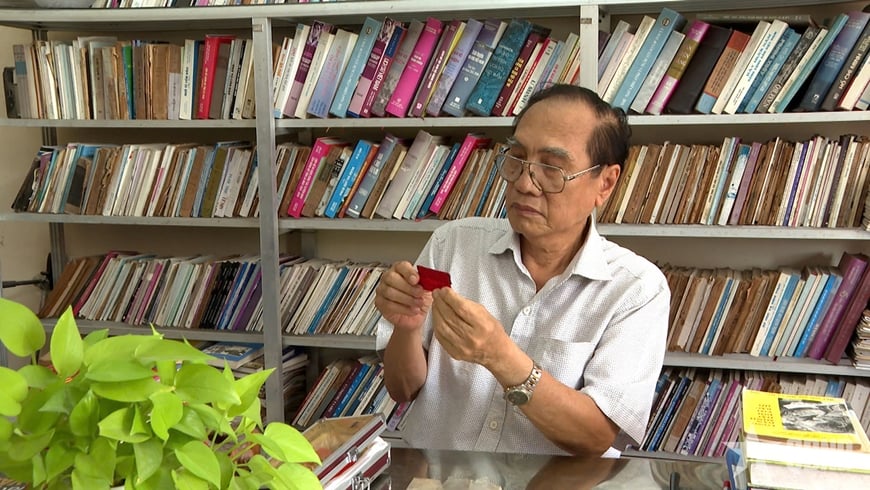
For Ms. Nguyen Bich Van in An Xuyen ward, Ca Mau province, years have passed with many changes, but the Testament of President Ho Chi Minh, left behind by her mother, remains a priceless treasure. Ms. Van recounts that her mother was a liaison officer operating in enemy-controlled territory. During the war years, to protect the Testament, she had to wrap it in many layers of rubber and hide it under a thatched roof. According to Ms. Van, living in enemy territory, under strict control, preserving a revolutionary document was a gamble with one's life. But her devotion to President Ho Chi Minh gave her mother the courage to safeguard the Testament as a safeguard of her belief in a future independence. "There were nights when it rained heavily, and my mother stayed awake, afraid that the water would damage the document. For our family, the Testament is not simply a piece of paper, but a reminder for our descendants to live in a way that is worthy of the sacrifices of so many people who came before," Ms. Van shared.
Beyond personal mementos and stories, in the Southwestern region of Vietnam, affection for Uncle Ho is also embodied in the temples erected during the fierce years of war—the Ho Chi Minh Temple in Chau Thoi commune, Ca Mau province, being a prime example. During those brutal years of war, amidst the smoke of bombs, there shone the radiant spirit of "we rebuild what the enemy destroys." Surrounded by enemy bullets, a sturdy temple made of reinforced concrete rose proudly, inaugurated just in time for Uncle Ho's birthday, May 19, 1972. And at that same time, a seven-member temple guard team, led by Mr. Nguyen Van Khoa, was formed during a deeply moving "living memorial" ceremony. They vowed to dedicate their youth and lives to safeguarding the sacred temple. And history has proven that no force can destroy the faith and affection that the people of the Southwestern region have for the beloved father of the nation.
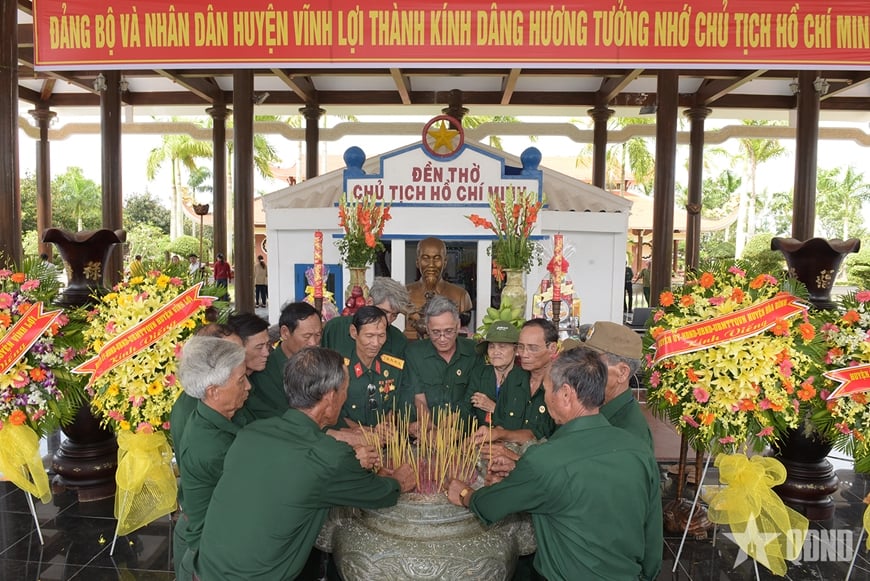
Mr. Nguyen Van Khoa, team leader of the Ho Chi Minh Memorial Temple security team in Chau Thoi commune, Vinh Loi district, Bac Lieu province (1972-1975) (now Chau Thoi commune, Ca Mau province), recalled: “After the temple was built, the enemy considered it a target to be destroyed at all costs. From the direction of Soc Trang and Bac Lieu airports, they continuously bombarded it; at night, artillery fire came from many directions. There were also 7-8 military outposts around, so they were constantly threatening to raid it. Once, they captured hundreds of people, forcing them to lead them to destroy the temple. But when they got close, from the elderly to the children, everyone unanimously sat down; no one wanted to take another step. The people clearly stated: 'If you want to shoot, shoot us, but we will not destroy the Ho Chi Minh Memorial Temple.' It was this unity and determination that ultimately forced many raids to retreat, failing to achieve their goal. Thanks to this, we and the people were able to protect the temple until the complete liberation of South Vietnam.”
More than half a century has passed, marked by the ebb and flow of the tides, yet the incense smoke on the altars dedicated to President Ho Chi Minh in the Southwestern region of Vietnam has never cooled. From the legend of the southern sapodilla tree to the resilient temples erected in the heart of enemy territory, all have woven together an epic of unwavering loyalty and devotion of the people of the Mekong Delta to the Father of the Nation. Preserving these relics and caring for these temples is a concrete way for the people of this southernmost region of the country to continue this tradition, ensuring that their love and respect for President Ho Chi Minh become a solid cultural and spiritual foundation for the government and people of the Mekong Delta to move forward.
According to qdnd.vn
Source: https://baodongthap.vn/tam-long-nguoi-dan-mien-tay-voi-bac-ho-a241039.html
![[Image] Close-up view of the interchange connecting the two expressways and Long Thanh Airport.](https://vphoto.vietnam.vn/thumb/1200x675/vietnam/resource/IMAGE/2026/05/25/1779703378210_ndo_br_z7863716673926-224453a31600126cce10622af6290afd-4549-jpg.webp)
![[Image] Hanoi's urban life under the challenge of a "scorching hot" environment](https://vphoto.vietnam.vn/thumb/1200x675/vietnam/resource/IMAGE/2026/05/25/1779706979265_nang-nong-t5-2026-minh-duy-7-4636-jpg.webp)



























































Comment (0)