


Mr. Nguyen Van De harvests buffalo placenta to feed shrimp and crabs. Photo: DANG LINH
The family of Mr. Nguyen Van Han, residing in An Bien commune, has been involved in the business of harvesting buffalo placentas for many years. Every day, he and his son-in-law drive their motorboat to the fields early in the morning to harvest buffalo placentas, bringing them back to their family's shrimp farm, and selling the rest to neighboring households. Mr. Han said that on average, his family supplies about 500 kg of buffalo placentas to farmers in the area each day, at a price of about 3,000 VND/kg. After deducting fuel costs, they earn a profit of 500,000 to nearly 1 million VND per day. "Industrial feed is very expensive now, so people are looking to buy buffalo placentas more than before. This is cheap, and crabs and shrimp eat it readily," Mr. Han said.
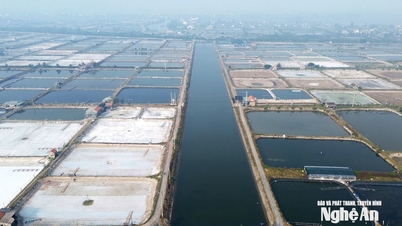
According to locals in the U Minh Thuong region, buffalo placenta, a naturally occurring bivalve mollusk found along rivers and coastlines, was so abundant that few paid attention to it. At one point, people would collect it but leave it behind because it was considered almost worthless. However, in recent years, with the rising prices of shrimp and crab feed, buffalo placenta has become a valuable food source for many households to reduce costs, and coastal residents have also gained additional income depending on the tides.
Mr. Nguyen Van De, a farmer raising freshwater prawns, crabs, and tiger prawns in An Bien commune, said that if he used only industrial feed, the cost per pond would be about 500,000 VND/day. Since switching to feeding with buffalo placenta, the cost has decreased significantly. “Each day, a pond only needs about 100kg of buffalo placenta to feed the prawns and crabs, which works out to about 300,000 VND. Saving a few hundred thousand VND per day means significant savings over the entire season,” Mr. De said.
Not only does it help reduce costs, but according to many farmers, this natural food source is also suitable for extensive and improved extensive shrimp farming models that utilize the natural ecological environment. Shrimp and crabs fed on fresh food are generally healthier, feed more vigorously, and grow faster. However, using buffalo placenta requires farmers to carefully manage the pond environment. If overfed, excess food can easily pollute the pond bottom and cause disease outbreaks. Therefore, farmers must regularly treat the pond bottom with probiotics and monitor the animals' feeding habits to adjust accordingly.
Regarding tiger prawns, Mr. Tran Van Hung, residing in Tan Thanh commune, stated: "Buffalo placenta should only be used during the shrimp's growth phase, about 10-15 days before harvest. Prolonged feeding can easily affect the shrimp's digestive system, weakening them and making them more susceptible to disease."
With the scarcity of trash fish, many households in the U Minh Thuong region are proactively cultivating buffalo placenta in their ponds as a long-term food source. Among them, the model of Mr. Tran Van Xinh, residing in Tan Thanh commune, has attracted much interest. Besides extensive shrimp and crab farming, Mr. Xinh utilizes the pond and canal system within his farm to naturally cultivate buffalo placenta. According to him, farmers previously relied heavily on trash fish, but the price was high and they were difficult to obtain, while buffalo placenta is both cheaper and suitable for ecological farming models.
To cultivate buffalo placenta effectively, Mr. Xinh renovated his ponds from the beginning of the season, dredging canals and ditches, removing unwanted fish, and using nets to filter water to prevent predatory fish from entering the ponds. He utilized water coconut leaves and branches as substrates for the placenta to attach to and grow. Mr. Xinh said: "After about 20 days, the placenta begins to develop steadily and can be used as food for crabs and shrimp. Thanks to having a readily available food source, the cost of raising the fish is significantly reduced."
Amidst the many fluctuations in the aquaculture industry, the tiny buffalo placenta is helping shrimp and crab farmers in the U Minh Thuong region reduce costs and maintain profits. The early morning boat trips to the shore and the ponds utilizing natural food sources reflect the diligence and adaptability of coastal people in their journey to adapt to difficulties and find a sustainable path for shrimp and crab farming.
Source: https://baoangiang.com.vn/tan-dung-nhau-trau-de-nuoi-tom-cua-a486083.html
![[Image] Hanoi's urban life under the challenge of a "scorching hot" environment](https://vphoto.vietnam.vn/thumb/1200x675/vietnam/resource/IMAGE/2026/05/25/1779706979265_nang-nong-t5-2026-minh-duy-7-4636-jpg.webp)

![[Image] Close-up view of the interchange connecting the two expressways and Long Thanh Airport.](https://vphoto.vietnam.vn/thumb/1200x675/vietnam/resource/IMAGE/2026/05/25/1779703378210_ndo_br_z7863716673926-224453a31600126cce10622af6290afd-4549-jpg.webp)












































































Comment (0)