

China is gradually abandoning dollar-denominated assets in favor of gold – a move toward a Beijing-led global de-dollarization campaign.
China's economic position is growing stronger, and the yuan is becoming a competitor to the US dollar. The world's second-largest economy is also an influential member of the BRICS+ group (comprising Brazil, Russia, India, and South Africa).
International political experts view the growing strength of BRICS as posing a challenge to the world order, seen as a formidable rival to the G7 and other international organizations. BRICS is creating a new economic, social, and monetary status quo, reversing what the world has accepted as normal for nearly eight decades.
Although it doesn't use the term "threat," the U.S. administration currently considers China the "most serious long-term challenge" to the international order. This also easily explains why China is pursuing the strategic goal of ending the dominance of the U.S. dollar – which is considered the solid foundation of American power.
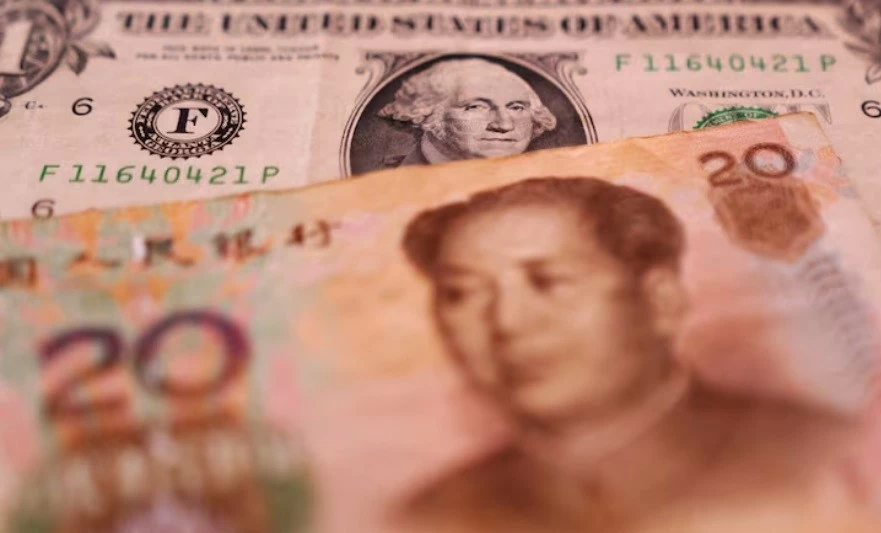 |
| The US dollar continues to outperform other currencies despite its declining influence. (Source: Reuters) |
The position of the US dollar
The dominance of the US dollar contributes to consolidating American power in the current international order, as the French economist Denis Durand explained in his article "Guerre monétaire internationale: l'hégémionie du dollar contestée?" (International Currency Wars: The Hegemony of the Dollar Challenged?).
"Besides the fact that some currencies have been pegged to the USD by a fixed link or through a fluctuation band, the US currency is also used in many Eastern European countries and regions, where it enjoys much higher public trust than the domestic currency (...) The US is currently the only superpower that can bear foreign debt in its own currency," economist Denis Durand analyzed.
The significant influence of the US dollar on the global economy is reflected in its excessive share of foreign exchange reserves at many central banks around the world. Despite its declining influence, the US dollar continues to outperform other currencies.
Despite a 12 percentage point decrease between 1999 and 2021, the share of the US dollar in the official assets of central banks worldwide has remained relatively stable at around 58-59%.
The US dollar remains widely trusted around the world, solidifying its position as the leading reserve currency. The USD reserves of central banks worldwide are invested in US Treasury bonds in the US capital markets, helping to reduce the cost of financing both government debt and private investment in the US.
However, the strength that the US economy has gained from the dollar's dominant position in the international market could also crumble like a paper house, according to expert Denis Durand. He believes there are two main reasons why the world's confidence in the dollar could decline.
First, as U.S. Treasury Secretary Janet Yellen acknowledged in an interview in April 2023, the U.S. is using the dollar as a tool to "subdue" rivals and exert influence over allies. This could ultimately weaken the dollar's position.
On the other hand , the US public debt situation is quite worrying, particularly the unsustainability of the debt, which threatens to affect the attractiveness of the USD as a global reserve currency. In 2023, US public debt reached over $33.4 trillion, nine times the amount in 1990. This enormous figure continues to raise concerns about its sustainability. Federal Reserve Chairman Jerome Powell has pointed out that US debt is growing faster than the economy, making it unsustainable in the long term.
A "golden opportunity" for China.
In fact, the US public debt presented a "golden opportunity" for China, and the world's second-largest economy quickly capitalized on this. Beijing carried out a massive sell-off of its holdings of US Treasury bonds. Between 2016 and 2023, China sold $600 billion worth of US Treasury bonds.
China is continuing its process of selling US Treasury bonds. According to the US Treasury Department, from March 2023 to March 2024, China sold $100 billion worth of US Treasury bonds, not including the $300 billion it has sold over the past decade.
In August 2017, China even surpassed Japan to become the largest creditor of the United States. China also holds more than $1.146 trillion in U.S. Treasury bonds, nearly 20% of the total held by all foreign governments. Beijing is now Washington's second-largest foreign creditor.
It is certainly no coincidence that before divesting from US bonds, Beijing introduced its own gold pricing system in yuan for the first time. On April 19, 2016, the Shanghai Gold Exchange – China's precious metals regulator – announced on its website the first daily "fixed" benchmark for gold at 256.92 yuan/gram.
Clearly, this policy is part of China's strategy to make gold a tangible backing for its currency.
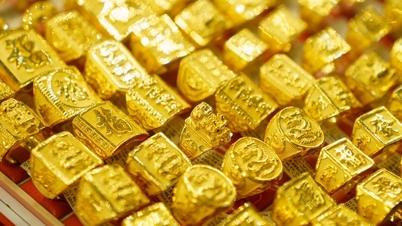
Meanwhile, China has replaced about a quarter of the US Treasury bonds sold over the past 10 years with gold. The Northeast Asian nation is now also the world's leading producer and consumer of gold. Like China's central bank, many central banks continue to buy gold.
As an alternative to the US dollar, gold allows China to store profits from its large trade surplus.
With the Shanghai Gold Exchange, which offers gold contracts denominated in yuan, Beijing is seeking to increase the use of its currency overseas with the aim of establishing the yuan as a benchmark for the global economy.
Pressure from former President Donald Trump
However, the Chinese currency is also under pressure from the possibility of Republican candidate Donald Trump returning to the US presidency, not only from speculators shorting the currency but also from mainland exporters hoarding USD.
Even as the Chinese stock market rallied following Beijing's comprehensive economic stimulus package, the looming bleak prospect of a Donald Trump victory in the November election, coupled with the threat of increased trade tariffs, continued to put pressure on the yuan.
The yuan has weakened by about 1.5% for three consecutive weeks, its sharpest decline in over a year.
"Over the next 12 to 18 months, as China faces the prospect of higher trade tariffs from all directions, the easiest policy adjustment mechanism for the economy may be currency devaluation," said Rong Ren Goh, a fixed-income portfolio manager at Eastspring Investments.
Source: https://baoquocte.vn/tan-dung-no-cong-khung-cua-my-trung-quoc-tham-vong-dung-vang-de-ha-guc-dong-usd-291582.html


![[Photo] Prime Minister Pham Minh Chinh attends the Conference on the Implementation of Tasks for 2026 of the Industry and Trade Sector](/_next/image?url=https%3A%2F%2Fvphoto.vietnam.vn%2Fthumb%2F1200x675%2Fvietnam%2Fresource%2FIMAGE%2F2025%2F12%2F19%2F1766159500458_ndo_br_shared31-jpg.webp&w=3840&q=75)


























































































Comment (0)