

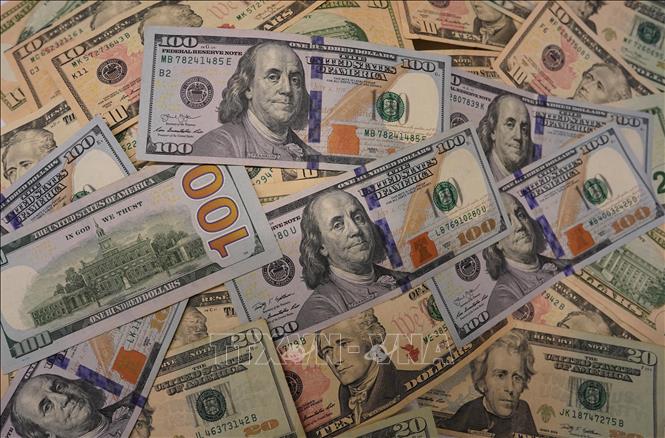
At the end of the December 5 trading session, the USD index - a measure of the greenback's strength against a basket of six major currencies - fell 0.1% to 98.994, near its lowest level in five weeks.
Market sentiment last week was largely dominated by weak macroeconomic data and speculation about the future direction of US monetary policy. For the week, the index fell 0.5%.
Firm belief
Markets are now betting on a nearly 90% chance that the Fed will cut interest rates at its December 9-10 meeting and could make two more cuts next year, according to a survey by financial data provider LSEG.
This expectation was reinforced after a series of weak labor market data was released this week. In the final session of the week, data showed that US consumer confidence improved in early December 2025, but this information was not enough to support the USD. In addition, the Personal Consumption Expenditures (PCE) price index report for September 2025 showed that US inflation remained under control. This data also did not change expectations that the Fed will cut interest rates.
ADP chief economist Nela Richardson said hiring has struggled recently amid macroeconomic uncertainty and a cautious consumer environment, noting that job cuts in November were mostly at small businesses, a group hardest hit by tariffs.
Meanwhile, Heather Long, chief economist at Navy Federal Credit Union, warned that this is no longer a low-hiring job market, but marks the beginning of a wave of layoffs.
Antonio Ruggiero, macro and foreign exchange strategist at financial services firm Convera, said the data has reinforced the case for the Fed to act. In addition, the US dollar is overvalued compared to other major currencies, so the greenback's weakness is entirely reasonable.
Even major banks have changed their forecasts for the Fed’s rate path. Morgan Stanley said on December 5 that it expects the Fed to cut rates by 0.25 percentage points by December 2025, similar to JPMorgan and BofA. All three banks had previously forecast the Fed would hold rates steady at its final meeting of 2025.
Additionally, another factor attracting attention is the possibility that White House economic adviser Kevin Hassett will replace Jerome Powell as Fed Chairman when Powell's term ends in May 2026.
Mr. Hassett, a PhD economist, served as Chairman of the Council of Economic Advisers during President Trump’s first term. He currently heads the National Economic Council (NEC), a White House agency that advises the President and Cabinet on policy issues.
According to Mr. Chris Turner, head of global markets at ING bank, the market believes that Mr. Hassett's coming to power will make the Fed more dovish, which means the central bank will make more interest rate cuts.
Outlook for the Week Ahead: Central Bank Meetings
Next week will see central banks take center stage, with a series of key policy meetings.
The series of meetings begins with the Reserve Bank of Australia (RBA, central bank) on December 9, followed by the Bank of Canada (BoC) and the Federal Reserve on December 10, and the Swiss National Bank (SNB) on December 11. The following week will see interest rate decisions from the Bank of Japan (BoJ), the European Central Bank (ECB) and the Bank of England (BoE).
The focus will be on the Fed at these meetings. While a 0.25 percentage point rate cut at the Fed’s final meeting of 2025 is almost certain, the dollar’s reaction will depend on the tone of Fed Chairman Powell’s subsequent press conference.
Given the above situation, analyst Michael Krautzberger of global investment management company AllianzGI said that although it is impossible to make an absolutely accurate forecast of the Fed's decision, recent statements by Fed policymakers, macroeconomic data and market prices all show the possibility of the US central bank cutting interest rates by 0.25 percentage points next week. AllianzGI still maintains its forecast that the Fed will cut interest rates by a total of 0.5 percentage points to the target range of 3.25-3.5% until mid-2026.
Technically, the outlook for the greenback remains bearish after the dollar index broke its uptrend since September. The index is currently supported at 98.80, a break of which could see the dollar weaken further.
Overall, with the market almost certain of a Fed rate cut, the USD is unlikely to recover firmly in the short term.
Source: https://baotintuc.vn/thi-truong-tien-te/niem-tin-fed-ha-lai-suat-gia-tang-suc-ep-len-dong-usd-20251206122114324.htm



![[Photo] National Assembly Chairman Tran Thanh Man attends the VinFuture 2025 Award Ceremony](/_next/image?url=https%3A%2F%2Fvphoto.vietnam.vn%2Fthumb%2F1200x675%2Fvietnam%2Fresource%2FIMAGE%2F2025%2F12%2F05%2F1764951162416_2628509768338816493-6995-jpg.webp&w=3840&q=75)
![[Photo] 60th Anniversary of the Founding of the Vietnam Association of Photographic Artists](/_next/image?url=https%3A%2F%2Fvphoto.vietnam.vn%2Fthumb%2F1200x675%2Fvietnam%2Fresource%2FIMAGE%2F2025%2F12%2F05%2F1764935864512_a1-bnd-0841-9740-jpg.webp&w=3840&q=75)


































































































Comment (0)