

Vietnam Airports Corporation (ACV) has just submitted a document to the Ministry of Construction and the Ministry of Finance, proposing to be assigned as the investor of phase 2 of the Long Thanh International Airport Project.
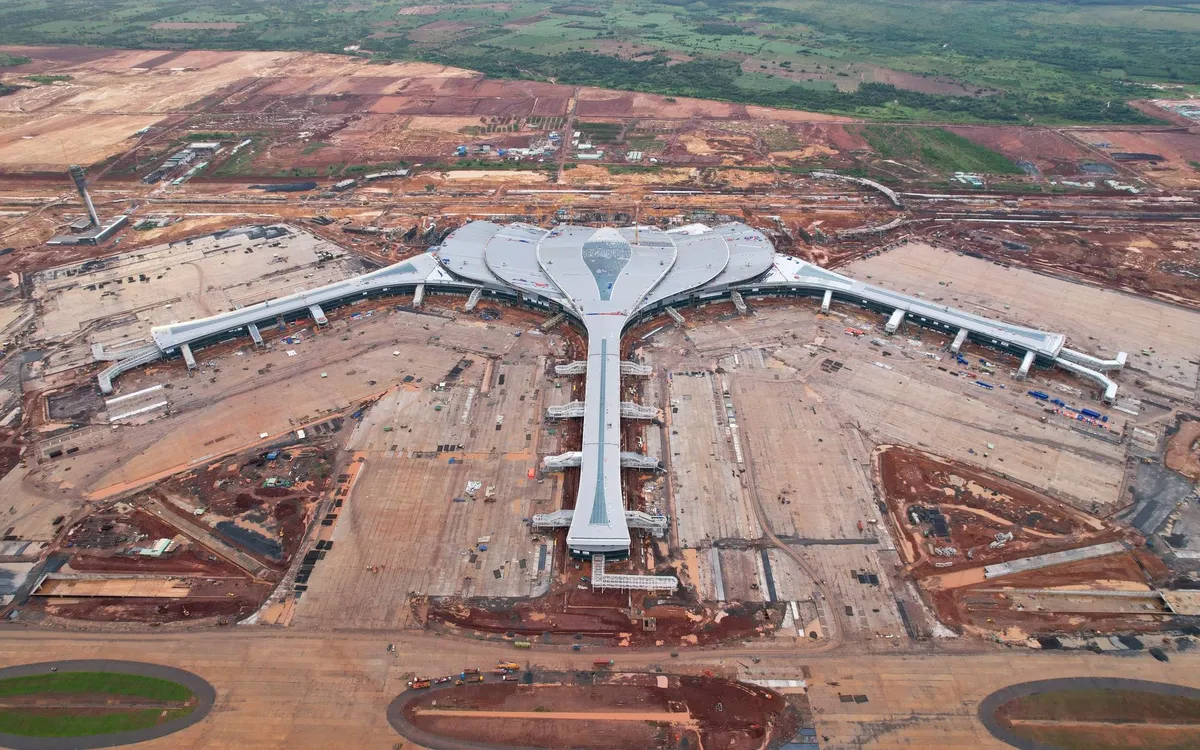
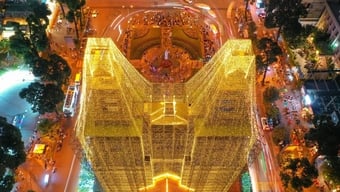
Panoramic view of passenger terminal, Long Thanh International Airport from above.
One airport – One operator
According to the assessment, phase 2 is of key importance in increasing the airport capacity to 50 million passengers and 1.5 million tons of cargo per year, gradually turning Long Thanh into an international aviation transit hub in the region.
According to the proposal, assigning ACV as the investor of phase 2 aims to ensure the principle of "one airport - one operator", avoiding fragmentation in management, investment and operation, while ensuring synchronization in planning, technical infrastructure and technology platform throughout the project life cycle.
Currently, ACV is the investor of component project 3 in phase 1, "Essential works in the airport carried out by the airport operator", and is also the unit assigned to manage and operate Long Thanh International Airport when it is put into operation.
This enterprise is also directly investing in the entire airport infrastructure, shared infrastructure and facilities serving exploitation, so it believes that continuing to take charge of phase 2 will ensure inheritance and consistency in investment.
ACV emphasized that Long Thanh is not only an infrastructure project, but also a "strategic symbol" of the national aviation industry. Therefore, the organization of investment in the next phase needs to be implemented in a consistent manner in terms of management thinking, exploitation model and development orientation according to modern international airport standards.
The enterprise affirmed its orientation to develop Long Thanh according to the "green - smart - 5-star standard" airport model, in which special attention is paid to autonomy and the ability to integrate information and communication technology (ICT) right from the design, investment to operation stages.
ACV's proposal to continue investing throughout the two phases also aims to ensure that the technology platform is not divided, overlapped or inconsistent.
Ready funding for phase 2 of the Project
Regarding the scale of investment, according to the plan submitted to the Ministry of Construction, the total investment for the project to build the third runway and auxiliary works alone is expected to be about 13,000 billion VND. The main items include runways, taxiways, airport equipment, signal paint, signs and other synchronous auxiliary infrastructure.
ACV said that this part of the work can be carried out entirely by the capacity of domestic contractors, from design, appraisal to construction and supervision, while using 100% of the enterprise's legal capital, without using government guarantees.
For the entire phase 2, the project will include the construction of an additional passenger terminal and other synchronous works to increase the total capacity of the airport to 50 million passengers/year and 1.5 million tons of cargo/year. The total estimated investment for this phase is about 80,000 billion VND, also using ACV's legal capital.
According to ACV, with its large scale and high technical requirements, the implementation of some items in phase 2 will require the participation of international contractors, especially in the fields of overall design, complex structures and modern airport technology.
To prepare for the investment, the company said it has developed a feasible capital balance plan, which basically ensures resources to immediately invest in the third runway from after-tax profits in 2024 and 2025. ACV plans to pay dividends in shares to increase charter capital, creating a financial foundation for the next investment phase.
In addition, ACV proposed that the Ministry of Construction allow the implementation of phase 2 according to the plan of separating the third runway project and auxiliary items for approval and investment first.
After completing the approval of this foundation part, the results will be compiled into a Feasibility Study Report for the entire phase 2 and submitted to the Minister of Construction for investment decision.
Previously, the Ministry of Construction also submitted a document to the Government requesting the National Assembly to allow the adjustment of the content of Clause 6, Article 2 of Resolution No. 94/2015/QH13 in the direction of allowing the Government to self-approve the Feasibility Study Report for Phase 2, without having to submit it to the National Assembly for approval.
According to the Ministry of Construction, in the Phase 1 Feasibility Study Report, the investment time for Phase 2 is expected to be in the period 2028-2032.
However, with the GDP growth scenario from 2026 set at double digits, demand for air transport, especially at Long Thanh airport, is forecast to increase faster than initial calculations.
Therefore, the Ministry of Construction believes that it is necessary to organize phase 2 investment research earlier than expected.
The Ministry of Construction also believes that early investment in the third runway will take advantage of available human resources, machinery, and equipment from phase 1 packages, helping to save time, costs, and shorten progress.
At the same time, early implementation also contributes to minimizing environmental and operational impacts when the airport is in operation, such as noise, dust and construction site conflicts.
Source: https://vtv.vn/acv-de-xuat-lam-chu-dau-tu-san-bay-long-thanh-giai-doan-2-100251206100939278.htm
![[Photo] 60th Anniversary of the Founding of the Vietnam Association of Photographic Artists](/_next/image?url=https%3A%2F%2Fvphoto.vietnam.vn%2Fthumb%2F1200x675%2Fvietnam%2Fresource%2FIMAGE%2F2025%2F12%2F05%2F1764935864512_a1-bnd-0841-9740-jpg.webp&w=3840&q=75)


![[Photo] National Assembly Chairman Tran Thanh Man attends the VinFuture 2025 Award Ceremony](/_next/image?url=https%3A%2F%2Fvphoto.vietnam.vn%2Fthumb%2F1200x675%2Fvietnam%2Fresource%2FIMAGE%2F2025%2F12%2F05%2F1764951162416_2628509768338816493-6995-jpg.webp&w=3840&q=75)






























































Comment (0)