

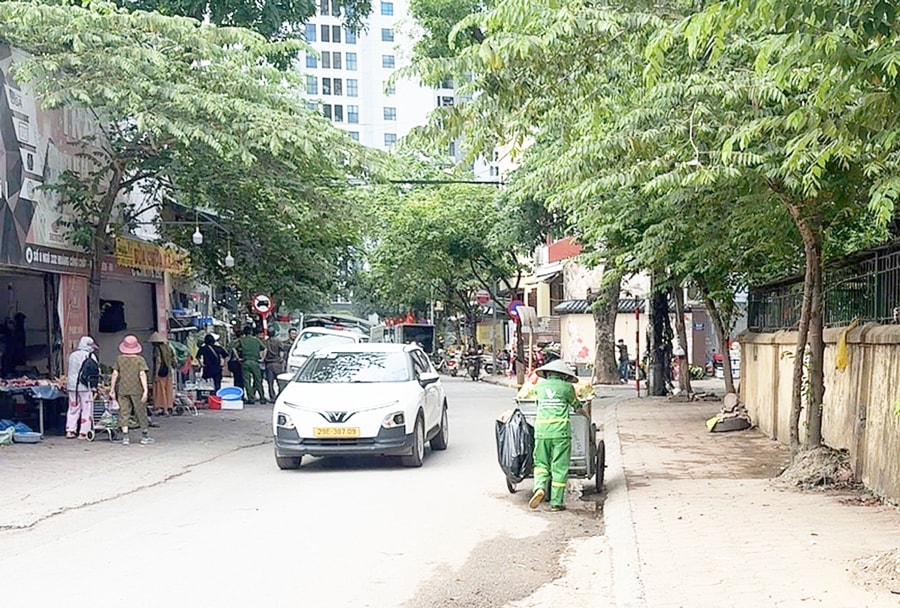
Take decisive action against unauthorized markets.
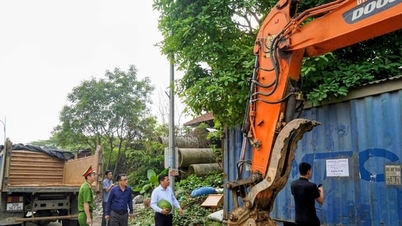
In recent days, communes and wards have simultaneously launched campaigns to dismantle and eliminate makeshift markets that have existed for many years. For example, the temporary market on Do Xuan Hop Street and the business area at the intersection of Nguyen Van Giap and Ham Nghi streets (Tu Liem ward) previously operated spontaneously, encroaching on sidewalks and roads to sell goods, failing to ensure traffic safety, environmental hygiene, and food safety. However, a survey by reporters from the Hanoi News and Broadcasting Agency shows that both markets have been cleared. In particular, the entire temporary market area on Do Xuan Hop Street has been enclosed with corrugated iron, and traders are not allowed to display or sell goods on the sidewalks, preventing the re-establishment of the spontaneous market.
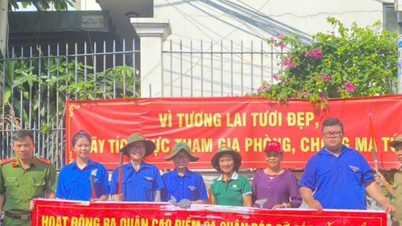
At the makeshift market in alley 332, Hoang Cong Chat Street (Phu Dien Ward), positive changes are clearly evident. Over the past week, the Ward's Steering Committee 197 mobilized police, civil defense forces, and urban order teams to continuously crack down on violations and completely dismantle the long-standing makeshift market. As a result, the alley is cleaner and more spacious, making traffic flow easier for residents.
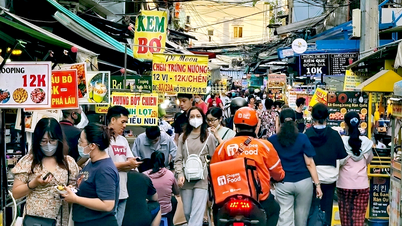
Prior to the demolition, dozens of stalls selling vegetables and fresh food occupied the entire sidewalk along this alley. Customers parked their vehicles in the middle of the road, causing frequent traffic congestion. Wastewater from the food stalls was discharged directly into the sewer, creating an unpleasant odor, while garbage was piled up on the sidewalk, making the urban landscape unsightly after each market closed.
Despite repeated enforcement actions, the violations continued to recur. However, following decisive directives from the city, Phu Dien ward has strengthened its forces, maintained regular inspections, and taken more resolute action. In addition to raising awareness and encouraging businesses to voluntarily remove encroaching items, authorities have also dismantled awnings, canopies, platforms, and confiscated equipment and materials used for illegal market activities.
After the peak period, the practice of selling goods on sidewalks has basically ceased. Only a few cases of clandestine business continue after the authorities leave. Ms. Nguyen Ngoc Huyen, a resident of alley 332, Hoang Cong Chat Street, said: “Previously, pedestrians had almost no space to walk because shops occupied the entire sidewalk, while garbage and wastewater caused serious sanitation problems. The government's crackdown has received the support of many households in the area.”
It is necessary to maintain the status quo and prevent re-encroachment.
In addition to clearing the area, many localities are actively arranging and allocating space for small traders to sell their goods, and have plans to prevent re-encroachment. In Tuong Mai ward, there are currently two temporary markets located in alley 106 Nguyen An Ninh street and alley 293 Tam Trinh road, with nearly 280 households selling essential goods. Previously, many households frequently displayed their goods spilling onto the road and sidewalks, erecting awnings and canopies that marred the urban landscape. To address this thoroughly, the ward police have developed a plan to clear the area and simultaneously implemented measures to prevent re-encroachment.
Accordingly, local security forces are assigned to regularly patrol and monitor the area, and will promptly coordinate to handle any signs of the market reopening. Task forces also maintain checkpoints in key areas, combining mobile inspections with regular reporting. Notably, according to the Chairwoman of the Tuong Mai Ward People's Committee, Dao Thi Thu Hang, to facilitate the stable operation of small traders after the relocation, the Ward People's Committee has developed a plan to relocate households to the Dong Tam market in accordance with regulations. Simultaneously, the ward is intensifying propaganda and mobilization efforts to discourage people from buying and selling at market locations outside the planned areas.
In Hoai Duc commune, after numerous awareness campaigns, signed commitments, and organized clearance operations, the local authorities are now focusing on maintaining the results. After completing the handling of violations, management responsibility is directly assigned to villages and residential groups, requiring regular patrols and holding leaders accountable for preventing re-encroachment. Simultaneously, the local authorities are studying options for relocating small traders to official markets or suitable business locations to ensure their livelihoods while still complying with the law.
However, while clearing the area is the first step towards success, maintaining the long-term results is the real challenge. The city's goal is not just to eliminate spontaneous markets, but also to relocate traders to official markets. However, reality shows that even though many traditional markets still have vacant business spaces, many traders remain hesitant to move inside.
This presents a significant challenge as many small traders are still unprepared to leave the informal markets and are hoping to resume operations, resulting in the continued existence of disguised temporary markets throughout the city. This also poses a considerable obstacle for authorities in completely eliminating these markets in a short period. However, if local authorities are persistent and decisive, resolving bottlenecks and allocating suitable land to stabilize the traders' morale, the above objective will certainly be achieved, once livelihood issues are addressed in harmony with the goal of building a civilized commercial and urban environment.
Source: https://hanoimoi.vn/tang-toc-giai-toa-cho-coc-cho-tam-976498.html
![[Photo] General Secretary and President To Lam and the President of the Philippines hold talks.](https://vphoto.vietnam.vn/thumb/1200x675/vietnam/resource/IMAGE/2026/06/01/1780283481955_vna-potal-tong-bi-thu-chu-tich-nuoc-to-lam-va-tong-thong-philippines-hoi-dam-8797519-1429-jpg.webp)



























































































Comment (0)