

Creating a "digital profile" for sidewalks.
The Ho Chi Minh City People's Committee has just agreed in principle to implement a software system for managing the temporary use of roads and sidewalks, as proposed by the Department of Construction. The pilot phase will last 18 months before the city evaluates its effectiveness to consider expanding the system.
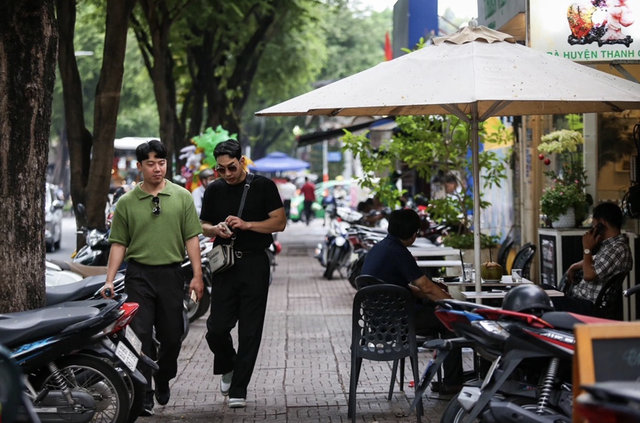
Ho Chi Minh City is about to pilot a digital platform for managing sidewalks.
PHOTO: NHAT THINH
According to the design, the system developed by VNPT Ho Chi Minh City will integrate many functions such as online application submission, licensing, electronic file management, fee collection, statistics, and data management on a digital map. Instead of fragmented management as before, authorities can visually observe all locations where temporary use of roads and sidewalks is permitted in the area. Each location will be linked to a specific data set regarding area, usage time, type of permit, and related financial obligations.
In other words, Ho Chi Minh City is gradually building a digital database for sidewalk space, viewing it as a special type of public urban asset. In fact, this model has been piloted in An Dong Ward since mid-May. Residents can scan a QR code or access the online portal to register for temporary sidewalk use, verify their identity using VNeID, upload documents, and receive results online. The system also supports cashless payments.
Dr. Nguyen Dang Dao, a PhD candidate in urban planning at the National University of Singapore, assessed that Ho Chi Minh City's beginning to digitize sidewalk and street management is a noteworthy shift in urban governance thinking. The issue of sidewalks has long been more than just urban order; it also relates to traffic, the urban economy , people's livelihoods, tourism, and the quality of public spaces. As the population and urban space expand, manual management methods struggle to meet the requirements for consistency, transparency, and real-time data updates.
"The application of digital platforms primarily helps cities utilize data more effectively. Authorities can identify which areas are being used for what purposes, the density of use, and the duration of use. This is an approach that many cities around the world have adopted in the process of building smart cities," Mr. Nguyen Dang Dao stated.
Sharing the same view, Dr. Vu Viet Anh, an architect and Director of the International Training Institute (Ho Chi Minh City University of Architecture), believes that digitizing sidewalk management is a reasonable and necessary roadmap. A digital platform will better support the process of considering and granting permits for the use of sidewalks for paid public activities, thereby creating resources for maintaining cleanliness and order, as well as infrastructure maintenance. Urban design can contribute to assessing the feasibility of each sidewalk space to ensure the maintenance of essential functions such as pedestrian access, parking, or service provision that meets community needs.
Sidewalks need upgrading.
In Vietnam, as in many Asian countries, sidewalks are not only infrastructure for pedestrians but also venues for many daily social activities, services, and community interactions. Therefore, digitalization needs to be accompanied by long-term urban planning and design strategies. Cities need to clearly identify which streets should be absolutely pedestrian-friendly, and which can combine pedestrian use with controlled business activities, tourism, or nighttime economy. Only then will digital data truly become the foundation for developing policies tailored to each area.
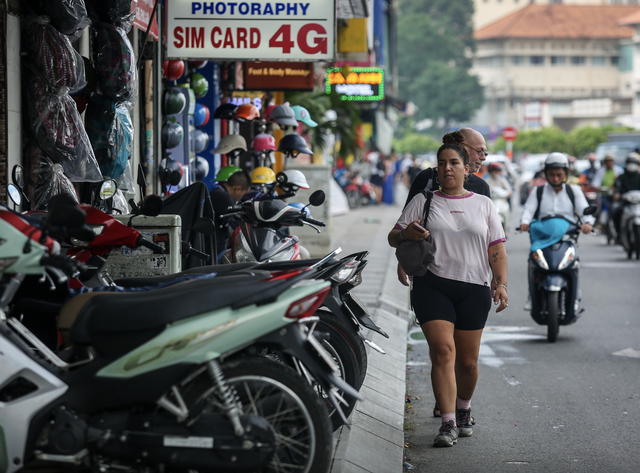
Pedestrians have to share space with vehicles on the sidewalk.
PHOTO: NHAT THINH
Architect Ton That Liem argues that each street has different sidewalk widths, population densities, pedestrian traffic, and business activities, so a single ratio cannot be applied mechanically. The digital platform needs to clearly show each permitted area and section. Only then can the licensing and fee collection process avoid arbitrariness.
Management software is just one link in the process of upgrading the quality of the city's public spaces. Besides digitalization, Mr. Nguyen Dang Dao emphasized that Ho Chi Minh City needs to simultaneously address a major issue: improving the quality of infrastructure design and sidewalk space. A good sidewalk is not just one that is orderly and well-managed, but also one that ensures consistency in landscaping, paving materials, greenery, lighting, shade, and public amenities. The ultimate goal is to create spaces that people want to use, where they can walk, rest, socialize, and interact with the community – that is the core value of sidewalks in a modern city.
The second issue is the flexibility in management. Each ward, each street, and even each street corner has different demographic characteristics, culture, and usage needs. Central areas typically have a higher density of tourists and commercial activity than suburban areas. Therefore, the city should not apply a single management model to the entire area. Policies need a certain degree of flexibility to adapt to the specific conditions of each community, rather than a one-size-fits-all management model.
Dr. Vu Viet Anh, an architect, also believes that sidewalk management cannot follow a "uniformization" approach. Not all sidewalks need the same design and the same policy. The important thing is to have a localized and distinctive character that suits the characteristics and potential of each area. The city needs scientific research based on architecture, landscape architecture, and urban design, while fully considering economic, financial, social, and cultural factors. Some areas need to be designed to increase attractiveness and create community spaces while still ensuring pedestrian functionality and technical infrastructure.
Digitalization should not be viewed simply as an administrative solution or a fee collection tool. While managing through apps might improve governance, it will struggle to address larger issues related to public spaces and people's livelihoods.
Dr. Vu Viet Anh, architect
Source: https://thanhnien.vn/via-he-len-nen-tang-so-185260529183602192.htm


![[Image] Pleasant weather helps students enter the 10th grade entrance exam with confidence.](https://vphoto.vietnam.vn/thumb/1200x675/vietnam/resource/IMAGE/2026/05/29/1780034401612_ngay-1-thi-lop-10-minh-duy-8-5009-jpg.webp)

![[Photo] Ba Lang An Lighthouse - the "eye of the sea" amidst the "rock museum" of Quang Ngai province.](https://vphoto.vietnam.vn/thumb/1200x675/vietnam/resource/IMAGE/2026/05/29/1780038698840_anh-man-hinh-2026-05-29-luc-14-10-42.png)



































































































Comment (0)