

 |
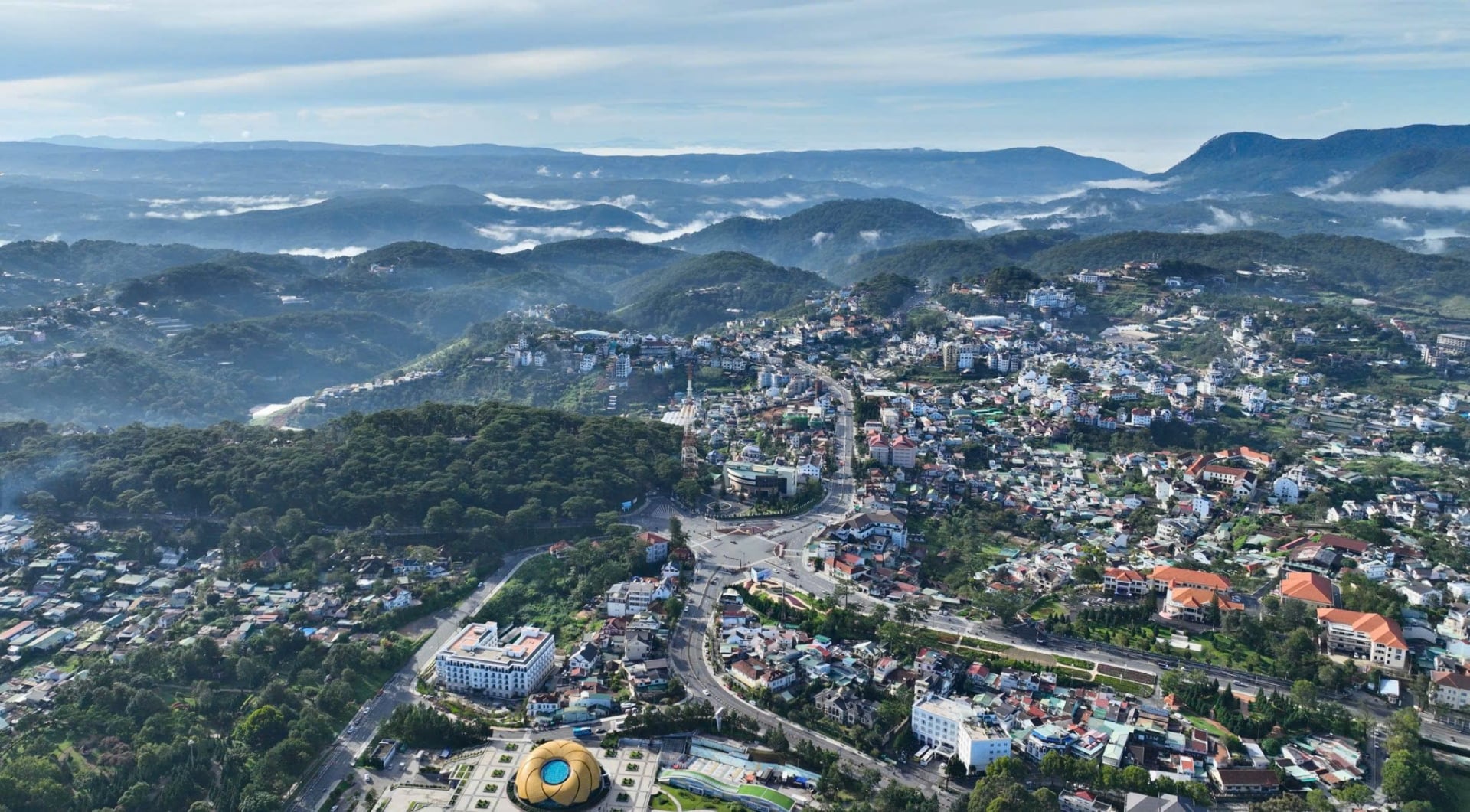
| The naming of the new wards after the merger in Da Lat City has been met with approval and praise from the people. |
The public's interest is demonstrated through feedback received via household representative voter surveys on the administrative reorganization plan at the provincial and commune levels, which localities have been implementing recently. This interest has also spread to social media forums, and many localities have had to change the naming conventions of communes and wards after listening to public opinion.
In Lam Dong province, the process of soliciting public opinion on the administrative unit reorganization plan, including the naming of new communes and wards after the merger, has so far been determined to be largely in line with public sentiment, with a high percentage of agreement alongside a few concerns and suggestions.
• “Carrying the names of the communes and villages along with each migration”
In his poem "The Homeland," poet Nguyen Khoa Diem wrote: "They pass on their accent to their children as they learn to speak / They carry the names of their villages and hamlets with them on each migration"... This "carrying along" the names of villages and hamlets can be clearly seen in the Lam Dong region.
At a Central Committee conference held after national reunification to discuss the redistribution of labor and population nationwide, the late Chairman of the Council of Ministers Pham Van Dong directed: Organize the relocation of millions of people from densely populated lowland and urban areas to the northern mountainous regions, the Central Highlands, and the Mekong Delta to reclaim land and build new economic zones to effectively utilize labor and land resources, create wealth, and bring prosperity and happiness to the people.
The Central Highlands region includes Lam Dong province. After liberation, people from the North and Central regions migrated to this fertile red basalt land to clear land and establish new economic zones. That's why, even in the southern part of the Central Highlands, there are still names with a distinctly Northern flavor. Right in the middle of Da Lat city, there's Ha Dong Flower Village and Nghe Tinh hamlet.
For example, in Lam Ha district, a place where Hanoi and Lam Dong provinces meet, people from Hanoi who came here to start a new life brought with them the names of villages and communes, as well as customs and traditions from the Red River Delta, to this highland area. This is why there are communes like Me Linh, Gia Lam, Hoai Duc, Dan Phuong, Phuc Tho, Tan Ha… Further south in Lam Dong province, in Da Huoai district, newly established by merging Da Huoai, Da Teh, and Cat Tien districts, each district previously had commune names brought by people from Quang Tri, Quang Ngai, Binh Dinh provinces… when they came to this new land to start a new life. Commune names like Quang Tri, Trieu Hai, Duc Pho, Tu Nghia, Quang Ngai, Phu My, Phuoc Cat… have been formed in this area for over 30 years.
For generations, Vietnamese people, whether living in their homeland or abroad, have held a deep affection for the names of their villages and communes. These names are not merely administrative designations or markers for identification on maps, but also represent the culture of an entire region and are a part of their memories, a way for the people living there to remember their origins.
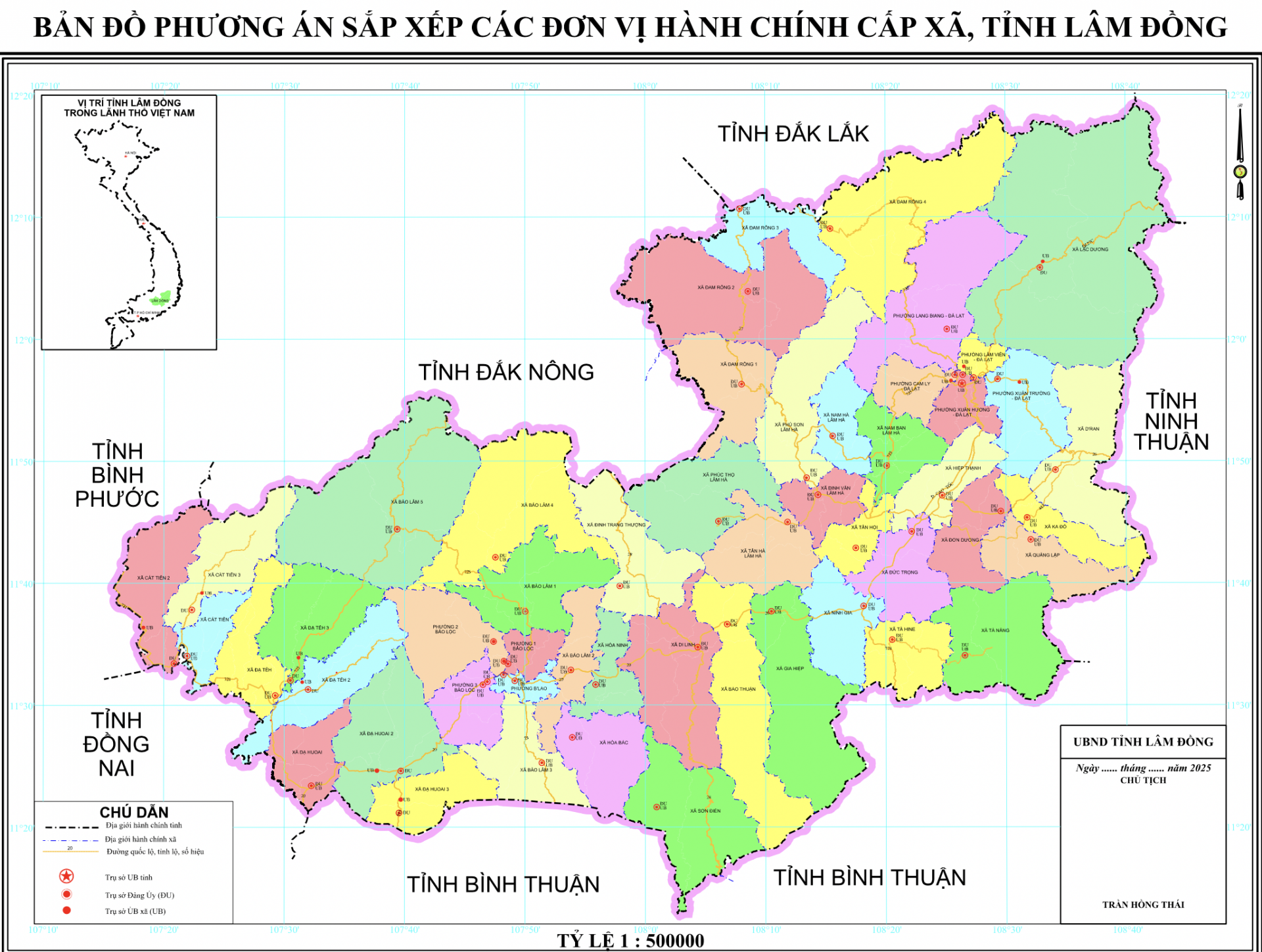 |
| After the reorganization, Lam Dong province now has 51 commune-level administrative units, including 9 wards and 42 communes. |
• HOW TO CHOOSE A NEW NAME THAT WILL PLEASE THE PUBLIC
In the current revolution to streamline the political system, when carrying out the reorganization and merger of provincial and commune-level administrative units, and abolishing the district level to organize a two-tiered local government model, in addition to issues of organizational structure, operating mechanisms, and personnel, the naming of newly established wards and communes is given great attention by local authorities and is of particular interest to the people.
For Lam Dong province, based on the Resolution on the unified policy of the Provincial Party Committee at the 20th Provincial Party Committee Conference, the 24th session of the 10th Provincial People's Council approved the Plan for rearranging commune-level administrative units in the province and the Plan for rearranging Lam Dong, Dak Nong, and Binh Thuan provinces.
Accordingly, the plan is to reorganize the provinces of Lam Dong, Dak Nong, and Binh Thuan by merging the three provinces into one, encompassing the entire natural area and population (both permanent and temporary residents) of the three current provinces. The new province will be named Lam Dong , with its administrative and political center located in Da Lat City, Lam Dong province.
According to the plan for reorganizing commune-level administrative units in the province, Lam Dong currently has 10 district-level administrative units, including 8 districts and 2 cities, and 137 commune-level administrative units, including 106 communes, 18 wards, and 13 towns. After the reorganization, Lam Dong will have 51 commune-level administrative units, including 9 wards and 42 communes, a reduction of 86 administrative units, or 62.77%.
Newly established communes and wards, formed by merging 2 to 4 communes and wards within the same existing district-level administrative boundaries, or even extending beyond those boundaries for some communes with similar socio-economic development characteristics and convenient geographical proximity, open up tremendous development opportunities in the future but also pose challenges and obstacles in the present, and the selection of names for the new communes and wards is one example.
Recognizing the importance and public interest in naming new provinces, communes, and wards, Resolution No. 76 dated April 14, 2025, of the Standing Committee of the National Assembly on the rearrangement of administrative units at all levels clearly states: The names of commune-level administrative units should be easy to read, easy to remember, concise, ensure systematic and scientific accuracy, be consistent with the historical and cultural traditions of the locality, and be supported by the local people.
To determine whether the proposal received "local people's approval and support," localities in Lam Dong province conducted a survey of voters representing households regarding the plan for rearranging administrative units at the provincial and commune levels in Lam Dong province, in accordance with legal guidelines and regulations. The results showed that 97.86% of voters agreed with the principle of merging Dak Nong, Binh Thuan, and Lam Dong provinces into a new province named Lam Dong, with the administrative and political center located in the current Da Lat city; 97.32% of voters agreed with the plan for rearranging administrative units at the commune level in Lam Dong province, and 0.83% disagreed.
With such a high level of consensus, it shows that the naming of communes and wards was carefully researched and selected by local authorities and specialized agencies before soliciting public opinion, and in reality, it has proven to be in line with the wishes and aspirations of the vast majority of the people.
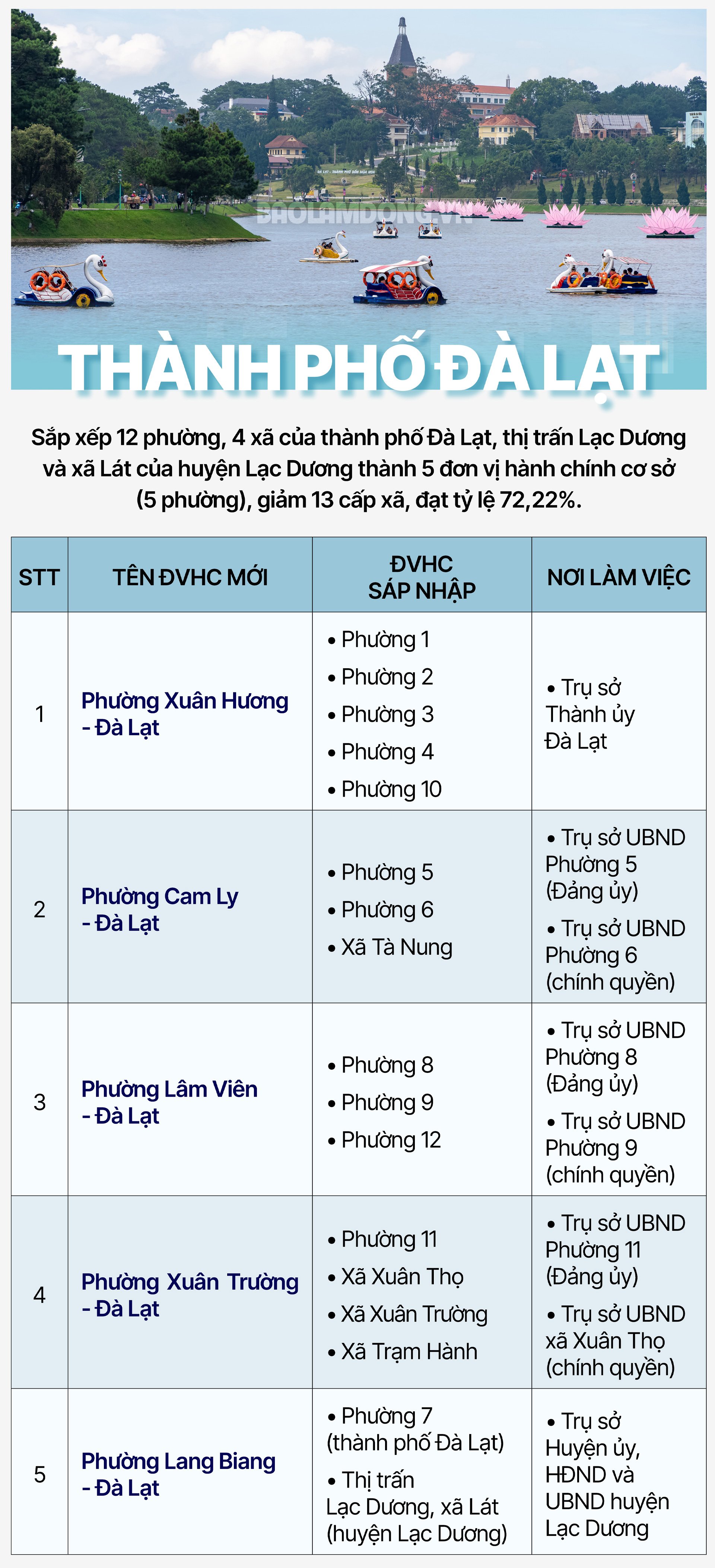 |
For example, in Da Lat City – the political, economic, cultural, and social center of the province – 12 wards and 4 communes of Da Lat City, Lac Duong town and Lat commune of Lac Duong district were reorganized and merged into 5 basic administrative units (5 wards), reducing the number of communes by 13, achieving a rate of 72.22%. The names chosen for the wards are: Xuan Huong Ward - Da Lat, Cam Ly Ward - Da Lat, Lam Vien Ward - Da Lat, Xuan Truong Ward - Da Lat, Lang Biang Ward - Da Lat.
This naming method is supported by the people because the ward names are all associated with unique characteristics of Da Lat such as Xuan Huong Lake, Cam Ly Waterfall, Lam Vien Plateau, Lang Biang Mountain… According to Da Lat city leaders, the naming of the wards was carefully considered because this is a city with a distinct urban memory and many landmarks; both the city as a whole and individual place names are international geographical indicators. This naming method ensures that after the reorganization, the ward names, although new, will still feel familiar and close to the hearts of residents and tourists.
In particular, all the wards are named after Da Lat because it is a famous international geographical indication since its formation. Therefore, adding Da Lat after the ward names aims to maintain the advantages for the wards after the reorganization. The Da Lat brand, combined with the place names given to the new wards, will help to quickly form reputable brands in many economic, cultural, social, and tourism fields. From the perspective of the people, Da Lat has become a brand with shared ownership, and naming it this way is also a way to ensure fairness and not lose the Da Lat brand.
Besides the five wards in Da Lat, the six merged communes in Lam Ha district were also named in a similar way: Dinh Van Lam Ha, Phu Son Lam Ha, Nam Ha Lam Ha, Nam Ban Lam Ha, Tan Ha Lam Ha, and Phuc Tho Lam Ha. The new commune names were created by combining the names of the communes and villages carried from their birthplaces, linked to the names of the economic zones where the people settled and established their lives. This also demonstrates the strong bond between the two regions of Hanoi and Lam Dong.
 |
• THERE ARE STILL CONCERNS
The newly merged communes remaining in the province are named after the old communes, old districts, or after famous landmarks or names that existed previously. This naming decision by Lam Dong province has received the approval and support of the people.
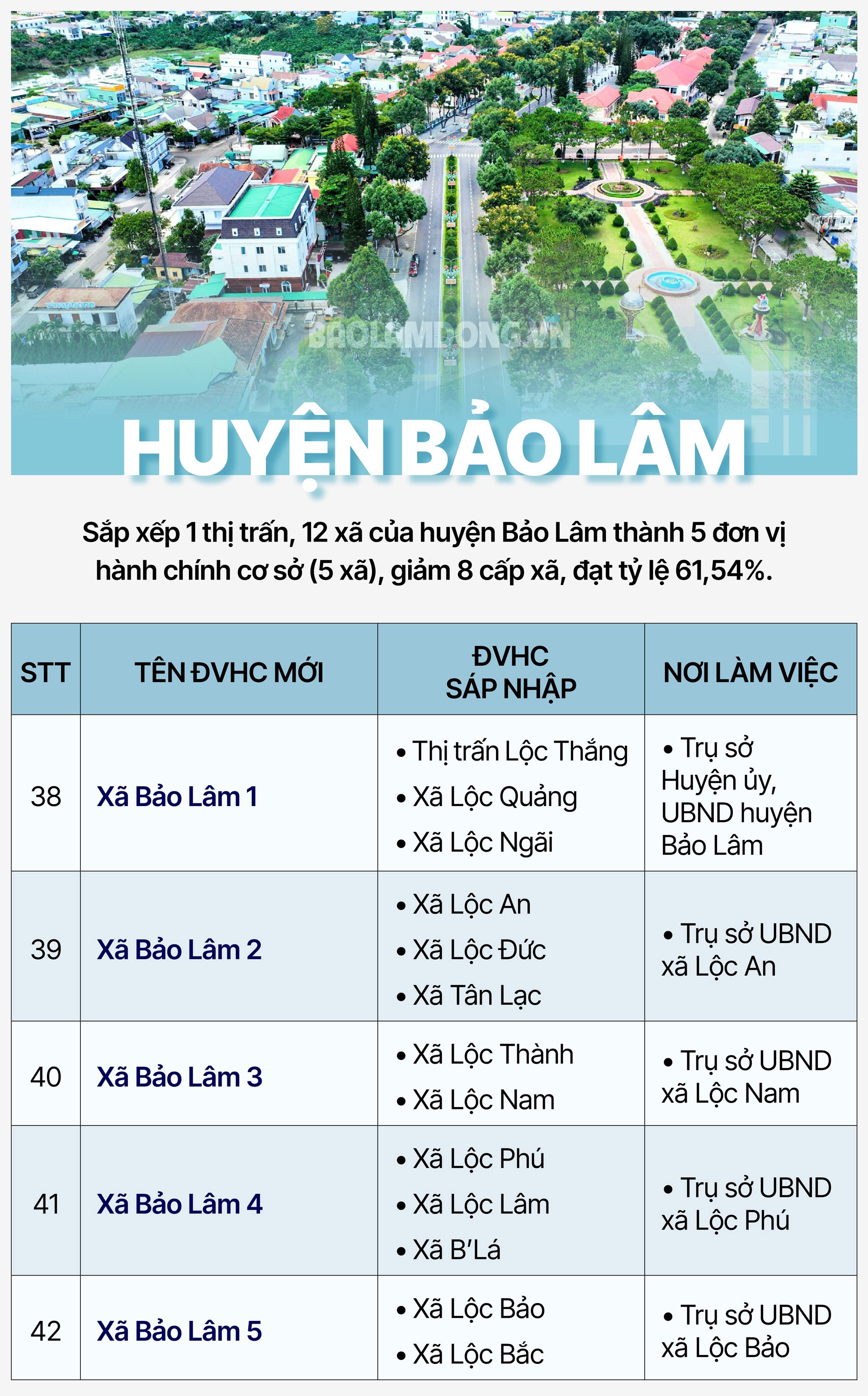
However, some newly named communes still use the district name followed by sequential numbers, as in the case of Dam Rong, Bao Lam, and Da Huoai districts. Regarding this naming method, the Ministry of Interior's guidelines also encourage naming commune-level administrative units sequentially or using the name of the district-level administrative unit (before reorganization) with a sequential number attached, to facilitate the digitization and updating of data.
This naming convention isn't wrong, but it creates a sense of regret that names once associated with the historical and cultural values of a region are no longer being used to further develop and promote the inherent values of those names that have been passed down through generations.
Master's degree holder Nguyen Van Hau (Bao Loc City) expressed: "Specifically, Bao Lam district naming the 5 new communes in order from Bao Lam 1 to Bao Lam 5 does not truly adhere to the principles stipulated in Decision 759 of the Prime Minister. It requires thorough and comprehensive research into the traditions, history, and culture of the localities, and prioritizing the use of one of the names of the administrative units before the merger to name the new units..."
The name Bao Lam district is only 30 years old, not long enough to form historical values, so it's not necessarily required. " We should retain the names of the communes recognized as Heroic Communes of the People's Armed Forces – which were revolutionary base areas and war zones during the two wars of resistance against France and the United States, such as: Loc Bac (including Loc Bao), Loc Lam (including Loc Phu), Loc An (including Loc Duc and Tan Lac), and Loc Nam. These are historical and cultural place names that need to be preserved through naming the communes to educate present and future generations about revolutionary traditions. So, why not use the names of these heroic communes to name the new communes, which would both comply with the principles of Decision 759 of the Prime Minister and promote historical and traditional values?"
The process of streamlining the administrative apparatus must be a "run-and-queue" process to meet requirements, thus demanding urgency and decisiveness. This also means that the work must be done while simultaneously learning from experience and making adjustments as needed. The selection and naming of new administrative units is one of the issues that requires careful and thorough consideration. After all, the names of lands and villages will remain with the people as a part of their very being, as the poet Nguyen Khoa Diem wrote in his poem "The Country."
"Landmarks that drifted away from bygone eras"
Drifting away in blood and drifting away in tears.
It has become etched in the names of people and places.
For so many years, it's been all along the lagoon and riverbank."
Source: https://baolamdong.vn/xa-hoi/202505/ten-goi-moi-sau-sap-xep-su-lua-chon-hop-long-dan-ec108ab/



![[Photo] General Secretary and President To Lam presides over a meeting on preparations for the review of one year of operation of the three-tiered government system.](https://vphoto.vietnam.vn/thumb/1200x675/vietnam/resource/IMAGE/2026/06/02/1780391821195_a1-bnd-4595-9717-jpg.webp)













































































Comment (0)