

Dr. Do Huu Nguyen Loc stated: December 2025 will mark the 20th anniversary of the establishment of the Ho Chi Minh City TESOL Association, which was licensed by the Ho Chi Minh City People's Committee and became the "common home" for English teachers in Ho Chi Minh City.
One of the key highlights of this year's conference is the strategy of expanding its scope of activities across new administrative and geographical areas.
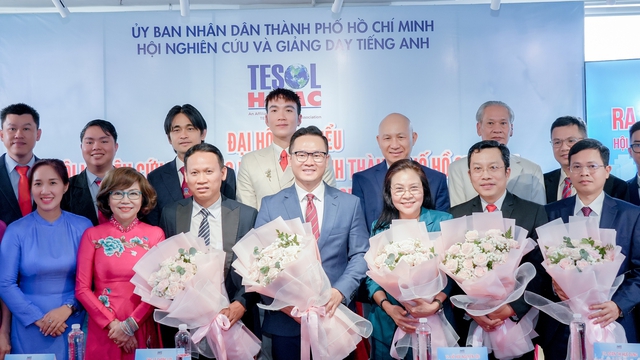
Key delegates of the Ho Chi Minh City TESOL Association at the Ho Chi Minh City TESOL Association Congress in December 2025.
Photo: B.D
Given that Binh Duong and the former Ba Ria - Vung Tau provinces do not yet have specialized English language associations, TESOL Ho Chi Minh City has decided to expand its activities to these two localities. This is a strategic step to meet the demand for high-quality English-speaking human resources in Binh Duong, the "industrial hub," and Ba Ria - Vung Tau, the tourism and service center. The association hopes to become a partner, protecting the rights and enhancing the capabilities of teachers in these areas.
The congress at the end of December 2025 also emphasized the association's role in realizing Government Resolution 51/NQ-CP of 2025, marking a transformation from a purely professional organization to a leading role in creating an environment where English is used as a second language.
"I'd also like to share some good news: the association has officially become an associate member of the International Association for Teaching English as a Second Language (TESOL). This opens doors for Vietnamese teachers to access global academic resources and receive internationally recognized professional support," Dr. Do Huu Nguyen Loc began.
Significant "gaps" in the internationalization of education.
As he once shared, to effectively teach subjects in English, three important factors are needed: "proficient English + effective teaching methods + specialized knowledge." According to him, what is the biggest challenge for teachers today?
In my opinion, there is currently a significant shortage of instructors who possess a harmonious integration of these three elements. Many lecturers are highly skilled in their subject matter but lack the confidence to teach in English. Conversely, some are proficient in English but lack formal pedagogical training or are unfamiliar with teaching in a second language.
Personally, I believe the first thing to do isn't to require lecturers to be "better at English," but rather to help them teach better in English. These two concepts are fundamentally different. Teaching specialized subjects in English requires instructors to possess EMI/CLIL competence—that is, the ability to simplify academic language, design lectures appropriate to the learners' English proficiency, and use language support strategies (scaffolding) while still ensuring the academic depth of the subject.
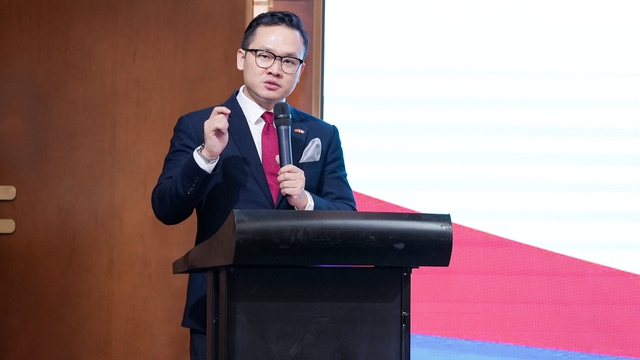
Dr. Do Huu Nguyen Loc speaking at an international conference.
Photo: B.D
Can you share more details?
Specifically, the current workforce generally falls into two main groups. The first group consists of lecturers with excellent English skills, but they have received specialized training in language and linguistics, rather than knowledge in other disciplines.
The second group consists of lecturers who are highly skilled in their respective fields such as economics, management, marketing, and law, but whose English proficiency is limited or who have not received formal training in teaching in English.
This mismatch has created a significant "gap" in the process of internationalizing higher education in Vietnam.
The second challenge relates to the role of government agencies. Currently, there is still a lack of long-term policies and strategies to develop a faculty capable of teaching specialized subjects in English. To my knowledge, there is still no clear training and standardization system in place.
This requires systematic training programs, along with support and guidance mechanisms, such as a model where experienced instructors mentor and guide younger or newly recruited instructors. Through this process, teachers' English-language teaching competence can be sustainably enhanced.

University lecturers and experts attending international scientific conferences.
Photo: Ngoc Long
Standing alongside English teachers in the new context
Could you tell us about the plans of the Ho Chi Minh City TESOL Association in promoting foreign language teaching and learning in a city like Ho Chi Minh City after the merger, where there are significant gaps between different areas, and in the long term, aiming to make English a second language in schools?
The association aims not only to protect the professional rights of English teachers but also to promote and improve the quality of English teaching and learning in the current educational context.
Over the past few years, the TESOL Association has implemented a number of specific activities to support universities, focusing on professional development in teaching English for specific purposes for non-English majors lecturers…
In addition, the association regularly organizes workshops and thematic series on the topic of teaching English for Specific Purposes. These activities provide opportunities for lecturers to update trends, share experiences, and discuss practical issues in the teaching process. Furthermore, the association also implements short-term training programs with a high level of practical application, focusing on "real teaching - real classroom - real situations".
The association also strives to build communities of practice where subject-specific lecturers, English language lecturers, and pedagogical and interdisciplinary experts can exchange, critique, and share teaching experiences. We believe that when lecturers feel they are not alone in the process of innovating teaching methods, they will be more confident in experimenting with new and more flexible teaching approaches in the classroom.
The current association also includes scholars from fields outside of linguistics, such as an associate professor with a PhD in physics working in the United States. This individual's contribution is particularly significant in the context of the Ministry of Education and Training's project to train over 220,000 English teachers at all levels and in all subjects before 2030.
Source: https://thanhnien.vn/thach-thuc-lon-nhat-voi-nguoi-day-tieng-anh-hien-nay-185260101232307338.htm


![[Photo] General Secretary and President To Lam and the President of the Philippines hold talks.](https://vphoto.vietnam.vn/thumb/1200x675/vietnam/resource/IMAGE/2026/06/01/1780286997787_anh-man-hinh-2026-06-01-luc-11-09-43.png)


![[Photo] Reception to welcome General Secretary and President To Lam and his wife on their State visit to the Philippines](https://vphoto.vietnam.vn/thumb/1200x675/vietnam/resource/IMAGE/2026/06/01/1780295488620_vna-potal-chieu-dai-chao-mung-tong-bi-thu-chu-tich-nuoc-to-lam-va-phu-nhan-tham-cap-nha-nuoc-toi-philippines-8798060-7855-jpg.webp)



















































































Comment (0)