

 |
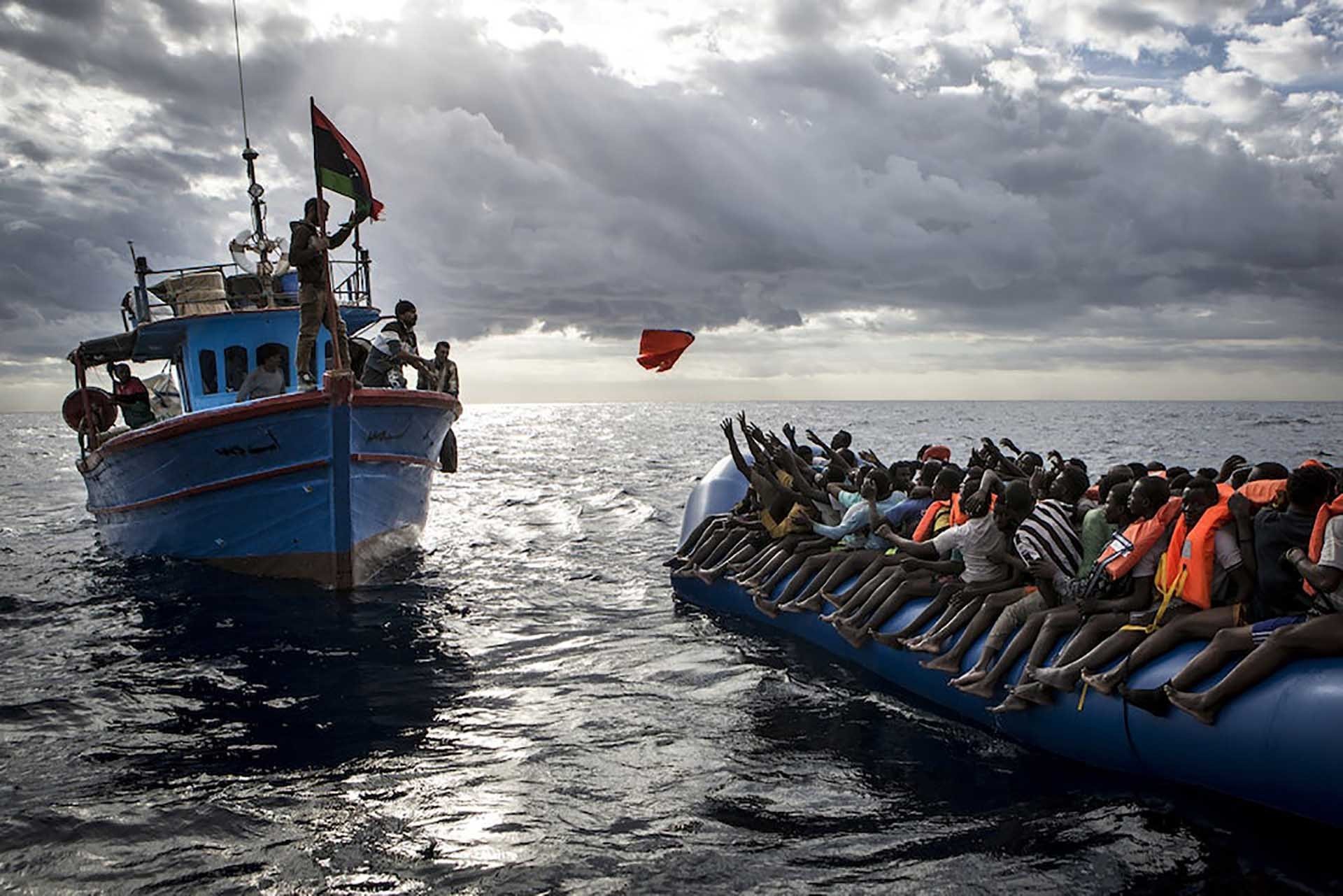
| Migrants are calling for help as their boat is unable to continue its journey. (Source: AFP) |
War, conflict, harsh living conditions, and the hope of a better life drive illegal migrants from Morocco, Algeria, Libya, Tunisia, Serbia, Syria, Afghanistan, Pakistan, India, and many other countries to risk their lives crossing the sea to reach Europe.
According to statistics from the European Border and Coast Guard Agency (Frontex), in 2022 alone, there were 330,000 "undocumented immigrants" entering European countries, a record number since 2016.
According to data from the United Nations High Commissioner for Refugees (UNHCR), the flow of illegal immigrants into Europe continued to increase in the first three months of 2023, with over 20,000 people entering Italy, a threefold increase compared to the same period in 2022.
Meanwhile, UK figures show a surge in the number of people entering the UK, exceeding 45,700. However, most of these illegal migrants will be deported back to their country of origin. Only a very small number are fortunate enough to live in refugee camps and remain for humanitarian or political reasons.
New tragedies
According to UNHCR statistics, from the time the organization began implementing the Missing Migrants Project and started collecting data from 2014 to 2022, 51,194 people have died while trying to enter Europe. Of those recorded, 30,000 were of unidentified nationality, 9,000 were from African countries, 6,500 from Asian countries, and over 3,000 from the Americas.
In 2022 alone, boat sinkings in the Mediterranean Sea, the closest route connecting Africa to Europe, claimed 25,104 lives. These migrants were primarily seeking to reach the UK, Italy, and Spain. Migrants from West and North Africa even crossed the West African-Atlantic to the Canary Islands, and from there entered other European countries. In 2022 and the first three months of 2023, this route also recorded 1,600 deaths, out of a total of 2,947 victims since 2021.
Besides the two routes mentioned above, the number of illegal migrants crossing the Turkish-Greek border is also unusually high. UNHCR data from 2022 shows that more than 1,000 people have lost their lives trying to reach Europe via this route. Crossing the Sahara Desert to enter the EU is another "death route" for illegal migrants. A UNHCR report indicates that since 2014, 5,620 people have died on this trans-Saharan route. The majority of these are Afghan refugees and migrants from West and South Asia.
As the migration flow continues to increase, so does the number of deaths. Yet, illegal migrants, hoping for a better life, continue to pour into Europe without hesitation. Tragedy at sea and on land borders continues to occur. According to Frontex , shipwrecks in the Mediterranean Sea alone during the first three months of 2023 claimed the lives of hundreds of people and left dozens missing.
Most recently, on February 26, a boat carrying migrants from Afghanistan, Iran, and other countries, departing from Türkiye, sank off the coast of eastern Calabria, Italy. At least 64 people died and dozens are missing. On April 8, 20 people went missing when their inflatable rubber boat sank off the coast of Tunisia after hitting a reef. On April 9, a boat departing from Libya carrying 400 people suffered engine failure and drifted in the waters between Greece and Malta. Then, on April 12, Tunisian coast guard forces found 10 bodies and rescued 72 people, while 30 remain missing. Prior to this, a migrant boat capsized off the coast of Tunisia, killing at least 27 people…
A solution to this perplexing problem?
The rise in illegal immigration is a major challenge, requiring effective measures and a unified voice from European countries.
Speaking on International Migrants Day, December 18, UN Secretary-General Antonio Guterres called on the world to “do everything possible” to prevent loss of life for migrants, considering this a humanitarian imperative, a moral and legal obligation. Mr. Guterres stated that approximately 280 million people worldwide have left their countries in search of better opportunities and lives, and emphasized that the vast majority of those who migrate safely and orderly contribute to economic growth and increased understanding.
Sharing the view of the UN Secretary-General, the Director-General of the International Organization for Migration (IOM), Antonio Vitorino, also stated that migrants are the foundation of development and progress. The IOM leader called for the elimination of the politicization of migration, as well as divisive and hostile views towards migrants.
At a recent conference, many EU members supported establishing a burden-sharing mechanism based on the principle that member states voluntarily accept a certain number of migrants, while those that do not must contribute financially, as proposed by France and Italy. However, what is happening shows that this mechanism is not binding enough to improve the situation. EU leaders agreed to apply stricter regulations to control migration, enabling the deportation of rejected asylum applications. A member state could use a court ruling in another member state to deport illegal migrants back to their country of origin. EU leaders also called for renewed contributions from members, the establishment of common funds to support migrants, and strengthened border management, infrastructure, and surveillance capabilities.
Disagreement
However, some EU countries still do not support the “voluntary sharing and contribution” plan, which aims to distribute 10,000 refugees annually to all member states, with France and Italy being among the most enthusiastic proponents. Austrian Interior Minister Gerhard Karner strongly opposed it, arguing that the move “sends the wrong signal to human trafficking gangs.” The Netherlands also stated that it would not accept asylum seekers under the proposal. Meanwhile, countries like Hungary and Poland have long opposed any mechanism for forced refugee resettlement. Many EU countries support a tougher approach to asylum policy. However, some countries, including Germany, which relies heavily on migrant labor, are concerned about the benefits derived from migrants and refuse to build rigid barriers. Germany does not want to exert pressure by withdrawing development aid or visas to countries that receive migrants.
While Italian Prime Minister Giorgia Meloni urged EU leaders to take more action, reiterating that “the responsibility to support migrants is a shared responsibility,” French Interior Minister Gérald Darmanin regretted that Italy had not acted as a responsible European nation. He stated that “governing migration flows is a common issue affecting us all, requiring a consistent solution across Europe.”
During a meeting with French President Emmanuel Macron on March 10th, British Prime Minister Rishi Sunak agreed to strengthen cooperation against human trafficking across the English Channel, build a four-meter-high fence, and contribute an additional 91 million euros to France to increase police support on French beaches. In return, British police will be granted access to French migrant control centers.
European Commission spokesperson Anitta Hipper acknowledged: “Migration is a challenge for Europe and must be addressed together.” Sara Prestianni, a human rights activist with EuroMed Rights, assessed: “Currently, Europe’s migration policy is more outward-looking, with an increased leverage and conditional approach. However, that is not the solution, but rather part of the problem. The recent tragedy further raises alarm bells and shows that the only solution to prevent illegal migrants from risking their lives is to open up legal pathways into the EU for them and for the EU to adopt a more appropriate, humane and responsible approach.”
Source
![[Photo] Secretary of the National Assembly Party Committee, Chairman of the National Assembly presides over the meeting of the Standing Committee and Executive Committee of the National Assembly Party Committee.](https://vphoto.vietnam.vn/thumb/1200x675/vietnam/resource/IMAGE/2026/06/03/1780480353201_ndo_br_bnd-2585-jpg.webp)
![[Photo] General Secretary and President To Lam presides over a meeting with the Central Organizing Committee.](https://vphoto.vietnam.vn/thumb/1200x675/vietnam/resource/IMAGE/2026/06/03/1780482764658_a1-bnd-4741-3342-jpg.webp)

























![[Photo] First session of the 14th Congress of the Vietnam Trade Union](https://vphoto.vietnam.vn/thumb/1200x675/vietnam/resource/IMAGE/2026/06/03/1780465947883_ndo_br_img-3852-jpg.webp)





















![[Video] Sunset at Lap An Lagoon – Where the sun sets over the fishing nets](https://vphoto.vietnam.vn/thumb/1200x675/vietnam/resource/IMAGE/2026/05/31/1780192137701_beach-landscape-sea-water-nature-grass-745871-pxhere-com.jpeg)
























Comment (0)