

Elite University
The speech by General Secretary and President To Lam at the ceremony commemorating the 120th anniversary of the founding of Vietnam National University, Hanoi (VNU) on May 16, 2026, is a strategic directive, not only for VNU itself but also for the entire Vietnamese higher education system.
I believe the most profound aspect of the speech is that the General Secretary and President recognized the Vietnam National University, Hanoi (VNU) in its entirety, encompassing its history, present, and future. VNU is not only a higher education institution with a long tradition, but also a symbol of Vietnamese intellect, a place where academic aspirations are embodied, talent is nurtured, and service to the nation is ensured.
But tradition only truly becomes valuable when it is transformed into responsibility and action. As the country enters a new era of development, Vietnam National University, Hanoi needs to rise even stronger, not only maintaining its role as a leading training and research center, but also becoming a pioneering force in science , technology, innovation, and digital transformation.
The two words "National" in the name of Hanoi National University carry great significance. It's not just a designation, but a mission. Hanoi National University must link its development with the major needs of the nation; it must train capable leaders; it must create new knowledge, new technologies, new policies, and make substantial contributions to national development.
I am particularly enthusiastic about the requirement to build Vietnam National University, Hanoi into an elite, modern, multidisciplinary university operating according to the model of an innovative university.
"Elite" here is not just understood as selecting the best, but more importantly, it must be elite in terms of academic quality, research capacity, technological innovation, international prestige, and practical contributions to the country.
An elite university should be a place where brilliant scientists, outstanding researchers, leading technology experts, exceptional students, innovative businesses, and policymakers converge. There, knowledge should not be confined to textbooks, laboratories, or scientific papers, but should be transformed into products, technologies, policies, businesses, and value-generating contributions to society.
To achieve that goal, in my opinion, the Vietnam National University, Hanoi (VNU) first needs to fundamentally reform its university governance model. VNU should be governed by objectives, quality, output, and social impact.
The "one VNU - one VNU" model and shared resources require each member university, research institute, laboratory, and strong research group to have clear tasks, targets, and responsibilities.
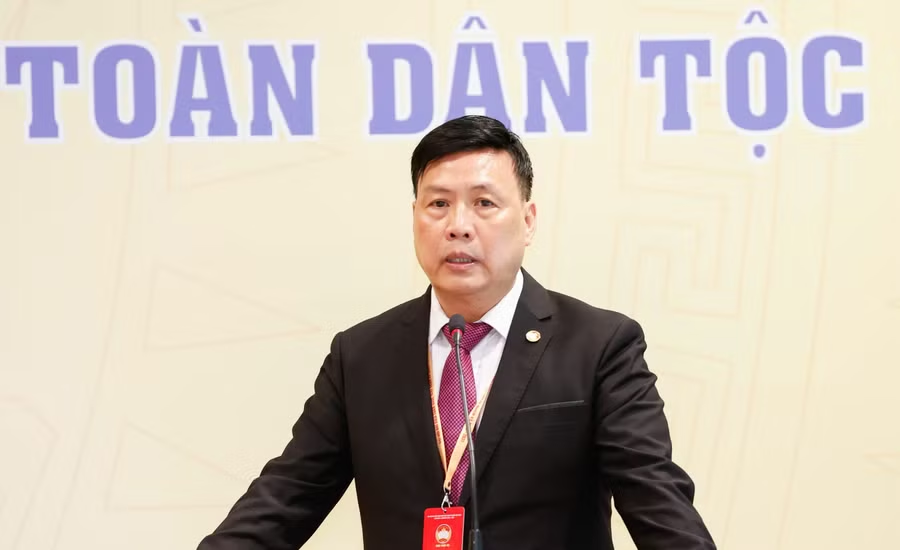
Removing institutional bottlenecks
We cannot judge universities solely by their enrollment size, the number of research topics, or the number of published articles. Those criteria are necessary, but insufficient. We need to evaluate them based on the quality of publications, the number of patents, the number of technology products transferred, the number of science and technology enterprises formed, the number of policies advised, the number of talented individuals trained, and their actual contribution to the country.
We must remove institutional, financial, human resource bottlenecks and university autonomy issues. A university that wants to innovate cannot be constrained by overly rigid administrative mechanisms.
University autonomy must go hand in hand with accountability, but accountability should not be transformed into increased bureaucracy. Vietnam National University, Hanoi (VNU) needs to be granted greater autonomy and initiative in academics, talent recruitment and retention, resource utilization, international cooperation, establishing science and technology enterprises, implementing science and technology activities, and commercializing research results.
If the goal is for Vietnam National University, Hanoi (VNU) to be among the top 100 universities in Asia by 2030, among the top 300 universities in the world by 2035, and for some key disciplines to be among the top 100 globally, then the mechanisms and investment allocated to VNU must be commensurate with that goal. It is unacceptable to expect a university to be internationally competitive while operating with mechanisms that lack flexibility and attractiveness to talent.
Furthermore, targeted investment is needed in key areas. Vietnam National University, Hanoi (VNU) is a multidisciplinary university, but being multidisciplinary doesn't mean spreading investment thinly. We need to select a few areas with advantages, strong scientific foundations, and strategic significance for the country to invest in to the fullest extent. These could include artificial intelligence, semiconductors, new materials, biotechnology, big data, new energy, sustainable science, educational science, policy science, and Vietnamese studies.
In each field, it is necessary to establish centers of excellence and strong research groups that meet international standards. These groups must have reputable leaders, a successor team, talented graduate students, modern laboratories, genuine international cooperation, and stable long-term funding. High-level research is impossible with short-term, fragmented, and inconsistent investment.
Scientific research needs to be linked to the major problems facing the country. This is an extremely important requirement, the "output" of science and technology activities. Universities cannot just research what they have, but need to research what the country needs and will need.
Vietnam National University, Hanoi (VNU) needs to proactively propose major research programs commissioned by the national government, such as digital transformation in state administration, semiconductor human resource development, AI applications in education and healthcare, smart cities, green economy, non-traditional security, climate change, digital culture development, and building Vietnamese people in the new era.
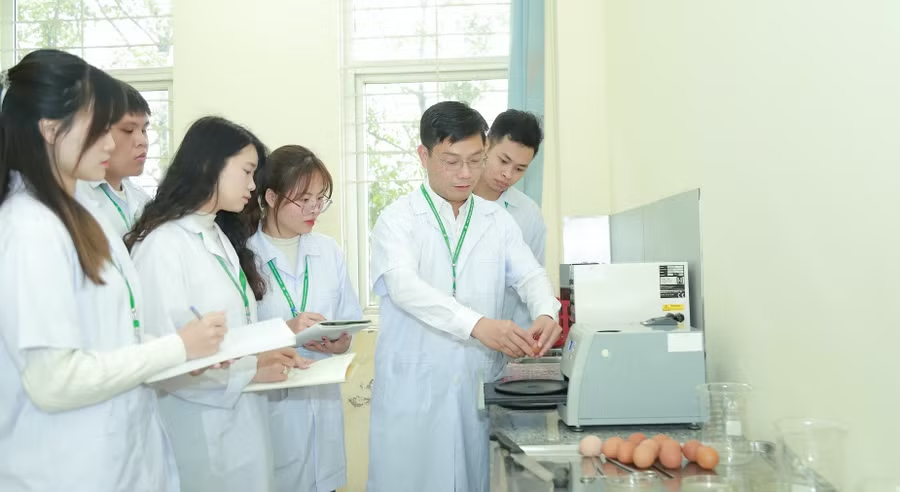
The nation's "wisdom"
Vietnam National University, Hanoi (VNU) must become the nation's "brain bank." When the State needs scientific arguments for strategic policy decisions, VNU must be a reliable source. When businesses need technology, high-quality human resources, and innovative models, VNU must be a strategic partner. When localities need development models, digital transformation, urban governance, and human resource development, VNU must be able to provide support.
A truly innovative ecosystem must be built in Hoa Lac. The Vietnam National University urban area in Hoa Lac needs to be developed as a university-technology-innovation city, not just a new campus. Connecting with the Hoa Lac High-Tech Park requires concrete programs: open laboratories, incubation centers, startup support funds, university-based spin-off businesses, business-ordered programs, and creative spaces for students, faculty, and scientists.
An innovative university must create a continuous flow from training to research, from research to technology, from technology to products, from products to businesses, and from businesses back to nurture the university. That is what constitutes a modern university ecosystem.
Talent policy
University competition today is essentially a competition for talent. For Vietnam National University, Hanoi to rise to regional and international prominence, it needs strong policies to attract talented professors, outstanding young scientists, Vietnamese experts abroad, and international scholars.
Talent policies cannot simply stop at invitations; they must be accompanied by conditions such as working spaces, laboratories, research groups, funding, housing, postgraduate scholarships, academic autonomy, and a professional scientific environment.
In particular, it is necessary to create conditions for young scientists to develop independently. A strong university must have strong successor generations. Young scientists need to be given significant tasks, supported in building research teams, connected internationally, and evaluated according to transparent academic standards.
In the era of AI and digital transformation, universities cannot simply impart existing knowledge. Universities must train individuals with critical thinking skills, self-learning abilities, interdisciplinary skills, digital skills, foreign language proficiency, creativity, and a sense of social responsibility. Students at Vietnam National University, Hanoi must be prepared not only for employment, but also to lead, adapt, and create new value.
Training programs need to be more flexible, interdisciplinary, and practical. The major challenges today are all interdisciplinary. Artificial intelligence is not just information technology; it also involves mathematics, ethics, law, education, and management. Semiconductors are not just electronics; they also involve physics, materials science, design, manufacturing, and supply chains. Sustainable development is not just about the environment; it also encompasses economics, society, technology, and public policy.
Foundation for international integration
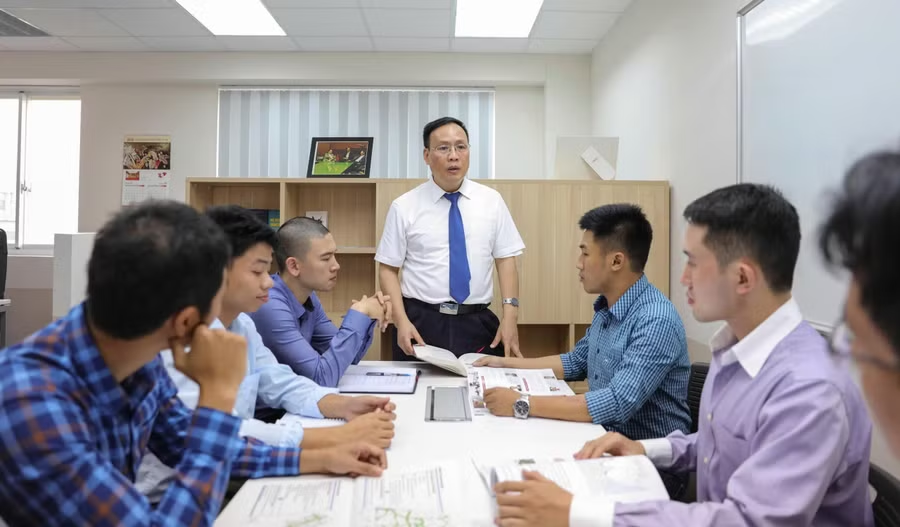
To achieve that goal, Vietnam National University, Hanoi needs its own training regulations, differing from those of the Ministry of Education and Training, to pilot the implementation of new training programs, new majors, and new training models that have never existed before.
Vietnam National University, Hanoi (VNU) must become a leading institution of Vietnamese intellect on the international stage. It must possess a strong foundation in basic science. Without a strong foundation in basic science, it's impossible to master core and strategic technologies. It must be a place where outstanding scientists, leading scholars, leaders, top universities, technology corporations, and international students come to exchange knowledge, collaborate on research, and gain a deeper understanding of Vietnam.
Strong internal capabilities and fundamental scientific strength are also the foundation for international integration. Academic diplomacy, built on a foundation of academic prestige, not only helps improve university rankings but also contributes to spreading soft power, cultural identity, and national prestige.
A great university must possess a spirit of academic freedom, scientific integrity, healthy academic debate, and a desire to serve. Teachers should not only impart knowledge but also inspire character, faith in science, and a sense of responsibility to the nation. Students should not only study for personal gain but also to serve the community and contribute to the country.
In my opinion, following the directives of the General Secretary and the President, Vietnam National University, Hanoi (VNU) should soon develop a specific action plan for the period 2026–2030, with a vision to 2035. This plan should clearly identify which disciplines should strive to be among the top in Asia, which should be among the top 100 globally, which research centers should achieve international standards, which technologies need to be mastered, which products need to be developed, which policies need consultation, and which training programs need innovation.
Furthermore, there needs to be a close coordination mechanism between Vietnam National University, Hanoi (VNU) and ministries, departments, localities, businesses, and international partners. Higher education cannot develop if it is detached from national development needs. Science and technology cannot thrive without large-scale commissioned projects.
Innovation cannot succeed without businesses and markets. Therefore, Vietnam National University, Hanoi – with its pivotal mission in the national higher education system – needs to be at the center of the knowledge-policy-technology-business-society network.
I believe that the statement by General Secretary and President To Lam has set a very clear requirement: Vietnam National University, Hanoi (VNU) must act more decisively, innovate more vigorously, and make more significant breakthroughs. This is both an honor and a great responsibility. VNU has a tradition, a team, a position, and the trust of the Party, the State, and society. The important thing now is to transform that trust into a program of action, turn goals into results, and transform tradition into a new driving force for development.
I was deeply moved when, at the rally commemorating the 120th anniversary of Vietnam National University, Hanoi, the General Secretary and President of Vietnam assessed that "Vietnam National University, Hanoi has become a brilliant symbol of Vietnamese intellect, a place where academic aspirations converge, talents are nurtured, and important contributions are made to the cause of national construction and development." This is truly a powerful encouragement for generations of teachers and students of Vietnam National University, Hanoi. 120 years of Vietnam National University, Hanoi, with its glorious and proud history.
With its 120-year history, its aspiration for innovation, and the special attention of the Party and State leaders, I believe that Vietnam National University, Hanoi (VNU) has the necessary conditions to become a symbol of Vietnamese intellect in the 21st century; and at the same time contribute to leading the development of Vietnam's higher education system towards a modern, liberal, creative, integrated direction and serving the country.
Source: https://giaoducthoidai.vn/thao-diem-nghen-ve-the-che-cho-dai-hoc-post778052.html

































































































Comment (0)