

Jerome Powell must carefully consider when to continue raising interest rates or when to stop, as China seeks to revive its deflationary economy .
When Federal Reserve Chairman Jerome Powell outlines the next move of the world's most powerful central bank, he may want to consult with officials in Beijing, Forbes observes.
The reason China returned to deflation in October is that its consumer price index (CPI) fell slightly by 0.2% year-on-year. Additionally, producer prices in China also decreased by 2.6% in October compared to the same period in 2022. This marks the 13th consecutive month of declining production, raising concerns that many factory owners are lowering prices to gain market share amidst excess capacity.
"China is an exception in the reopening process after the pandemic because its economy is facing increasing deflationary risks rather than inflationary pressures," commented Grace Ng, senior economist for mainland China at JP Morgan.
Deflation is defined as a sustained and large-scale decrease in the prices of goods and services over a given period. This is not a positive development for the economy. When consumers and businesses delay spending in anticipation of further price drops, economic problems worsen.
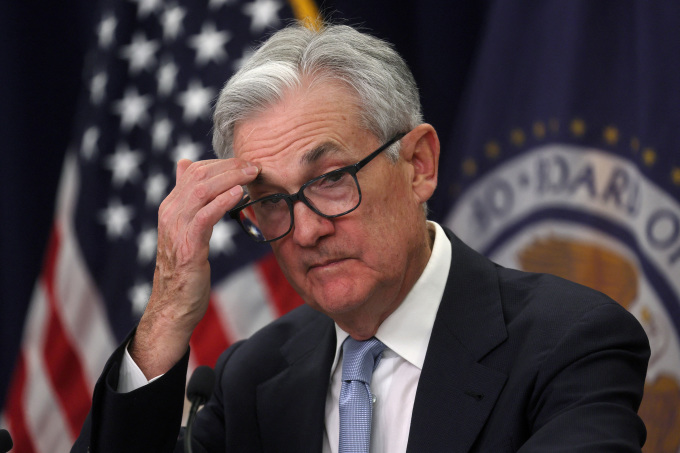
Federal Reserve Chairman Jerome Powell in Washington, D.C., on March 22. Photo: Reuters
When the Chinese delegation arrives in San Francisco this week for the Asia-Pacific Economic Cooperation (APEC) summit, they may receive many questions about Beijing's plans to avoid deflation.
Since the late 1990s, APEC has never been as concerned about the weakening of the world's second-largest economy as it is now. The last time there was such worry about China's weakening was at APEC 1997 in Vancouver, Canada. That conference took place against the backdrop of the Asian financial crisis.
A month before the conference, U.S. and International Monetary Fund (IMF) officials worked to prevent currency instability in Indonesia, South Korea, and Thailand from spreading to China. The main concern at the time was that Beijing would also devalue the yuan, triggering a new race to the bottom of the exchange rate.
And China did not devalue its currency. But when APEC was held, concerns about China devaluing its currency flared up again. Adding to the overall difficulty was the fact that Japan – then Asia's largest economy – would be dragged into the crisis.
As the heads of state sat down for the APEC 1997 summit, they received news that Yamaichi Securities, one of Japan's four legendary, centenary brokerage firms, had collapsed. In the days that followed, U.S. President Bill Clinton and other Asia-Pacific leaders worked to persuade Japanese Prime Minister Ryutaro Hashimoto to take control of Tokyo's financial system.
APEC 1997 served as an important lesson, as this year's APEC is taking place in North America, at a time of greatest concern about the fragility of the Chinese economy. Recent signs of deflation in the country only add to these worries.
No central banker monitors China as closely as Powell. As he prepared to travel to San Francisco for APEC, the Fed chairman said they would not hesitate to raise interest rates again if necessary.
Much of that could depend on China, where growth is slowing and the risk of default is rising, according to Forbes. Of course, almost no one thinks the country's economy will collapse. However, its real estate market is clearly in crisis.
Real estate accounts for 30% of GDP, making it a clear and present danger to the finances of Chinese local governments. Therefore, Beijing is shifting from advocating for debt reduction to increasing stimulus measures. In addition to cutting interest rates and easing home purchase requirements in major cities, China announced last month a 1 trillion yuan (approximately $137 billion) plan to support the economy.
Nevertheless, Serena Chu, senior economist for China at Mizuho Securities Asia, forecasts that the country's CPI this year will only reach around 0.2%. "China may face long-term deflationary pressure as domestic demand may not be able to meet the idle capacity," she said.
For Powell, it was crucial to recognize the point at which excessive monetary tightening became a major threat to developing economies, including China. In 1997, the Fed's actions impacted the entire Asian region. The appreciation of the USD following the Fed's aggressive tightening cycle of 1994-1995 disrupted the area.
It remains unclear what the Fed will decide. The latest information from Powell is that they will proceed "cautiously." Some Fed governors, such as Michelle Bowman, believe that another interest rate hike is necessary to ensure inflation returns to the 2% target.
But pushing China into greater difficulty could backfire on the U.S. and the world. According to E&Y's model, if China's GDP growth unexpectedly falls one percentage point below baseline in 2023 and 2024, weaker trade and investment flows, along with tighter financial conditions, would reduce U.S. GDP by 0.3 percentage points and global GDP by 0.5 percentage points.
The hard landing (rapid and abrupt economic recession) in China in 2015-2016 demonstrated the sensitivity of global financial markets to negative developments in that economy, according to E&Y.
At that time, concerns that the Chinese economy was entering a downward spiral rattled global financial markets, leading to a significant drop in US stocks. Risk appetite, commodity prices, and long-term government bond yields also declined.
Phi An ( according to Forbes, EY, JPMorgan )
Source link

![[Image] Hanoi's urban life under the challenge of a "scorching hot" environment](https://vphoto.vietnam.vn/thumb/1200x675/vietnam/resource/IMAGE/2026/05/25/1779706979265_nang-nong-t5-2026-minh-duy-7-4636-jpg.webp)


![[Image] Close-up view of the interchange connecting the two expressways and Long Thanh Airport.](https://vphoto.vietnam.vn/thumb/1200x675/vietnam/resource/IMAGE/2026/05/25/1779703378210_ndo_br_z7863716673926-224453a31600126cce10622af6290afd-4549-jpg.webp)

































































































Comment (0)