

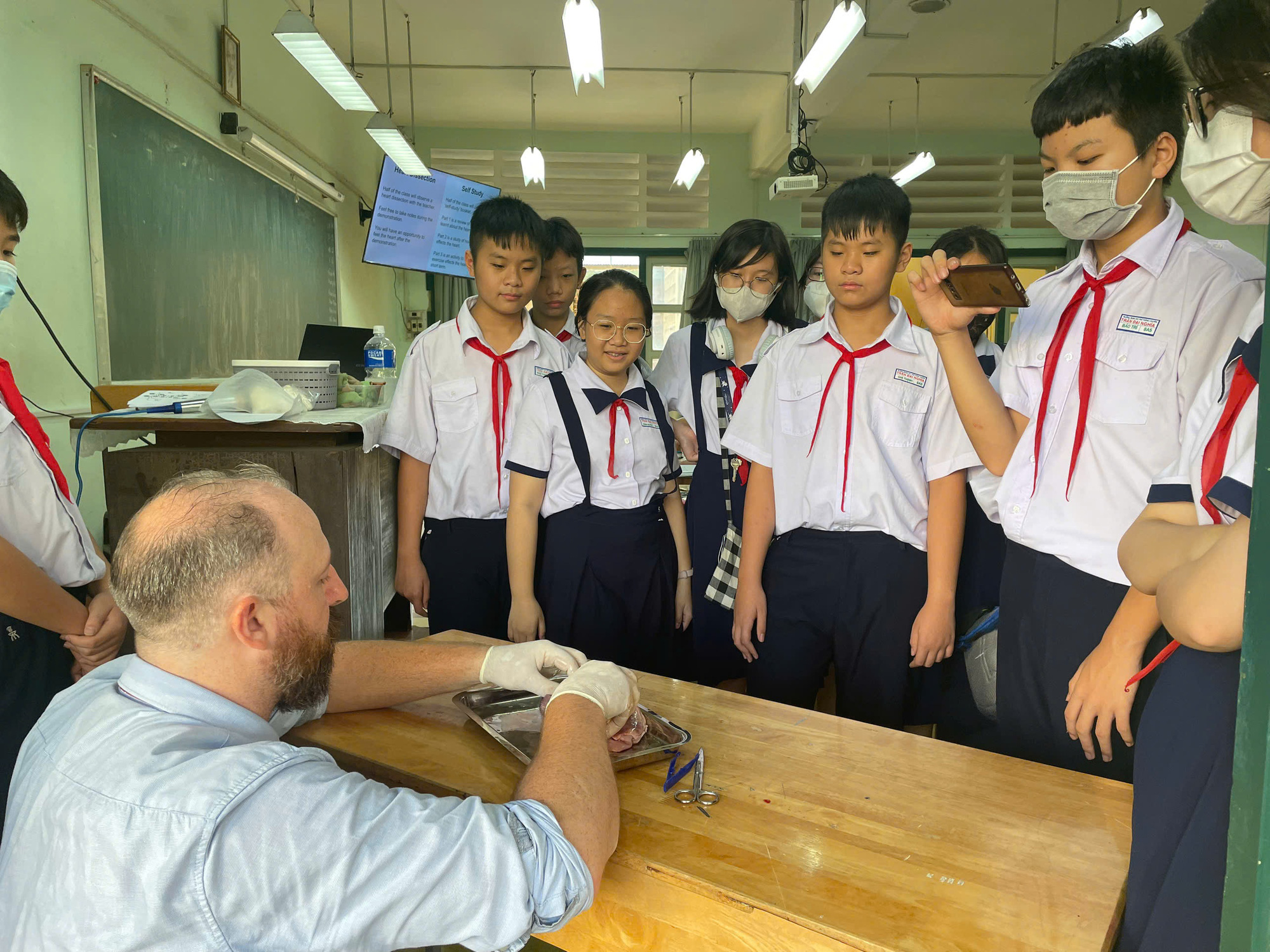
A science lesson in the integrated English program for students at Tran Dai Nghia Specialized High School - Photo: NHAT PHUONG
This locality is the first in the country to implement this policy of the Politburo .
Advantages of continuous English language programs
At Nguyen Thuong Hien High School (Tan Binh District, Ho Chi Minh City), one of the schools with the highest entrance exam scores in the city's public high school system, many people will easily notice students communicating with each other in English.
During English lessons, English is the official language for both students and teachers in most classes, from regular classes to integrated classes and specialized English classes.
Ms. Tran Van Thy, head of the English department at Nguyen Thuong Hien High School, said that after about 20 years of building and developing the teaching of English as a language for reading, writing, and communication, and as a tool for students' self-development, the English proficiency of students at the school is currently at a good level.
The percentage of students at this school who can communicate well in English in regular classes (excluding specialized English or integrated classes) is approximately 70-80%. In specialized English and integrated classes, the percentage of students who speak English fluently is almost 100%.
Nguyen Thuong Hien School currently offers three types of English language instruction: enhanced, integrated, and regular. Regular students make up the largest proportion of the school. In regular classes, students have 3 English lessons per week with Vietnamese teachers (using textbooks), 3 enhanced lessons with Vietnamese teachers, and 2 enhanced lessons with foreign teachers.
Commenting on the possibility of making English a second language in this school, Ms. Thy believes that students have many advantages in listening, speaking, and writing English. Because students in Ho Chi Minh City currently learn English and hone their listening and speaking skills extensively from primary and secondary school, their English proficiency at the school is already at a good level.
"From my experience teaching and receiving students over the years, I've observed that students receive systematic English instruction in the lower grades. They participate in various programs such as integrated English (from grade 1), enhanced English (from grade 1), elective English (from grade 1), etc., and continue learning in this way at the lower secondary level."
"In addition, English language teaching activities in primary and secondary schools are very diverse, so the English proficiency of students in Ho Chi Minh City is already good enough for top-tier high schools when they enter high school. This is concretized by the consistently leading results in English scores in the high school graduation exam for many years, as well as the results of the national excellent student competition for students from Ho Chi Minh City," Ms. Thy commented.
According to data from the Department of Education and Training, at the primary school level, Ho Chi Minh City implements several English programs with learning outcomes in addition to the English program prescribed by the Ministry of Education and Training . These include the elective English program, the enhanced English program according to Decision No. 2769 of the Ho Chi Minh City People's Committee, and the integrated program according to Decision 5695.
"Implementing diverse English programs in schools not only helps students in English subjects, but also helps schools become familiar with managing multiple programs running simultaneously; it helps teachers and students be more active in communication, creating a good foundation for making English a second language in teaching," commented an official from the Department of Education and Training.
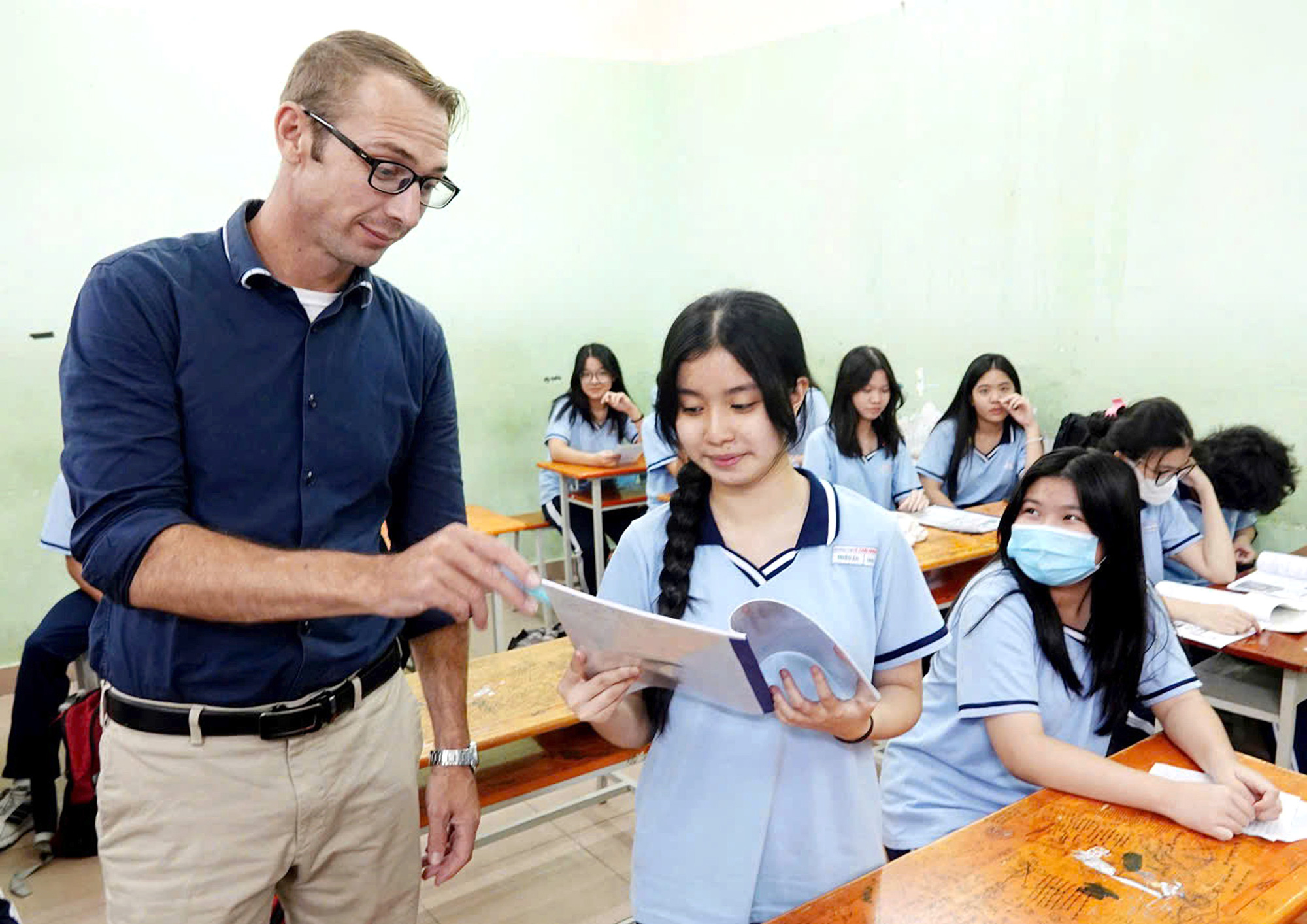
Students learn English with foreign teachers in Ho Chi Minh City - Photo: NHU HUNG
The barriers
Conversely, Vietnamese teachers who want to use English to teach subjects need a roadmap; it's not yet possible to implement the ideal model of using English to teach all subjects, even in places where students speak English well, like Nguyen Thuong Hien High School.
According to the school's leadership, the barriers to using English in teaching come from the teachers themselves. While teachers currently possess English qualifications, due to a lack of spoken and written English practice over time, they lack natural communication skills and will struggle when teaching in the classroom.
On the other hand, subject teachers are not professionally trained in English-speaking environments, so teaching subjects using English terminology will not be easy to do overnight and requires a phased approach.
Ms. Nguyen Thi Kim Duyen, head of the English department at Tran Dai Nghia High School for the Gifted, where in the 2023-2024 school year there were 4 top-scoring students in the national English competition, believes that introducing English into schools faces many challenges.
"Students in even specialized schools have uneven English proficiency levels. Not to mention that most subject teachers cannot communicate in English and their English proficiency is also inconsistent... These are major challenges that need to be addressed when we want to make English the second language in schools," Ms. Duyen commented.

Native English-speaking teachers interact with students during an English-language lesson at a school in Ho Chi Minh City - Photo: NP
Sufficient legal basis
The Politburo recently announced the conclusions on the implementation of Resolution 29, which requires the education sector to strengthen international integration in education and training to meet the requirements of improving the quality of human resources to serve national development in the new period. The focus is on improving the foreign language proficiency of students, gradually making English the second language in schools.
Subsequently, at a conference in late August 2024, Deputy Minister of Education and Training Pham Ngoc Thuong affirmed that Vietnam had the legal basis (the conclusion of the implementation of Resolution 29 of the Politburo) to gradually introduce English as a second language in schools.
Also at this conference, Mr. Thuong directed Ho Chi Minh City to promptly prepare a proposal to submit to the Ministry of Education and Training for a pilot program to make English the second language in public schools, selecting a few schools to implement it first.
In addition, a crucial factor in promoting English as a second language in schools is the desire of parents, the needs of students, and the students' abilities in this subject.
According to data from the Ho Chi Minh City Department of Education and Training, the city currently has nearly 800 operating foreign language and computer training centers (including about 100 short-term education facilities with foreign investment). A total of over 23,000 courses have been offered, with approximately 182,000 participants. Of these, about 156,000 are under 18 years old, accounting for over 85% of the total.
These figures also accurately reflect the actual demand for English language learning among students in Ho Chi Minh City, especially for communication skills, as many parents, in addition to enrolling their children in school English programs, also send them to language centers.
"My homeroom class follows an enhanced English program, but when I asked parents, about 80% of the students attend English courses at language centers every week, several times a week," a primary school teacher in District 10 shared.
According to Ms. Do Ngoc Chi, principal of Nguyen Binh Khiem Primary School (District 1, Ho Chi Minh City), sending children to learn English is a high demand among parents today, as they want their children to have the opportunity to develop and adapt to an increasingly globalized society.
On the other hand, the 2018 general education curriculum mandates English instruction from grade 3, so in some schools in Ho Chi Minh City, the percentage of parents supporting the introduction of English as a second language in teaching will be very high.
"At our school, the number of students participating in programs related to the use of English is high, and even though they are still in primary school, a significant number of them can communicate well in English," Ms. Chi said.
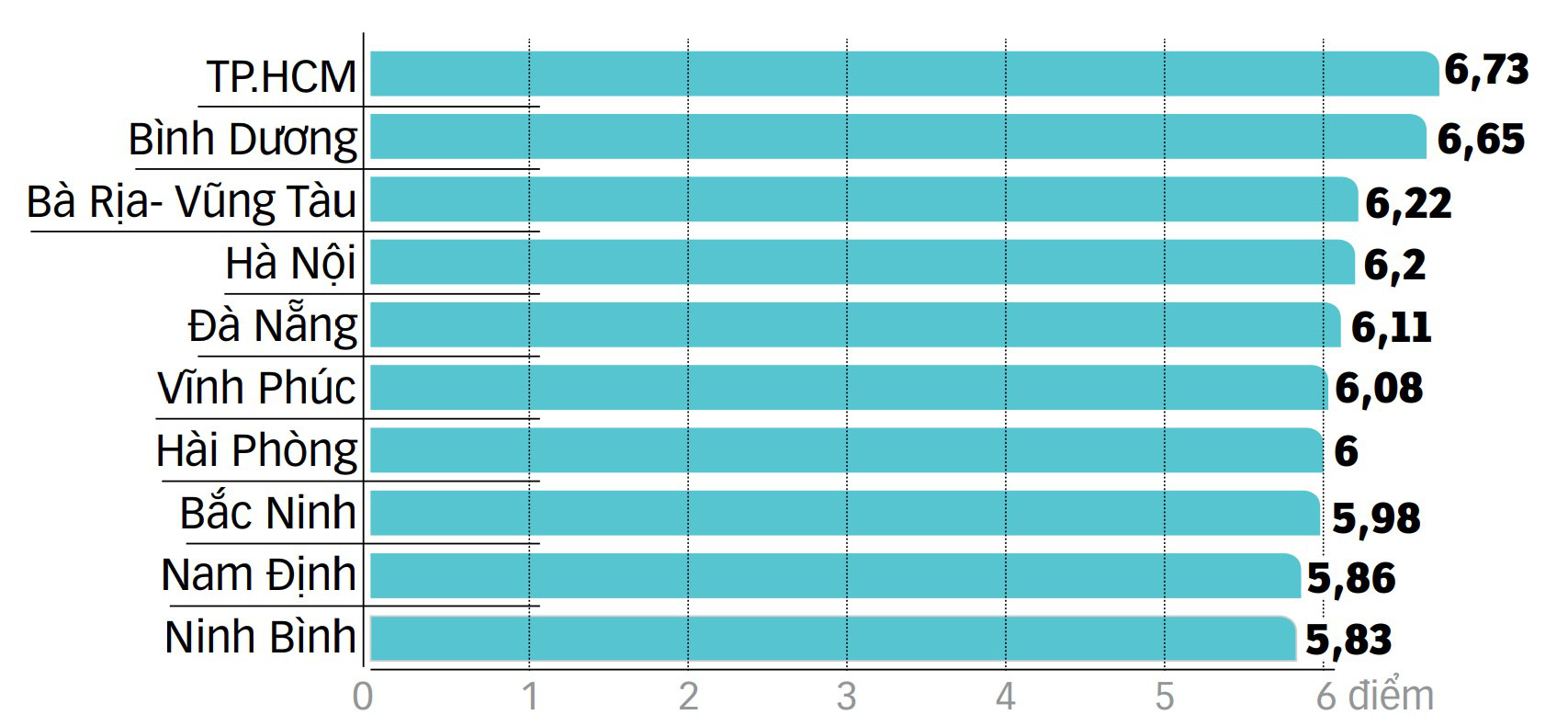
Top 10 localities with the highest average foreign language scores in the 2024 high school graduation exam nationwide - Graphic: N.KH.
Advantages from the teaching staff
According to Dr. Nguyen Thanh Binh, Head of the English Department (Ho Chi Minh City University of Education), the biggest advantage of Ho Chi Minh City making English a second language in education is its team of experienced, well-trained, and highly qualified English teachers. Many teachers have had the opportunity to participate in international training programs and access modern teaching methods. Furthermore, the city has attracted a large number of foreign teachers, contributing to improving the quality of English teaching in schools.
Mr. Binh noted that Ho Chi Minh City already has local resources to implement the program according to the roadmap and can use these resources to support teachers of other subjects in improving their English proficiency and accelerating the process of incorporating English into teaching.
* Mr. NGUYEN VAN HIEU , Director of the Department of Education and Training of Ho Chi Minh City:
A set of criteria will be developed.
* Sir, how has Ho Chi Minh City prepared for the implementation of the policy of using English as a second language in schools?
- Currently, in meetings, I have assigned the relevant departments to draft criteria for schools using English as a second language. For example, how many subjects should be taught in English? What level of English speaking ability among students in the school would qualify the school as using English as a second language?...
First, the department wants to increase the number of hours taught in English. For example, currently in Ho Chi Minh City, many schools teach mathematics and science in English, and some schools are teaching subjects in English under Project 5695 (integrating the English curriculum into the Vietnamese curriculum with a duration of 8 lessons/week).
Students in this program can use English as their language and means of communication. They communicate confidently in English, and upon completing high school, they will have sufficient English proficiency to pursue university programs taught in English through international partnerships, international schools in Ho Chi Minh City, or study abroad in English-speaking countries.
The Department will develop a set of criteria for recognizing schools that use English as a second language. These criteria will include aspects such as teaching, school activities, and the use of English in communication.
* When is the department expected to complete the draft of the criteria?
- The Ho Chi Minh City Department of Education and Training is currently organizing a workshop to gather opinions from experts and scientists to develop a set of criteria for schools using English as a second language from the preschool level.
Once finalized, these criteria will be submitted to the Ho Chi Minh City People's Committee for promulgation. It is expected that these criteria will be completed during the 2024-2025 school year and implemented starting in the 2025-2026 school year.
* What are the advantages of Ho Chi Minh City in making English a second language in schools?
- The biggest advantage is that the public strongly supports teaching in English. Currently, up to 99% of first-grade students in Ho Chi Minh City are learning English. Ho Chi Minh City has been implementing this since the Ministry of Education and Training's new general education program required English teaching from grade 6 onwards.
Currently, while the 2018 general education program teaches English to students from grade 3, Ho Chi Minh City has extended English education to grade 1, with many programs considered to have good learning outcomes.
Source: https://tuoitre.vn/thi-diem-dung-tieng-anh-day-hoc-tp-hcm-chuan-bi-ra-sao-20240915222528129.htm

![[Photo] General Secretary and President To Lam presides over a meeting on preparations for the review of one year of operation of the three-tiered government system.](https://vphoto.vietnam.vn/thumb/1200x675/vietnam/resource/IMAGE/2026/06/02/1780391821195_a1-bnd-4595-9717-jpg.webp)

























































































Comment (0)