

Challenge
The Vietnam Institute of Educational Sciences said that it had surveyed 3 provinces and cities before the administrative merger: Hanoi, Tuyen Quang, Soc Trang with 1,440 students, 960 teachers about teaching English in general schools today. Mr. Do Duc Lan, Deputy Director in charge of the Development Cooperation Center (Vietnam Institute of Educational Sciences) informed that in rural areas, about 30 - 40% of students are not confident about their English ability even though their scores on their report cards are still good. According to the teachers' assessment: 3 - 4% are at the level of exceeding the standard; 50% are at the level of meeting; about 35% of students are at the level of nearly meeting. The rest have not met.
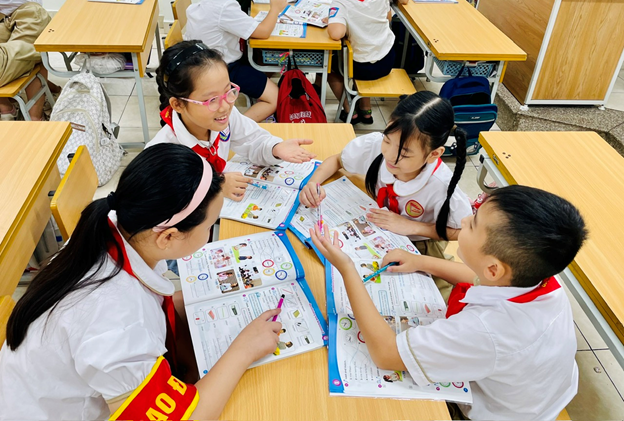
14% of students said that the English test and assessment were not appropriate. The percentage of students who felt pressured when learning English was still high; there was a lack of practice environment, and listening and speaking skills were not regularly assessed.
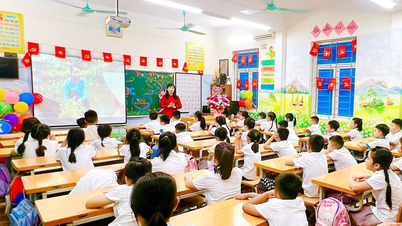
Ms. Luc Thi Ha, Principal of Pa Vi Primary School (Meo Vac district, old Ha Giang province), Tuyen Quang province said that the entire Meo Vac district (old) has only 1 English teacher with 18 primary schools.
Regarding the conditions for English teaching, the majority of teachers (40 - 50%) said that the school only partially met the requirements. The percentage of teachers who assessed the condition as "fully met" was only 25 - 27%. Mr. Lan informed that the percentage of teachers who can teach subjects in English in all schools is currently very low. Many managers and teachers who were asked said that it is difficult to implement teaching in English due to staff issues. From the survey results, Mr. Lan raised the question: Will there be obstacles when implementing the project in the context of foreign languages being an optional subject in the high school graduation exam?
Mr. Nguyen The Son, Deputy Director of the General Education Department ( Ministry of Education and Training ) said that when implemented, the project is expected to impact about 50,000 educational institutions from kindergarten to university nationwide with nearly 30 million children, pupils, and students and about over 1 million managers and teachers.
The project will be implemented over a 20-year period (2025-2045). Phase 1 (2025-2030) focuses on building the foundation and standardizing English usage. Phase 2 (2030-2035) expands and strengthens English usage. Phase 3 (2035-2045) aims for completion and enhancement, with English being used naturally and developing an English-speaking ecosystem in education, communication, and school administration.
According to Mr. Son, for preschools, the successful implementation of the project will create an additional 12,000 English teacher positions in public schools. For primary schools, it will create nearly 10,000 additional English teacher positions. At the same time, at least 10% (200,000 people) of teachers who teach in English must receive training and professional development in English and pedagogy from now until 2035.
Areas with suitable conditions will be prioritized for implementation.
Mr. Nguyen The Son, Deputy Director of the Department of General Education (Ministry of Education and Training), affirmed that the Ministry of Education and Training will implement the project first in areas with suitable conditions, avoiding a uniform or indiscriminate approach. The issue of preserving the mother tongue and teaching the language of neighboring countries in border provinces was also raised by Mr. Son when implementing the project. The Ministry of Education and Training plans to issue the implementation plan before December 15th.
Regarding the teacher shortage, Mr. Son noted that it's not just English but also other subjects. The Department of General Education will coordinate with the Department of Teachers (Ministry of Education and Training) to advise on solutions to address this issue. He believes that localities must carefully consider and plan the most appropriate implementation, especially regarding the development of the teaching staff. Solutions to consider include: policies to attract teachers from disadvantaged areas, mechanisms for foreign teachers to participate in teaching, and contracting with non-tenured teachers to teach in public schools…
Ms. Luc Thi Ha, Principal of Pa Vi Primary School (Meo Vac District, former Ha Giang Province), Tuyen Quang Province, said that according to the 2018 general education program, students are required to learn English from grade 3. According to Ms. Ha, the biggest challenge for disadvantaged areas is the lack of English teachers. The entire Meo Vac District (formerly) has only 1 English teacher for 18 primary schools. Ms. Ha informed that up to now, there are still many quotas for schools but it is still difficult to recruit.
Last October, the Hanoi Department of Education and Training organized a training course on innovative English teaching methods and solutions to make English a second language in schools for over 600 officials from the culture and social affairs departments of 126 communes and wards, along with more than 800 key English teachers and administrators from public and private primary schools in the area.
According to Ms. Tran Luu Hoa, Deputy Director of the Hanoi Department of Education and Training, it is necessary to change the mindset of teaching and learning English in general schools, from imparting knowledge to developing the ability to use language in practice. The teaching staff is the decisive factor in this transformation process. Each teacher is both the person implementing the program and the core of innovation in pedagogical thinking, teaching methods and classroom organization - thereby spreading the spirit of innovation to colleagues and students in their unit.
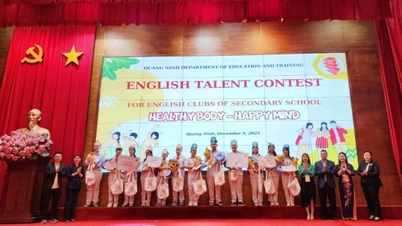
Last October, the Department of Education and Training of Quang Ninh issued a document guiding the teaching and learning of foreign languages in general schools, requiring preparation of conditions to implement the project of making English the second language in schools. In the 2025-2026 school year, the department encourages primary education institutions with sufficient conditions to implement the teaching and learning of elective English for students in grades 1 and 2, but pay attention to ensuring connectivity with the compulsory foreign language subject from grade 3.
Source: https://tienphong.vn/dua-tieng-anh-tro-thanh-ngon-ngu-thu-hai-trong-truong-hoc-khong-dan-hang-ngang-cung-tien-post1802636.tpo


![[Photo] Explore the US Navy's USS Robert Smalls warship](/_next/image?url=https%3A%2F%2Fvphoto.vietnam.vn%2Fthumb%2F1200x675%2Fvietnam%2Fresource%2FIMAGE%2F2025%2F12%2F10%2F1765341533272_11212121-8303-jpg.webp&w=3840&q=75)

























![[Video] The craft of making Dong Ho folk paintings has been inscribed by UNESCO on the List of Crafts in Need of Urgent Safeguarding.](https://vphoto.vietnam.vn/thumb/402x226/vietnam/resource/IMAGE/2025/12/10/1765350246533_tranh-dong-ho-734-jpg.webp)






















































Comment (0)