

Overcoming limitations in career guidance, streaming, and articulation.
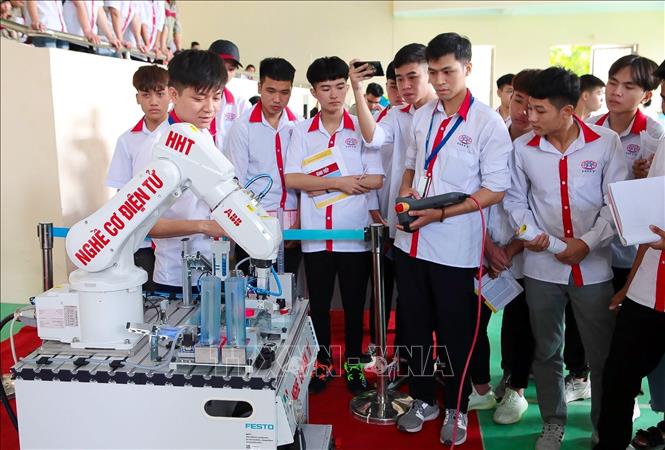
In response to the need for continued innovation, development, and improvement of the quality of vocational education , creating breakthroughs in human resource development, especially high-quality human resources with vocational skills to meet the requirements of accelerating industrialization, modernization of the country, and international integration, in addition to inherited content, the amended Law on Vocational Education has undergone fundamental and comprehensive changes from within.
In order to perfect the national education system towards openness, flexibility, and interconnectedness, creating lifelong learning opportunities for all citizens, the Law has added the vocational high school model and expanded the scope of participation in vocational education activities.
Vocational high school is a very popular model worldwide and has been unanimously recognized by National Assembly delegates as a groundbreaking innovation in the national education system. Vocational high school is defined as being at the same level as high school, integrating core knowledge from the high school curriculum with vocational skills to help students complete their general education while equipping them with the ability to perform and solve tasks in stable conditions and familiar environments related to their chosen profession; they will be able to apply modern techniques and technologies to their work, work independently, and work in teams.
The addition of vocational high school models aims to strengthen career guidance for young people right from the secondary school level, increase the number of students after lower secondary and upper secondary school entering vocational education; and overcome limitations and weaknesses in career guidance, streaming, and articulation.
Expanding the scope of participation in vocational education is also a crucial solution to ensure that the national education system is designed to be open and flexible. The new law stipulates that higher education institutions can participate in vocational education in certain sectors and fields that align with the development orientation of priority areas (arts, sports, teacher training, national defense and security) to ensure the specificity and continuity between levels without affecting the goals and mission of vocational and higher education.
The amended law also creates breakthroughs in curriculum innovation, training organization, and quality assurance in vocational education through the regulation of program and training institution standards; management of registration activities on a digital data platform; and recognition of accumulated knowledge or skills of learners to participate in other learning programs.
The issuance of regulations on program standards and training institution standards aims to provide learners and society as a whole with complete and transparent information about the programs they can choose. It also serves as an incentive for vocational education institutions to develop plans to supplement the necessary conditions. Furthermore, it provides a basis for state management agencies to inspect, evaluate, and take decisive action against institutions that do not meet the standards.
The provisions in the Law regarding licensing and information registration are also a significant innovation. Licensing for vocational education activities will be done by industry group instead of by individual profession as currently. Institutions will be able to proactively determine their enrollment scale in accordance with the conditions stipulated by the Ministry of Education and Training. A key new point is that even though licenses are granted by industry group, before organizing enrollment and training, institutions must register their enrollment information with the specialized database system.
Recognizing the crucial role of businesses in collaborating with the State and vocational education institutions in training skilled human resources to meet labor market demands, the Law supplements regulations on State policies towards businesses, including preferential policies on taxes and land; and policies regarding the participation of business personnel in vocational education activities as visiting lecturers, co-workers, or instructors. The Law also adds regulations on the Human Resource Training Fund of businesses, which serves as an incentive for employees to stay with the business long-term.
Higher education plays a driving role in developing high-quality human resources.
Throughout the 46 articles of the amended Law on Higher Education, the key phrase is "Modernizing higher education, increasing the quality of university training." The law institutionalizes the policies and orientations for the development of higher education in the new era, such as the role and mission of public and private higher education; removing bottlenecks and obstacles regarding university autonomy, developing training programs, attracting staff, and attracting investment resources. Higher education is identified as playing a core role and being the driving force for the strong development of high-quality human resources, promoting science and technology, and national innovation.
According to the Ministry of Education and Training, this revised law aims to create breakthroughs and pioneers in innovation for higher education institutions, fostering elite training, high-quality education, and providing highly skilled human resources to serve national and global development. Simultaneously, it aims to establish a unified higher education system, advanced university governance, and increase endogenous strength; to end the activities of the University Council in public higher education institutions, and to strengthen the leadership role of the Party organization within higher education institutions.
Notably, the amended Law fully institutionalizes the principle of "ensuring full and comprehensive autonomy for higher education institutions regardless of the level of financial autonomy," moving away from the view that "autonomy means self-reliance" and towards a mechanism where the State and higher education institutions jointly care for the development of higher education. Autonomy includes academic autonomy, organizational structure, training, scientific research, international cooperation, personnel, and finance, while affirming accountability as a mandatory legal obligation. These adjustments ensure that autonomy becomes substantive, alongside mechanisms for controlling power, guaranteeing academic integrity, transparency, and quality of operations at higher education institutions.
Regarding the regional university model, overall, national and regional universities established under the Party and Government's policies have proven effective and achieved certain successes in human resource training, contributing to regional and national development. National and regional universities are listed in prestigious rankings of educational institutions in Asia and the world. This model is also suitable for the practices of some countries with modern education systems such as China, South Korea, Singapore, the United States, and Canada, where multi-campus or regional universities lead regional development and allocate resources efficiently. According to the current network planning of higher education institutions, regional universities have the mission of carrying out strategic tasks, linking regions, and developing the science, technology, and innovation ecosystem.
The revised law aims to improve the internal governance efficiency of each regional university, clarifying the strategic coordination function of regional universities and the academic, organizational, and financial autonomy of member universities; perfecting the decentralization mechanism, accountability mechanism, personnel standards, operating methods, and responsibilities of each level. The Government has also directed the Ministry of Education and Training to conduct a comprehensive review of the organizational model of each regional university, assess the current level of decentralization, and review intermediate units and stages that are no longer appropriate in accordance with the spirit of Resolution 71-NQ/TW; thereby proposing a plan for restructuring and streamlining to ensure operational efficiency, limit overlaps, and avoid creating additional administrative management levels.
Regarding postgraduate training in the health sector, this is a group of issues that has received many opinions from National Assembly delegates. Through a comprehensive review and consultation with international experience, the training of resident physicians and specialists (Level I and Level II) is postgraduate training aimed at producing skilled doctors to work in hospitals, and does not fall under the academic master's or doctoral degree programs. The Ministry of Education and Training and the Ministry of Health have reached a high level of consensus on the general principles of postgraduate training programs in the health sector leading to resident physician and specialist doctor degrees, which are guided, organized, and managed by the Ministry of Health. This standardizes the work that the Ministry of Health has been doing until now.
The amended Higher Education Law clearly demonstrates a vision for reform, creating a legal framework for the development of modern, autonomous, transparent, integrated higher education, closely linked to science and technology, innovation, and the needs of national development in the new era.
Source: https://baotintuc.vn/giao-duc/the-che-hoa-cac-chu-truong-de-phat-trien-manh-me-nguon-nhan-luc-chat-luong-cao-20251210171259441.htm




























![[Video] The craft of making Dong Ho folk paintings has been inscribed by UNESCO on the List of Crafts in Need of Urgent Safeguarding.](https://vphoto.vietnam.vn/thumb/402x226/vietnam/resource/IMAGE/2025/12/10/1765350246533_tranh-dong-ho-734-jpg.webp)






















































Comment (0)