

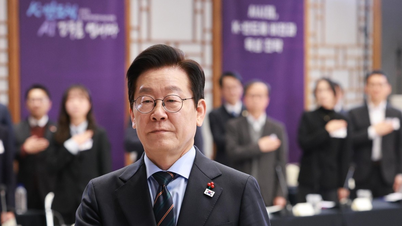
According to Chosun Biz , the Korea Institute for Curriculum and Evaluation (KICE) announced on December 10th that its director, Oh Seung-geol, has submitted his resignation.
KICE reported that Mr. Oh had resigned and quoted him as saying: “Because the English exam in the 2026 Suneung University entrance exam was not in line with the goal of evaluating scores on a perfect scale, I am fully aware of my heavy responsibility in causing anxiety to candidates and parents, as well as creating confusion in the admissions process.”

Mr. Oh resigned as President after 2 years and 4 months in office, starting in August 2023, before completing his 3-year term. Prior to this, his predecessor, Lee Gyu-min, also resigned mid-term in 2023 due to controversy surrounding the "extremely difficult questions" in the Suneung mock exam. Of the 12 presidents of KICE (Korea International Exam) to date, only four completed their full term; the majority resigned due to errors in the exam design process.
KICE said it will review the entire test preparation process and implement improvements to ensure that future tests are consistent and accurately reflect assessment objectives, according to The Korea Herald .
According to published data, the Suneung exam on November 13th recorded only 3.11% of candidates achieving the highest score (90 points or higher) in English. This is the lowest rate since the adoption of the absolute score grading system in 2018 and is even lower than the standard 4% for subjects graded using relative scores. In 2024, this rate is projected to be 6.22%.
At a press conference on December 4th, Mr. Oh expressed regret that the difficulty level "deviated from the set target." He stated that the question-setting team had to change many questions due to the discovery that they overlapped with practice tests at private centers, leading to an inadequate assessment of the difficulty level of some questions.
The South Korean Ministry of Education announced it will conduct a comprehensive investigation into the exam question setting and evaluation process. On December 8th, Chief of Staff to the President, Kang Hoon-sik, also demanded that KICE and the Ministry of Education provide clear explanations regarding the "difficulty of the English exam causing confusion among test-takers and parents."
The English exam sparked intense controversy.
This year's English section of the Suneung National University Entrance Examination was deemed particularly difficult and unrealistic by experts. Many native-speaking professors and even AI experts struggled with some of the questions. One American professor commented that the exam used "complex, outdated, and rare language," even "so bizarre that even native speakers were confused."

The most debated question was question 39 – which asked to identify the appropriate place to insert a sentence into a paragraph. Both native speakers and ChatGPT chose answer 1, while the official answer was 3, sparking controversy about the validity of the exam and its answer key.
The English section of the Suneung exam has been notoriously difficult for many years and is increasingly unrealistic, likened to "decoding ancient texts." Many experts argue that the gap between classroom knowledge and the difficulty of the exam forces candidates to resort to shortcuts or intense test preparation, while neglecting the goal of assessing actual English proficiency. However, others argue that the exam is still appropriate for its admissions purpose, aiming to measure reading comprehension at the university level.
The Suneung Exam is one of the world's most stressful exams, lasting 8 hours and with over 550,000 test-takers this year. On exam day, South Korea temporarily suspended flights during the English exam, increased subway traffic, and deployed additional police to help test-takers arrive at their exam locations on time.
Source: https://vietnamnet.vn/lanh-dao-co-quan-ra-de-thi-dai-hoc-tu-chuc-vi-de-tieng-anh-qua-kho-2471259.html



















![[Video] The craft of making Dong Ho folk paintings has been inscribed by UNESCO on the List of Crafts in Need of Urgent Safeguarding.](https://vphoto.vietnam.vn/thumb/402x226/vietnam/resource/IMAGE/2025/12/10/1765350246533_tranh-dong-ho-734-jpg.webp)








































Comment (0)