

Using solar energy, the device from the University of Cambridge can operate in any open body of water without the need for electricity.
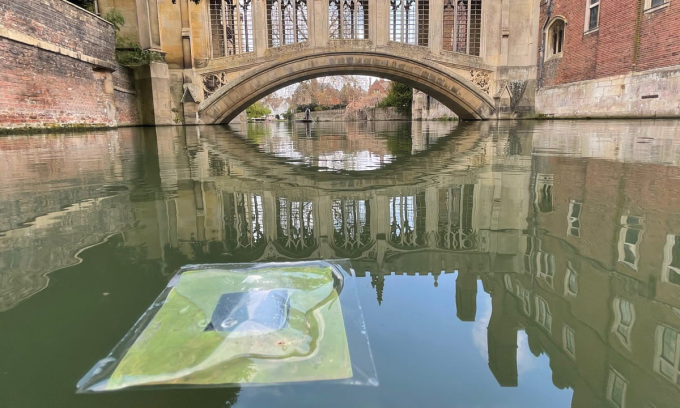
The floating device is being tested on the River Cam, Cambridge. Photo: Virgil Andrei
Inspired by photosynthesis, a research team at the University of Cambridge has developed a solar-powered device that can simultaneously produce hydrogen fuel and clean water from seawater or polluted water, New Atlas reported on November 14. Because it operates in any open body of water and requires no external power source, the device can be installed in remote areas or places with limited resources. The new research was published in the journal Nature Water.
Photocatalytic water splitting processes convert sunlight directly into hydrogen but typically require pure water and land to build the plant, and also release excess heat. The photocatalytic device developed by the team at the University of Cambridge uses any untreated water source, making it a more sustainable solution.
They placed a photocatalytic material that absorbs ultraviolet light onto a nanostructured carbon mesh that absorbs infrared light to create steam, which the photocatalytic material uses to produce hydrogen. The porous carbon mesh, treated to repel water, helps the photocatalytic material float and separate from the water below, preventing pollutants from affecting its operation. Additionally, this structure allows the device to harness solar energy more efficiently.
The research team used a layer of ultraviolet light-absorbing material on top of the floating device to produce hydrogen through a water splitting process. The remaining light in the solar spectrum is transmitted to the bottom of the device, causing the water to evaporate. This process mimics transpiration—the process by which water moves within a plant and evaporates from parts such as leaves, stems, and flowers.
Scientists tested the device with various water sources, including water from the River Cam in central Cambridge and turbid wastewater from the paper industry. In artificial seawater, the device maintained 80% of its initial efficiency after 154 hours. The research team stated that because the photocatalytic material was separated from water pollutants and remained relatively dry, the device was able to maintain stability during operation.
Thu Thao (According to New Atlas )
Source link


![[Photo] Prime Minister Pham Minh Chinh presides over a meeting on private sector economic development.](/_next/image?url=https%3A%2F%2Fvphoto.vietnam.vn%2Fthumb%2F1200x675%2Fvietnam%2Fresource%2FIMAGE%2F2025%2F12%2F20%2F1766237501876_thiet-ke-chua-co-ten-40-png.webp&w=3840&q=75)






































































![[Infographic] Controlling rabies in pet dogs and cats](https://vphoto.vietnam.vn/thumb/402x226/vietnam/resource/IMAGE/2025/12/21/1766288809667_infographic-kiem-soat-benh-dai-tren-dan-cho-meo-nuoi20251221091138.webp)


















Comment (0)