

In large cities and urban areas, this worry even becomes a constant pressure for many families every summer. While schools are closed but the work life continues, many parents find themselves lacking the resources to supervise their children. Meanwhile, community spaces for children are limited; age-appropriate cultural and artistic activities are not abundant; and many children spend most of their time at home with television, phones, or social media.
Some more affluent families seek opportunities for their children to participate in skills-based experiential classes, training programs organized by the military or police, or summer camps. These are positive activities that contribute to developing discipline, life skills, and teamwork in children. However, not all families have the means to access such programs. Therefore, the gap in opportunities for enjoying summer cultural activities among different groups of children remains quite significant, especially for children in rural areas, remote regions, and ethnic minority communities.
In this context, the role of children's literature, theater, and film becomes even more important. However, the reality is that these are precisely the areas where there are many gaps that warrant serious consideration.
Children's literature: The author gap and the gap with young readers.
Children's literature has long been considered an important part of cultural life, contributing to the formation of character and nurturing the imagination of the younger generation. However, the current reality shows that the number of authors who dedicate themselves to writing for children remains limited.
For many years, the children's book market has relied primarily on a few familiar names such as To Hoai, Nguyen Nhat Anh, Vo Quang, and Nguyen Thi Thanh Nhan, while a new generation of writers has yet to emerge. This has resulted in a lack of diversity in children's literature, preventing it from meeting the increasingly varied needs of young readers.
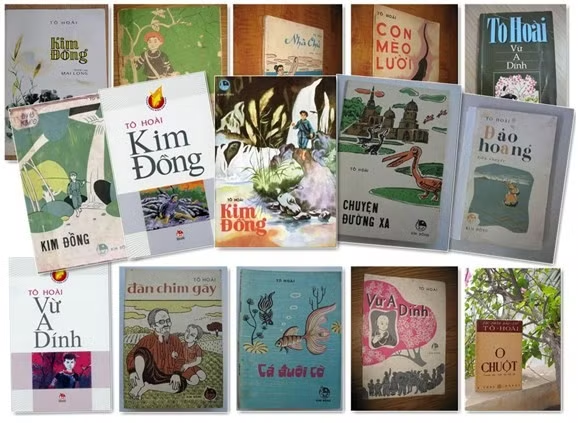
Another fact that needs to be acknowledged is that the number of translated children's books is increasingly dominating the publishing market. This is an inevitable trend in the context of integration, but without a proper balance, children may absorb many foreign cultural values while having few opportunities to engage with stories that are close to Vietnamese life, nature, and culture.
Meanwhile, with the rapid development of digital technology , children's reading habits are changing quickly. Without sufficiently engaging books to accompany them, the risk of a decline in reading culture among children is entirely possible.
Therefore, the gap in children's literature is creating a need for more attention in contemporary cultural life.
Children's theater: Lack of good scripts, lack of access opportunities.
Along with literature, children's theater is also facing many difficulties in attracting young audiences.
In reality, the number of theatrical works specifically for children is currently limited. Most theaters and performing arts groups struggle to find suitable scripts. Many programs have to re-publish familiar stories or adapt foreign inspirations, while works deeply rooted in Vietnamese culture and specifically for children remain scarce.
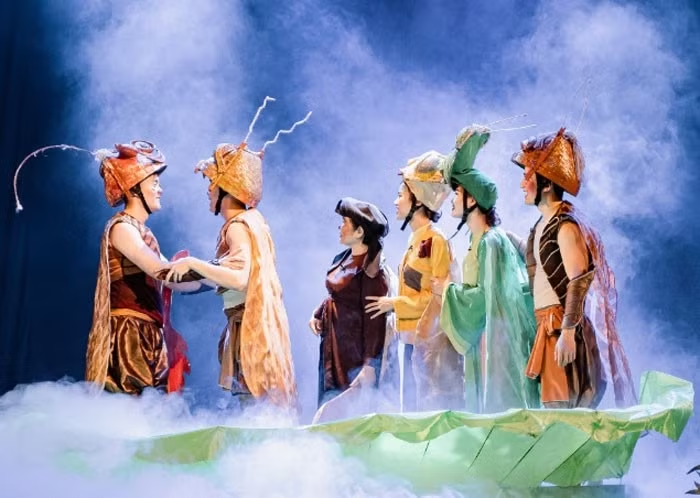
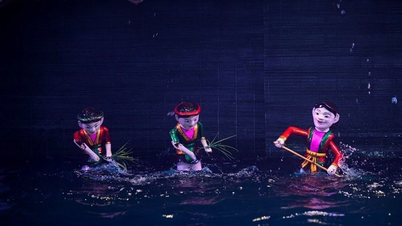
Meanwhile, theater is an art form that has the ability to directly and vividly impact children's emotions. Engaging performances not only bring joy but also help children access lessons about history, culture, and life values in a gentle and natural way.
However, in the context of children today having increasingly early access to modern technological platforms, making the stage more appealing to young audiences is becoming a difficult problem for performing arts organizations. The lack of good scripts, insufficient investment resources, and inadequate mechanisms to encourage creativity are preventing many children's theater programs from achieving widespread impact in society.
It's worth noting that children's need for art has never diminished. What they need is not just pure entertainment, but works that are both engaging and possess aesthetic and educational value appropriate to their age.
Children's cinema: A long-standing "thirst"
Among the various art forms for children today, film is perhaps the field that most clearly reveals a gap.
There was a time when millions of young viewers were captivated by films like: "Southern Land," "Kaleidoscope," "Special Task Force C21," "Wildflowers," etc. These works not only brought innocent laughter but also fostered friendship, love, and profound life lessons. However, most of these films are now 20 to 25 years old.
In recent years, domestic children's films have been sporadic, failing to establish a stable product line catering to young audiences. Many works marketed as children's films actually only use children's images to reflect adult issues, preventing children from truly becoming the central focus of the story.
Notably, during the summer months – a time when children's movie-watching demand is high – cinemas primarily show imported films. Meanwhile, Vietnamese animation, considered the most suitable genre for children, almost entirely lacks feature films, limiting itself to 10-15 minute movies. As a result, it rarely appears on the big screen and has yet to create a strong appeal for young audiences.
This situation stems from several factors: a lack of scripts, a shortage of child actors, difficulties in production organization, and especially the low potential for return on investment. Making children's films requires more effort than making films for adults, while the mechanisms for supporting creativity in this field are still not truly stable.
This shows that children's cinema needs more favorable conditions to develop more sustainably in the future.
Children cannot be left to "fend for themselves" in entertainment spaces.
The gap in children's literature, theater, and film is forcing many children to turn to mass-market entertainment online.
In a vast but undirected information space, children easily access content that is inappropriate for their age. This not only affects their aesthetic sense but also directly impacts the process of personality formation.
A society that properly cares for children is not only demonstrated through ensuring adequate learning and living conditions, but also by proactively creating a suitable cultural environment for their holistic development.
Investing in children's literature, theater, and film is therefore not just a matter for the arts and culture sector alone, but an important part of the human development strategy.
A truly meaningful summer for children is not just a time for rest after a school year, but also requires more suitable cultural spaces where they can play, experience, and nurture their souls. The gap in "spiritual nourishment" for children therefore needs to be more fully recognized in order to find appropriate solutions in the future.
Keywords:
Source: https://congluan.vn/thieu-nhung-mon-an-tinh-than-danh-cho-lua-tuoi-hoc-duong-post347019.html
![[Image] Hanoi's urban life under the challenge of a "scorching hot" environment](https://vphoto.vietnam.vn/thumb/1200x675/vietnam/resource/IMAGE/2026/05/25/1779706979265_nang-nong-t5-2026-minh-duy-7-4636-jpg.webp)
![[Image] Close-up view of the interchange connecting the two expressways and Long Thanh Airport.](https://vphoto.vietnam.vn/thumb/1200x675/vietnam/resource/IMAGE/2026/05/25/1779703378210_ndo_br_z7863716673926-224453a31600126cce10622af6290afd-4549-jpg.webp)














































































Comment (0)