

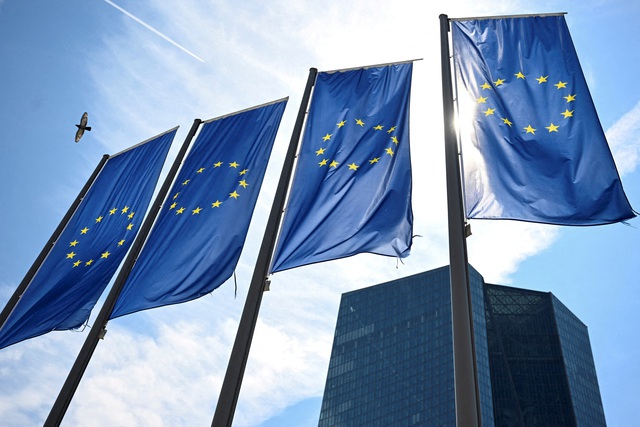
European Union flag
Photo: Reuters
Although small and sparsely populated, this island nation occupies a strategically important geographical location in global politics . A NATO member, Ireland remains outside the EU due to concerns about falling behind in living standards if it were a member. In 2009, Ireland initiated negotiations with the EU regarding accession, but unilaterally halted them four years later.
Therefore, the renewed focus on EU accession negotiations reflects a very significant shift in public sentiment and the internal political and social atmosphere of this Arctic island nation in recent times. Without the emergence of new and powerful influencing factors, this shift would certainly not have been possible.
This new factor is the changing times. In Ireland, the golden age of economic and social prosperity is over, replaced by difficulties and challenges that force the island nation to move beyond its isolation and integrate deeply into continental Europe, taking full advantage of the EU.
The conflict in Ukraine and the fact that Russia is now considered an adversary, rival, and enemy by the EU and NATO, rather than a partner as before, has disrupted the long-standing order and dynamics on the continent in terms of politics, security, economics, and trade.
Then came the issue of US President Donald Trump's desire to annex Greenland, which belongs to Denmark, and the fact that NATO members in Europe, such as Ireland, could no longer fully trust Washington. Furthermore, the Arctic region faced an increasing risk of militarization and became a battleground for strategic competition among major partners. Such circumstances forced the island nation to choose the EU.
Source: https://thanhnien.vn/thoi-cuoc-buoc-lua-chon-185260308222621542.htm
![[Photo] General Secretary and President To Lam and his wife begin their official visit to Thailand.](https://vphoto.vietnam.vn/thumb/1200x675/vietnam/resource/IMAGE/2026/05/27/1779881249412_anh-man-hinh-2026-05-27-luc-18-10-51.png)
![[Photo] The courage of new recruits of Brigade 144 on the training ground.](https://vphoto.vietnam.vn/thumb/1200x675/vietnam/resource/IMAGE/2026/05/27/1779881651341_anh-man-hinh-2026-05-27-luc-18-32-52.png)

































![[Photo] The courage of new recruits of Brigade 144 on the training ground.](https://vphoto.vietnam.vn/thumb/402x226/vietnam/resource/IMAGE/2026/05/27/1779881651341_anh-man-hinh-2026-05-27-luc-18-32-52.png)




















Comment (0)