

A few years ago, before he started cultivating Japanese bitter greens, Mr. Tran Thanh Phong (Tan Xuan commune) only had a few acres of rice paddies, growing one rice crop per year. From that, he came up with the idea of finding a crop suitable for the soil conditions, easy to cultivate, and providing a steady income. And he chose to grow Japanese bitter greens.
 |
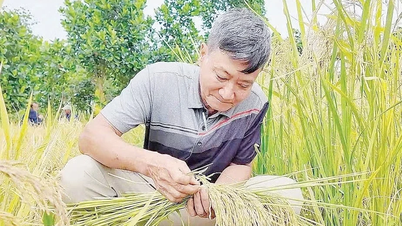
| Mr. Tran Thanh Phong is harvesting vegetables. |
Initially, growing Japanese bitter greens was quite unfamiliar to many local farmers. Many were apprehensive about market demand and worried about the uncertainty of the consumption market. But this very "unusual" aspect opened up a different path for Mr. Phong. He switched from growing rice once a year to growing vegetables, allowing for year-round harvesting.
Lacking experience, the early days were not easy at all. The vegetables grew slowly, pests and diseases appeared, and sales were mainly through small-scale, independent buyers. At times, Phong almost had to start over, adjusting soil preparation, changing planting schedules, and researching and learning about cultivation techniques suitable for the local climate. "Growing vegetables is like raising children; you have to understand what they need to expect them to grow well," Phong said with a gentle smile.
Following Phong to learn about this vegetable, he recounted: "Initially, due to lack of experience, after some time growing it, I found that Japanese bitter greens are very easy to grow and adapt well to acidic and saline soils. They have a quick harvest time (once a month) and high yield."
This type of vegetable is quickly consumed and favored by the local people because it is easy to prepare, such as boiling, stir-frying, or making soup and hot pot... On average, 1,000 square meters yield 1 ton of fresh vegetables per month, thereby providing a stable income for the family.
Not stopping there, Mr. Phong boldly expanded his farming area and rearranged the harvesting process to meet the requirements of traders and long-term customers. Over the past two years, his vegetable farm has become even more firmly established in the market thanks to the application of VietGAP-standard farming practices.
“Nowadays, even farmers selling vegetables need to understand the market to survive; otherwise, they can easily be eliminated from the market.” Then he revealed, “Seeing the economic benefits far exceeding those of rice farming and coconut cultivation, I boldly converted several acres of Siamese coconut trees to bitter melon cultivation. Now I have a land lease contract with the cooperative for a considerably larger area…”
What's commendable is that as the model has grown, Mr. Phong hasn't "gone it alone." The bitter melon field, which was just over 3 hectares in the middle of the Tan Xuan rice paddies two years ago, has now expanded, spread further, become lush green, and attracted many neighboring households to participate. The area covered in green bitter melon along the Ba Tri freshwater lake in Tan Xuan commune has become a highlight of the effectiveness of transforming farming models on less productive rice paddies.
Currently, his Japanese bitter melon garden provides regular employment for more than 10 local workers, mainly middle-aged people and rural women. The regular work brings a stable income, helping many families to cover their living expenses and stay connected to their land and hometown.
After deducting all expenses, Mr. and Mrs. Phong still have a profit of over 15 million VND per month. This income level, once a dream for farmers in this once impoverished rural area, has now become a reality.
Besides creating livelihoods, Mr. Phong is also willing to share his experience in growing Japanese bitter melon with the surrounding community. Many farmers from within and outside Tan Xuan commune come to visit and learn about soil improvement, propagation techniques, care, and harvesting. For him, the development of the model is only truly sustainable when more people work together and benefit.
The lush green vegetable plots of Mr. Phong's family and other households in the area have confirmed that this agricultural economic model is suitable for the local climate and soil conditions, contributing to job creation and improving income in a stable and sustainable manner.
Text and photos: CAM TRUC
Source: https://baovinhlong.com.vn/kinh-te/nong-nghiep/202512/thu-nhap-on-dinh-tu-trong-rau-dang-nhat-ff20aba/
![[Photo] General Secretary and President To Lam meets with National Assembly delegates from ethnic minorities.](https://vphoto.vietnam.vn/thumb/1200x675/vietnam/resource/IMAGE/2026/04/20/1776696701056_a1-bnd-8331-3342-jpg.webp)

![[Image] National Assembly discusses the implementation of the socio-economic development plan.](https://vphoto.vietnam.vn/thumb/1200x675/vietnam/resource/IMAGE/2026/04/20/1776696707422_ndo_br_img-20260420-185419-jpg.webp)



































































Comment (0)