

Time - a formidable enemy
But if you look closely at the match's progression, this wasn't the defeat of a player past his prime. Djokovic lost to an exceptional talent in world tennis, in a match that showed the most worrying thing for him right now isn't his technique or class, but the ravages of time.

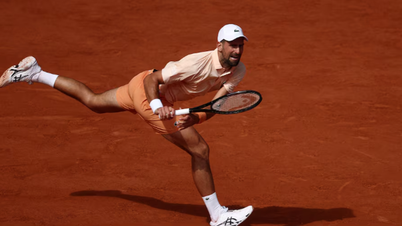
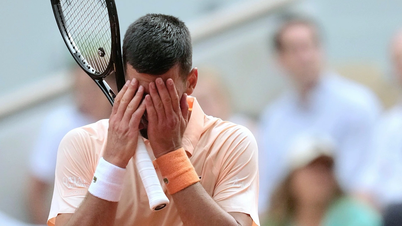
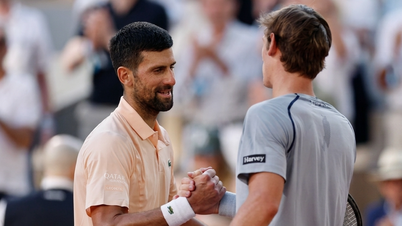
Djokovic (left) exited Roland Garros 2026 in the third round after a comeback defeat to Joao Fonseca.
This year's Roland Garros presents a rare opportunity for Djokovic. Carlos Alcaraz is not participating. Jannik Sinner, the world number one, was unexpectedly eliminated in the second round. With his experience, composure, and desire to win his 25th Grand Slam, Djokovic naturally becomes one of the strongest contenders.
But then he was eliminated in the third round. What surprised the public wasn't the defeat itself, but the manner in which Djokovic lost. Djokovic won the first two sets 6-4, 6-4, controlled most of the match, and seemed poised to advance to the fourth round. Yet, Djokovic allowed his younger opponent to come back and win with scores of 6-3, 7-5, 7-5.
This is only the second time in his Grand Slam career that Djokovic has lost after leading by two sets, and the first such loss happened… 16 years ago. Looking at the entire match, it's hard to say this is the image of a player past his prime. Djokovic didn't play badly. He wasn't overwhelmed.
He didn't make too many mistakes. Even for most of the match, his class was clearly evident, and at times Djokovic was only a few points away from victory. However, Djokovic couldn't maintain that dominance for five hours like he did during his prime.
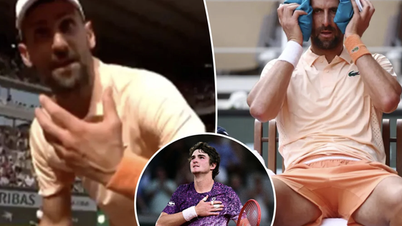
Djokovic - an icon of resilience .
He has won countless marathon matches lasting four or five hours. His battles against Roger Federer, Rafael Nadal, Andy Murray, and later Carlos Alcaraz all demonstrated the extraordinary endurance of the player widely regarded as the greatest tennis player in history. Djokovic still serves well, returns brilliantly, and reads the game among the best in the world. If judged solely on his tennis skills, Djokovic remains one of the strongest players on the ATP Tour.

Djokovic remains among the strongest players on the ATP Tour.
What changes is the ability to maintain intensity. Djokovic of the 2011-2023 period was often the stronger player when matches went on longer. Djokovic of 2026 begins to struggle when the fight enters the fourth or fifth hour. Against Fonseca, he led by two sets. But as the younger opponent accelerated, Djokovic's energy was no longer as abundant as before. The gap between age 39 and age 19 finally became apparent. It wasn't a decline in technique. It was the law of time.
Fonseca is not a fleeting phenomenon; if Djokovic had lost to an unknown player, concerns about his decline would likely have been much greater. But Joao Fonseca is not a name that appeared out of nowhere. The 19-year-old Brazilian is already considered one of the brightest talents in men's tennis. Fonseca was once world number one in junior rankings, has reached the ATP Top 30, and is considered by many experts to be the greatest hope for Brazilian tennis since Gustavo Kuerten.
More importantly, Fonseca possessed qualities perfectly suited to modern tennis: a powerful serve, a devastating forehand, explosive movement, and, most notably, an astonishingly strong mentality at such a young age.
Few would have thought a 19-year-old could remain calm after losing the first two sets to Djokovic on Philippe-Chatrier court. But Fonseca didn't collapse. Fonseca continued to attack, continued to believe in his chances, and ultimately completed the biggest comeback of his young career. It wasn't a sign of an unusually brilliant day. It was a sign of great talent.
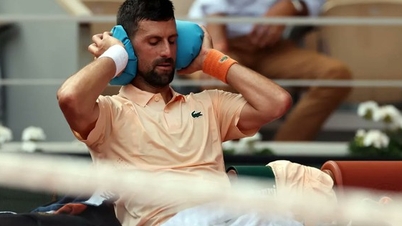
Age begins to make a difference.
Not past his prime, but no longer invincible. Perhaps the most accurate assessment of Djokovic at this point is that he remains among the elite of world tennis, but no longer holds absolute dominance. Carlos Alcaraz and Jannik Sinner are currently the two players creating a gap between themselves and the rest. Djokovic is still capable of defeating any opponent in a specific match. He remains a contender in every Grand Slam tournament he participates in.

Fonseca possesses qualities that are very well suited to modern tennis.
However, the era when he entered Grand Slams as the number one contender has ended. To win a major tournament now, Djokovic needs more than just to play well. He also needs to be physically fit enough to endure two grueling weeks of competition against opponents nearly two decades younger.
Djokovic, a player who can still go deep in Grand Slams and make even the world's best young opponents wary, cannot be considered past his prime. But the defeat to Joao Fonseca is also a reminder that men's tennis is entering a new phase. Djokovic didn't lose to a phenomenon. He lost to a talent who could become a major star of the next generation. More importantly, he lost in a battle where age is beginning to make a difference.
For nearly 20 years, young players have had to prove they were good enough to beat Novak Djokovic. Today, Djokovic is still good enough to compete with them. The only difference is, for the first time in his career, he has to compete against an opponent no legend has ever beaten. Time's up!
Source: https://nld.com.vn/thua-fonseca-tuoi-19-djokovic-chua-het-thoi-196260530142618249.htm

![[Image] Nearly 125,000 Hanoi students completed the Literature exam for the 10th grade entrance exam.](https://vphoto.vietnam.vn/thumb/1200x675/vietnam/resource/IMAGE/2026/05/30/1780117233041_ndo_br_thiet-ke-chua-co-ten-2-png.webp)






















![[Photo] Admire the coral "masterpiece" amidst the million-year-old heritage of Dak Lak province.](https://vphoto.vietnam.vn/thumb/1200x675/vietnam/resource/IMAGE/2026/05/30/1780107638639_y25-jpg.webp)


































































Comment (0)