

Despite rising market prices in the area, the meals for soldiers at the mess hall of Battalion 2, Regiment 82, remain well-prepared and varied, thanks to Regiment 82's consistent success in agricultural production. Lieutenant Colonel Nguyen Van Huu, Head of Logistics and Technical Services of Regiment 82, shared: "Although market prices in the area fluctuate significantly, and land and ponds for agricultural production have been limited in recent years, while the unit has a large number of personnel, the unit still ensures a plentiful supply of clean food for the soldiers' meals. We guarantee prices are 5-10% cheaper than market prices, with green vegetables being 15-20% cheaper."
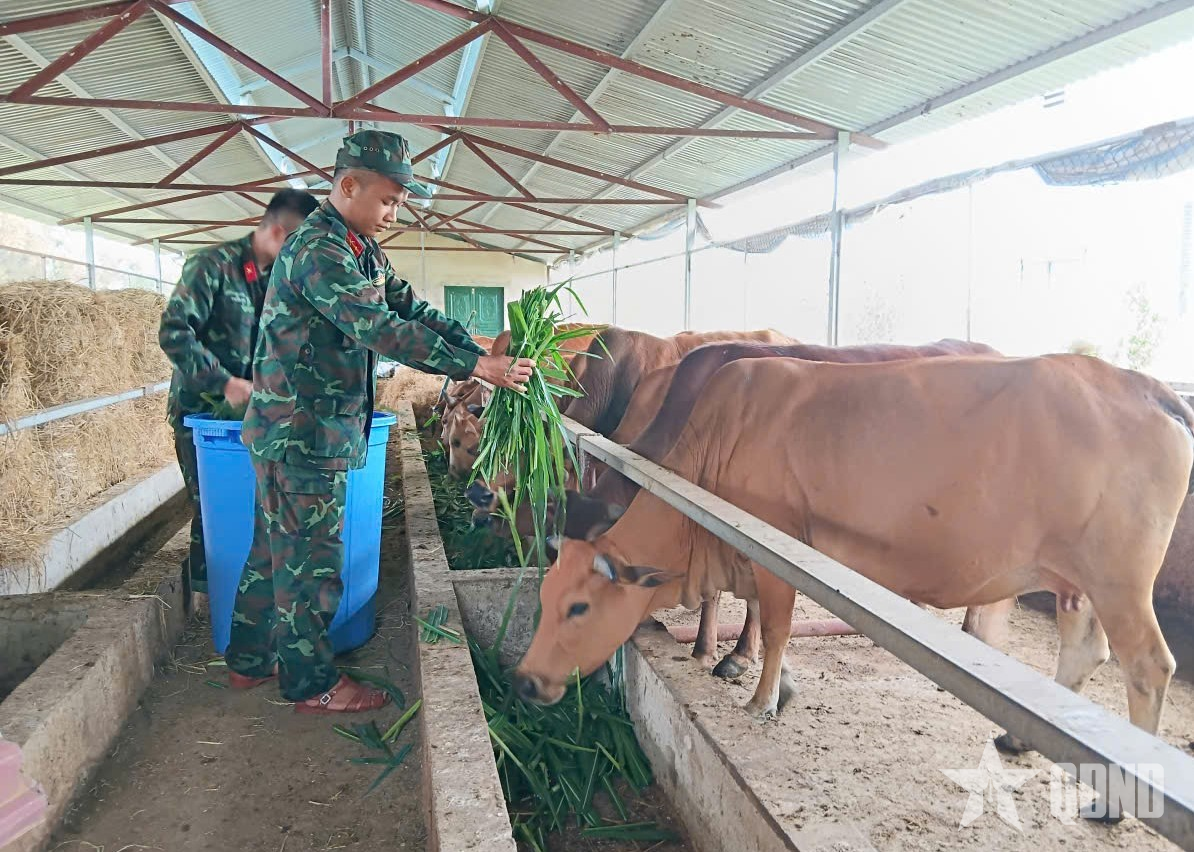 |
Soldiers of the 82nd Regiment care for the cattle herd at the regiment's processing station. |
Accompanied by Major Tran Van Ha, Assistant Quartermaster of the regiment, on a visit to the unit's agricultural production area, we witnessed firsthand the lush green vegetable garden ready for harvest, including kohlrabi and cabbage, surrounded by a comprehensive irrigation system. In the fish pond area, hundreds of laying ducks swam; on the hillside in front, a herd of cows grazed peacefully.
Major Tran Van Ha said: "This is a model of cattle farming in confinement combined with natural grazing implemented by Battalion 2. Recently, due to the frequent outbreaks of African swine fever in the area, in addition to maintaining the required number of pigs, the Regiment's command directed the battalions to switch to raising grass-fed livestock from the production fund of each unit, focusing on a model of breeding cows in confinement combined with natural grazing. This model has been implemented by the battalions since the beginning of 2024. Currently, each unit maintains 10-15 cows; the regimental processing station regularly has 40-50 cows. To ensure the effectiveness of this model, the unit selects native cattle breeds with high weight gain potential, adaptability to the climate, weather, and feed sources in the unit; and selects breeding cows that have reached reproductive age. The main feed for the cows is roughage: natural grass, banana trees; in addition..." The unit planted 300m² of elephant grass and 200m² of corn and cassava in the hillside area. The processing station organized on-site milling to supplement the concentrated feed for the cows; the soybean pulp was utilized to fatten the herd."
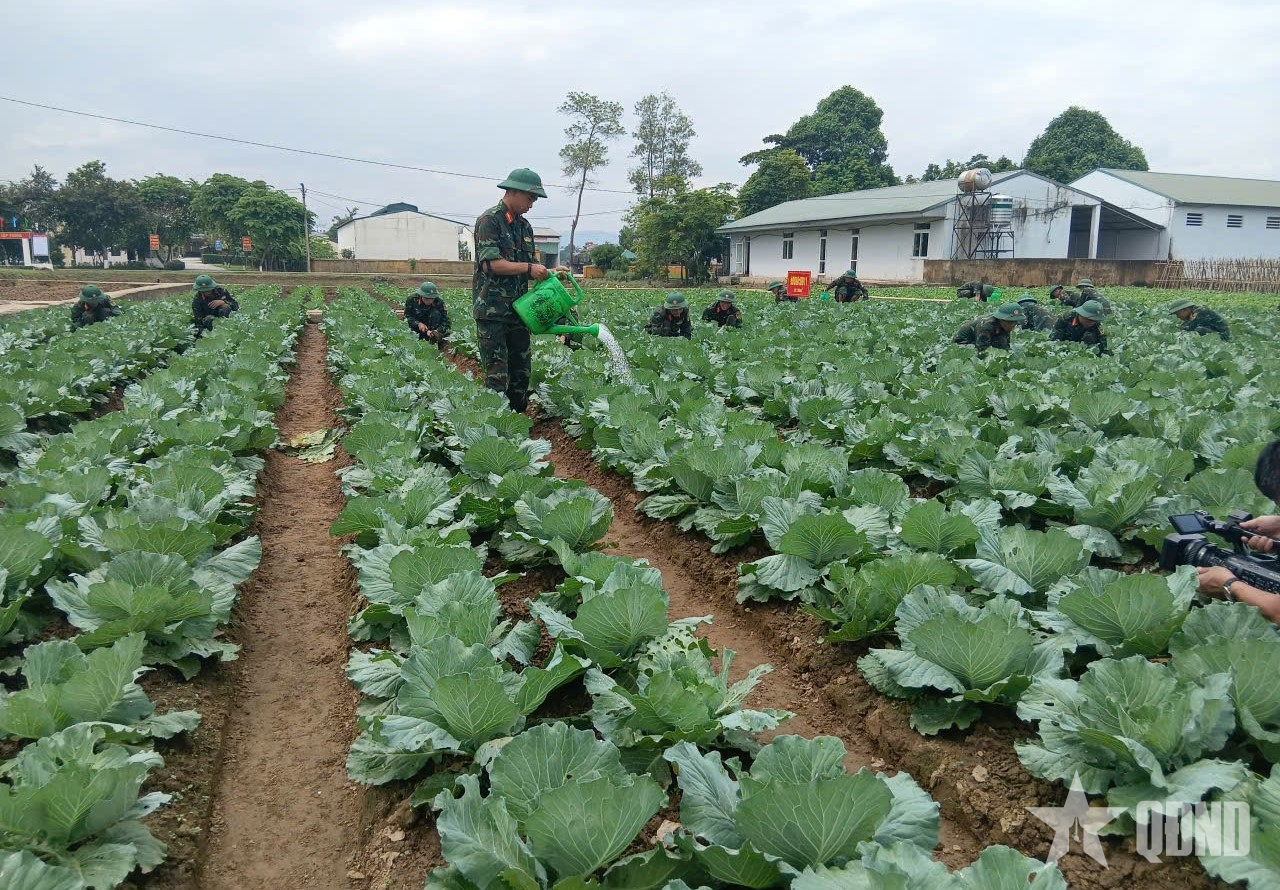 |
| Soldiers of Battalion 3, Regiment 82, Division 355, Military Region 2, tend to a vegetable garden. |
Besides the model of raising cattle in confinement combined with natural grazing, Regiment 82 is currently effectively implementing a large-scale poultry farming model. This model is implemented at the regiment's processing station and its subordinate battalions and companies, with a scale of 3,500-4,000 meat poultry, including: hybrid Ri chickens, Tam Hoang chickens, Super ducks, and French geese, covering an area of 1,150 m² ; and raising 800-1,000 egg-laying ducks on an area of 350 m² .
Lieutenant Colonel Nguyen Van Huu further shared: "During the breeding process, the unit focuses on ensuring biosafety. The unit builds semi-permanent, dry, well-drained livestock pens that prevent leaks, protect against drafts, and provide warmth in winter. The breeding area is clearly separated from other areas and far from the soldiers' living quarters. A lime pit is dug in front of the breeding area for disinfection, and only breeders are allowed to enter and exit the pens. Anyone wishing to enter the area must strictly adhere to disease prevention regulations: wear protective clothing, boots, and disinfect as required. The unit carries out veterinary hygiene and regular vaccinations according to each breed of animal. After harvesting, a thorough cleaning is organized, including spraying disinfectant, spreading lime for disinfection, clearing bushes, unclogging drains, and preparing for the next batch… From the beginning of 2025 to the present, Regiment 82 has harvested 28.81 tons of poultry meat, reaching 71.7% of the meat quota; and 9.1 tons of eggs." "Hold it, reaching 50% of the required amount for inclusion in soldiers' meals."
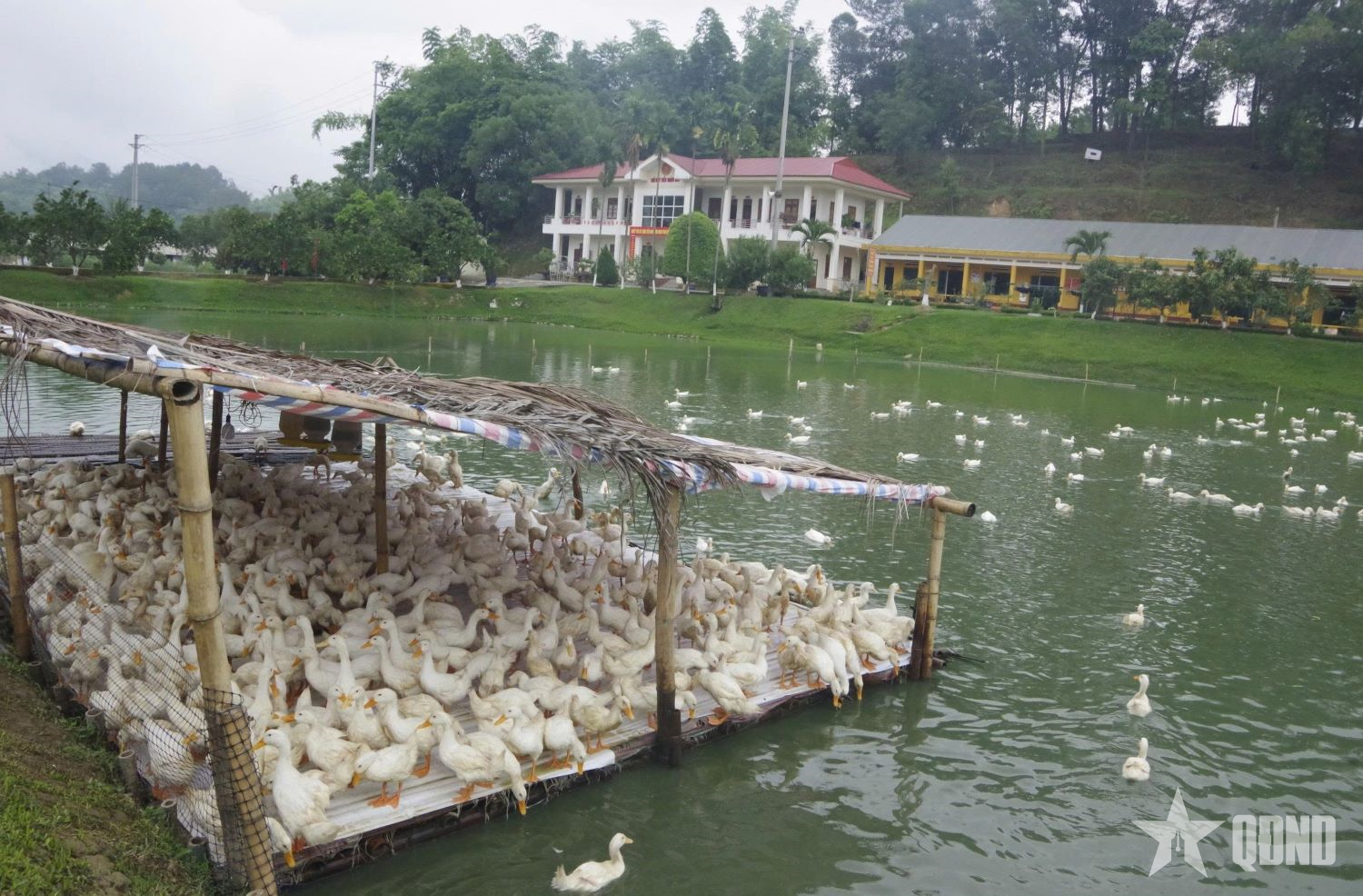 |
| Model of duck farming for meat production at Battalion 1, Regiment 82, Division 355, Military Region 2. |
Closely monitoring the weather and climate conditions, the Logistics and Technical Branch of Regiment 82 is currently advising the unit's commanders and coordinating with relevant agencies and units to continue converting 100% of the winter vegetable crop area. The structuring includes 50% of the area for cabbage and kohlrabi; 10% for green beans, long beans, and okra; 20% for various types of leafy vegetables: mustard greens, Chinese cabbage, sweet cabbage, and Chinese cabbage; 5% for various herbs; and 15% for high-quality vegetables in preparation for the Lunar New Year, including potatoes, onions, carrots, and cauliflower. The trellis system for gourds and pumpkins, covering 4,500 m² , is developing well and is ready for harvest.
Lieutenant Colonel Bui Ngoc Tuyen, Commander of Regiment 82, emphasized: "The Party Committee and the regiment's command have determined that agricultural production and troop sustenance are not only the responsibility of the logistics sector, but also the responsibility of all agencies and units. The unit always fosters a sense of self-awareness, creativity, and initiative among officers and soldiers to overcome all difficulties, ensuring that agricultural production and livestock breeding achieve the highest efficiency, contributing to improving the quality of training, combat readiness, and all aspects of work in the unit."
Source: https://www.qdnd.vn/quoc-phong-an-ninh/xay-dung-quan-doi/thuc-tuc-binh-cuong-o-trung-doan-82-1013033



![[Image] Close-up view of the interchange connecting the two expressways and Long Thanh Airport.](https://vphoto.vietnam.vn/thumb/1200x675/vietnam/resource/IMAGE/2026/05/25/1779703378210_ndo_br_z7863716673926-224453a31600126cce10622af6290afd-4549-jpg.webp)






























































Comment (0)