

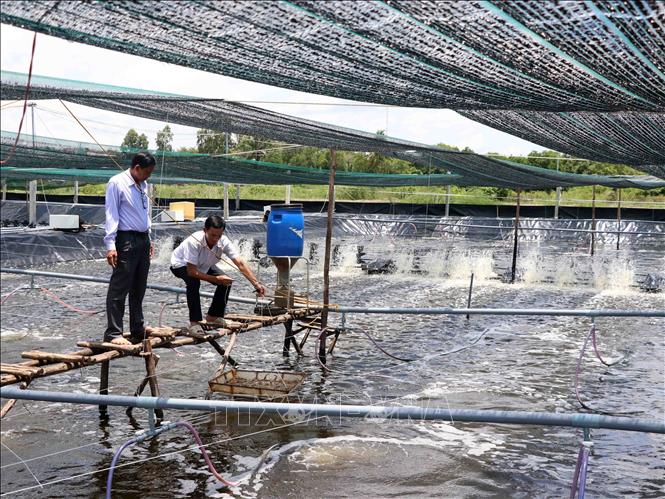
Businesses and farmers are transitioning to green and circular production.
In the context of the rapidly developing aquaculture industry, finding sustainable production models that ensure both productivity and environmental protection has become an urgent requirement. According to experts, although it has become one of the important economic sectors, bringing in significant export value, Vietnam's aquaculture industry still relies mainly on natural resources and ecosystems. For sustainable development, the aquaculture industry needs to shift from resource-based to a circular economy model, applying high technology and greening the value chain (circular farming, clean energy, reduced emissions, water and resource conservation).
According to the Vietnam Association of Seafood Processing and Export (VASEP), the shift towards a green and circular economy is a general trend across the entire industry, with many businesses investing in circular production models and sustainable aquaculture to meet the demands of environmental regulations and standards from partners and import markets, in line with international requirements on environment, trade, and disease prevention.
In the Mekong Delta, many large corporations and businesses involved in aquaculture, processing, and exporting seafood, as well as those supplying raw materials (seedlings, feed, biological products, equipment, and aquaculture technology), are shifting to circular, high-tech, and clean production methods, reducing greenhouse gas emissions and ensuring compliance with international environmental certifications. Among these, integrated shrimp-mangrove farming models, natural ecological farming without the use of drugs or chemicals, and recirculating aquaculture systems with no wastewater discharge are improving productivity and product quality, gaining favor in both domestic and international markets.
Minh Phu, Vietnam's leading seafood group with products available in over 50 countries and territories, has achieved 7 international certifications for shrimp farming across four types: mangrove shrimp, rice-field shrimp, industrial shrimp, improved extensive shrimp farming, and integrated farming. The group is focusing on developing its mangrove shrimp brand, with 5 projects already receiving international certification, primarily implemented in Ca Mau and An Giang provinces, involving 4,679 farming households and covering an area of 17,963 hectares.
De Heus (Netherlands), a company specializing in animal feed production, is collaborating on the implementation of a water-saving recirculating aquaculture system (RAS-IMTA) for shrimp farming in Ca Mau province, initially covering 100 hectares and aiming to expand to 1,500 hectares. De Heus is committed to supporting the transformation of aquaculture into a green, recirculating, and environmentally responsible system to meet the Net Zero 2050 goals; assisting shrimp farmers in increasing production efficiency, ensuring export-standard products, and contributing to reduced emissions and environmental protection through green growth.
While aquaculture businesses with existing potential are strongly transforming towards circular production and greening shrimp farming, farmers, in response to this general transformation trend, have also proactively participated in pilot programs and projects on circular farming models with the support of the local agricultural sector and sponsors, as well as the collaboration of businesses.
Ms. Dang Thi Loan's family in Vinh Hau commune, Ca Mau province, is one of the first households to participate in the recirculating aquaculture project combined with mangrove forest restoration, implemented jointly by the International Union for Conservation of Nature (IUCN) and the Coca-Cola Foundation. With over 1.5 hectares of shrimp and crab farming in a recirculating pond system, after a year of piloting, Ms. Loan said that thanks to technical advice and guidance, and environmental restoration, the shrimp and crabs are developing well, are of good quality, and losses are avoided thanks to the mangrove forest acting as a protective habitat for the aquatic life.
“Many years ago, raising shrimp and crabs in mangrove ponds was very advantageous; the shrimp and crabs grew large, had firm flesh, and the farming time was short. Later, we encountered many difficulties due to seed sources, diseases, and the impact of climate change, environmental factors, and water sources, so the farming time increased and productivity decreased. Now, participating in this recirculating aquaculture project, our biggest hope is to improve our livelihoods and income,” Ms. Loan shared.
Promoting green aquaculture in the Mekong Delta
Digital transformation – green transformation, circular production – is a mandatory requirement for the entire economy today, and the fisheries sector, in particular, is oriented towards green aquaculture and seafood processing, environmental protection, improving people's livelihoods, and enhancing the quality, value, and brand of Vietnamese seafood products for sustainable development.
The national strategic orientation for sustainable development of agriculture in general and fisheries in particular is defined in the resolutions of the Central Committee of the Communist Party of Vietnam, 11th and 12th terms, on proactively responding to climate change, strengthening resource management and environmental protection; and the National Plan for Adaptation to Climate Change for the period 2021-2030, with a vision to 2050.
Sustainable aquaculture development is also emphasized in Government Resolution 46/NQ-CP on promoting agricultural industrialization, encouraging the development of green, sustainable agriculture that adapts to climate change, protects the environment, and ensures national food security; proactively preventing and minimizing damage from natural disasters; and is concretized in the Project on Sustainable Aquaculture Development in the Mekong Delta region until 2030 of the Ministry of Agriculture and Rural Development (now the Ministry of Agriculture and Environment ).
According to Dr. Pham Trong Thinh, a climate change expert at IUCN, based on the national strategic orientation for sustainable aquaculture development, it is necessary to continue implementing solutions to enhance resilience and adaptability, mitigate natural disaster risks, and reduce the damage caused by climate change. Simultaneously, it is essential to build and improve institutions and policies; develop human resources, science and technology, financial resources, investment, and international cooperation.
“Along with applying new technologies in aquaculture such as recirculating aquaculture, biofloc farming, automation technology, AI, microorganisms, renewable energy, and the use of biological products, localities in the Mekong Delta should also apply sustainable farming methods such as shrimp farming combined with mangrove forests, biologically balanced shrimp farming, pond renovation, and linking production and consumption chains,” suggested Dr. Pham Trong Thinh.
In fact, provinces and cities in the Mekong Delta are implementing sustainable aquaculture programs adapted to climate change to develop green seafood products for export. Ca Mau province, with its three sides bordering the sea, is the national aquaculture center, possessing a unique marine ecosystem, wetlands, and mangrove forests, creating favorable conditions for developing a green and circular economy. It is promoting programs to develop shrimp and crab farming under mangrove forests, shrimp-rice farming, and ecological shrimp farming, among others.
To date, Ca Mau has approximately 48,000 hectares of shrimp farming under mangrove forests. Ca Mau mangrove shrimp has achieved 9 international certifications (with nearly 22,000 hectares certified and a production of about 10,000 tons). Ca Mau is also developing and gradually expanding the model of super-intensive whiteleg shrimp farming using a closed-loop recirculating water system, without wastewater discharge, and applying RAS-IMTA technology.
Can Tho City currently has approximately 97,000 hectares of aquaculture (including 52,490 hectares of brackish water shrimp, 915 hectares of pangasius catfish, and 43,673 hectares of freshwater fish and other aquatic products). The Can Tho Department of Agriculture and Environment states that brackish water shrimp plays a key role and is a decisive factor in the city's aquaculture economic growth. To improve farming efficiency and address the challenges, Can Tho is applying effective and environmentally sustainable farming models, including recirculating aquaculture systems (RAS) in intensive shrimp farming.
As one of the country's major "fishery hubs," and the birthplace of pangasius and basa fish, An Giang province has identified agriculture, forestry, and fisheries as the pillars of its economy for the period 2025-2030. Accordingly, An Giang will focus on developing a green and circular economy linked to in-depth agricultural development; promoting the development of clean, organic, and high-tech agriculture, reducing emissions and adapting to climate change; strengthening value chain linkages, and building brands for key agricultural and aquatic products.
The Mekong Delta is the largest aquaculture production center, accounting for approximately 95% of pangasius fish production and 70% of shrimp production, and about 60% of the country's total seafood export value. However, it is also one of the most vulnerable regions in the world , facing numerous serious challenges from climate change, saltwater intrusion, drought, erosion, land subsidence, freshwater scarcity, pollution, migration, and unsustainable production practices. Transforming production towards green and circular approaches, with the aquaculture sector as the main driver, is key to the sustainable development of this delta region.
Source: https://baotintuc.vn/kinh-te/thuy-san-dan-dat-chuyen-doi-xanh-o-dong-bang-song-cuu-long-20251219075557147.htm

![[Photo] Prime Minister Pham Minh Chinh attends the Conference on the Implementation of Tasks for 2026 of the Industry and Trade Sector](/_next/image?url=https%3A%2F%2Fvphoto.vietnam.vn%2Fthumb%2F1200x675%2Fvietnam%2Fresource%2FIMAGE%2F2025%2F12%2F19%2F1766159500458_ndo_br_shared31-jpg.webp&w=3840&q=75)



































































Comment (0)