

.jpg)
There have been many changes in people's lives compared to the past.
But overall, their fundamental traditions still hold a dominant influence on the thinking and actions of the highlanders surrounding this cloud-covered mountain peak.
The Spirit of Rice, the God of Water, and the rhythm of life of the Ca Dong people.
In the latter half of the annual rainy season, on the eastern slopes of the Ngoc Linh mountain range, the Ca Dong people begin their rice cultivation season.
After farming, a Ca Dong family has many other tasks to do. Most of them create their own tools for farming and forestry.
The gods Wing and Ya Co – the water gods – reign throughout the vast mountains and forests; as environmentalists put it, "as long as there are trees in the forest, there will be water."
The importance of water sources and irrigation channels is not only crucial for the survival of the local people but also profoundly influences their mindset.
Nowadays, slash-and-burn farming on steep mountain slopes is not as common as it used to be, but the Ca Dong people still consider upland rice a stable source of food reserves.
There are many traditional rituals associated with rice cultivation from the beginning to the end of the season. In these rituals, the Rice God holds the most important position.
The Ca Dong people believe that the spirit of the rice will favor the homeowner who knows how to properly perform the rituals of bringing the spirit of the rice from the granary to the fields at the beginning of the season, pruning and welcoming the spirit of the rice from the fields back to the granary on the first day of harvest.
.jpg)
Amap horn
The Ca Dong people are attached to the Amap horn, an ancient and minimalist instrument made from fern stalks, but its soft and delicate sound can resonate far across the community and the surrounding forest hills.
They play the Amap horn at cultural festivals, especially during the Spring Festival.
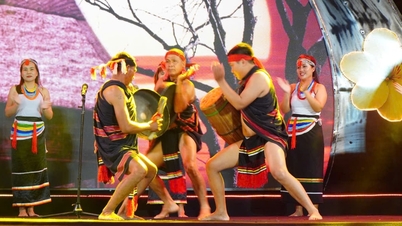
While the summit of Ngoc Linh Mountain was still shrouded in white clouds, the sound of the Amap horn rose. The horn's melody, sometimes soaring like the wind in the mountains, sometimes deep and resonant like a babbling stream, urged the Ca Dong boys and girls to don their new traditional clothing.
The village elder lit the first incense stick of the year. The sound of drums and gongs echoed in the fresh breeze.
Somewhere on the mountainside, the sound of the Amap horn resonates, carrying the lifeblood of the plants and trees, the silent rhythm of the vast forest after a long, dry, cold season.
When the Ca Dong people hear the sound of the Amap horn, they understand each other's feelings between young men and women in the village, between relatives in the community, and also their connection with the forest world .
The sound of the trumpets blended with the gentle rustling of the wind in the pristine mountains, allowing them to temporarily forget the hardships of their daily lives.
Living in harmony with the mountains and forests
After the rainy season has passed and the rice has been harvested and stored, the Ca Dong people prepare their gardens, fences, and take care of their homes.
If one were to find a profound meaning in the lives of the Ca Dong community on the eastern slopes of the Ngoc Linh mountain range, it would be their self-possessed way of adapting to their remote highland environment.
There have been many fundamental changes compared to their previous beliefs and ways of life, but deep down in their hearts, they still retain a sense of friendliness and harmony with the natural environment where they live.
In any harsh mountainous environment, they have managed to overcome the challenges using primitive methods to survive, or at least they have adapted and naturally endured the unique living conditions.
Today, although living conditions and the forest ecosystem are no longer as mysterious as before, leading to the complete dependence of highlanders on supernatural forces, what remains in the depth of their ethnic culture is enough for them to adapt to their living circumstances.
For them, after all the struggles for daily sustenance, there is something far more sacred and profound in the communication between people and between people and the supernatural world.
Although life has changed today, ancient beliefs and customs remain an invisible, silent thread connecting them to the mountains and forests.
All of this reflects a quiet yet enduring spiritual world, where humans harmonize with nature to survive, to love, to preserve cultural traces, and at the same time reflect the depth of ethnic identity that is still present in contemporary life.
Source: https://baodanang.vn/tieng-ken-amap-บน-dinh-may-phu-3323544.html


![[Image] Hanoi's urban life under the challenge of a "scorching hot" environment](https://vphoto.vietnam.vn/thumb/1200x675/vietnam/resource/IMAGE/2026/05/25/1779706979265_nang-nong-t5-2026-minh-duy-7-4636-jpg.webp)

![[Image] Close-up view of the interchange connecting the two expressways and Long Thanh Airport.](https://vphoto.vietnam.vn/thumb/1200x675/vietnam/resource/IMAGE/2026/05/25/1779703378210_ndo_br_z7863716673926-224453a31600126cce10622af6290afd-4549-jpg.webp)




















































































Comment (0)