


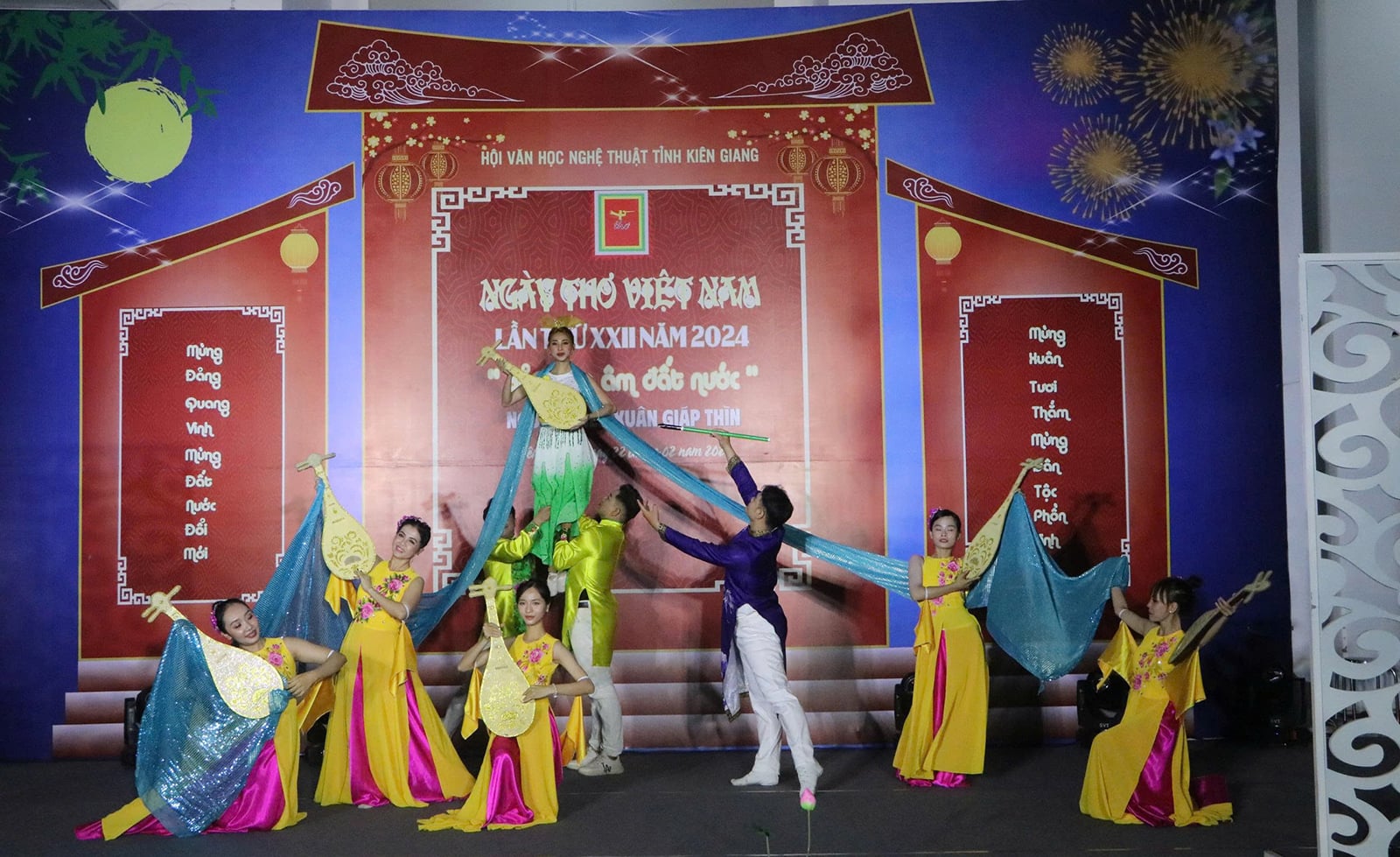
The Provincial Federation of Literature and Arts Associations maintains the tradition of organizing the annual Vietnamese Poetry Day. Photo: TIEU DIEN
Literature has always been intertwined with history and social life. In turbulent regions like the Mekong Delta, literature bears the strong imprint of the natural environment, the processes of exploration, migration, adaptation, and cultural coexistence. An Giang – a land at the headwaters, a place where many ethnic communities, religions, and cultural traditions intersect – has long been an inspiring space for writings about the people of the border region, about nature, about working life, and about the subtle yet profound social changes.
Over the years, An Giang literature has made positive contributions to the overall literary landscape of the region and the country. Many works realistically reflect life in rural areas, new urban centers, border regions, coastal areas, islands, and mountainous and lowland areas. Many writers have persistently dedicated themselves to this land with a sense of responsibility and genuine love for their profession, such as Nguyen Quang Sang, Anh Duc, Le Van Thao, Son Nam, Tran Bach Dang, etc. However, looking directly at the reality, it can be seen that local literature is facing many challenges, such as a young generation of writers who have not yet truly inherited the tradition, fragmented support for writing, inadequate promotion of works outside the province, and especially the lack of long-term mechanisms to nurture literary talent.
Contemporary social life places new demands on literature. These include issues of climate change, migration and urbanization, the shift in values within a market economy , and cultural exchange and conflict during integration. Literature cannot remain outside these movements. However, for literature to truly reflect and accompany life, writers need the right conditions for creation, the space for experimentation, and appropriate encouragement.
Government Decree No. 350/2025/ND-CP has approached this issue in a fairly comprehensive way. From supporting creative writing, organizing writing camps, competitions, and literary awards to encouraging translation and promoting works both domestically and internationally; from unlocking social resources to applying digital technology in literary dissemination. If implemented appropriately, these directions will create a more favorable environment for the development of local literature in both quantity and quality. When this Decree comes into effect, local literature will be empowered, spread, and affirm its position in the overall flow of national literature.
For An Giang, the important thing is not to mechanically copy models, but to apply the spirit of Decree No. 350/2025/ND-CP to solve very specific problems of local literature, such as how to ensure writers can create with peace of mind, how to ensure works reach the public, and how to prevent literature from being detached from contemporary social life.
The management of literature and arts in the current period requires a different approach than before. It is no longer management in a purely administrative sense, but rather management in the spirit of companionship, support, and creating a creative environment. Government Decree No. 350/2025/ND-CP, aimed at encouraging the development of literature, has, from this perspective, opened up a flexible space for localities to proactively develop programs suitable to their specific cultural characteristics.
For An Giang, the implementation of Decree No. 350/2025/ND-CP needs to be closely linked to the practical realities of local literary life. First and foremost, it requires adequate attention to the existing writing community, while simultaneously creating conditions to discover and nurture young writers. Literature can only develop sustainably through generational continuity, when young writers are encouraged to experiment, their initial explorations are accepted, and they are guided by experienced writers.
Furthermore, literature should be viewed in its organic relationship with other aspects of cultural and social life. Literature can accompany education, tourism, and media; it can contribute to building the image of the people and land of An Giang in the public consciousness. The promotion of literary works should not be limited to traditional print publishing but should utilize digital platforms and various forms of interaction to introduce authors and their works in a flexible and accessible way to today's audience.
Literature not only creates works but also contributes to shaping the spiritual essence of a region. An Giang, being a headwater region with diverse ecological environments and multiple layers of culture, has literature as a repository of memories, a reflection of the present, and a beacon for the future. Decree No. 350/2025/ND-CP, if implemented with a long-term vision and a proactive spirit, will be the necessary impetus for the literary flow of the riverine region to continue to spread, endure, and deepen in contemporary life.
TRAN SANG
(Vice President of the Provincial Federation of Literature and Arts Associations)
Source: https://baoangiang.com.vn/tiep-suc-cho-van-hoc-an-giang-a474290.html
![[Photo] Walking amidst the coffee blossoms in the Central Highlands](https://vphoto.vietnam.vn/thumb/1200x675/vietnam/resource/IMAGE/2026/02/22/1771736214034_ndo_bl_img-3460-8365-jpg.webp)


































Comment (0)