

“An independent and self-reliant economy does not mean that Laos has to produce and manufacture everything itself, but rather aims to reduce dependence through the most efficient use of the country's natural resources and other potential sectors.”
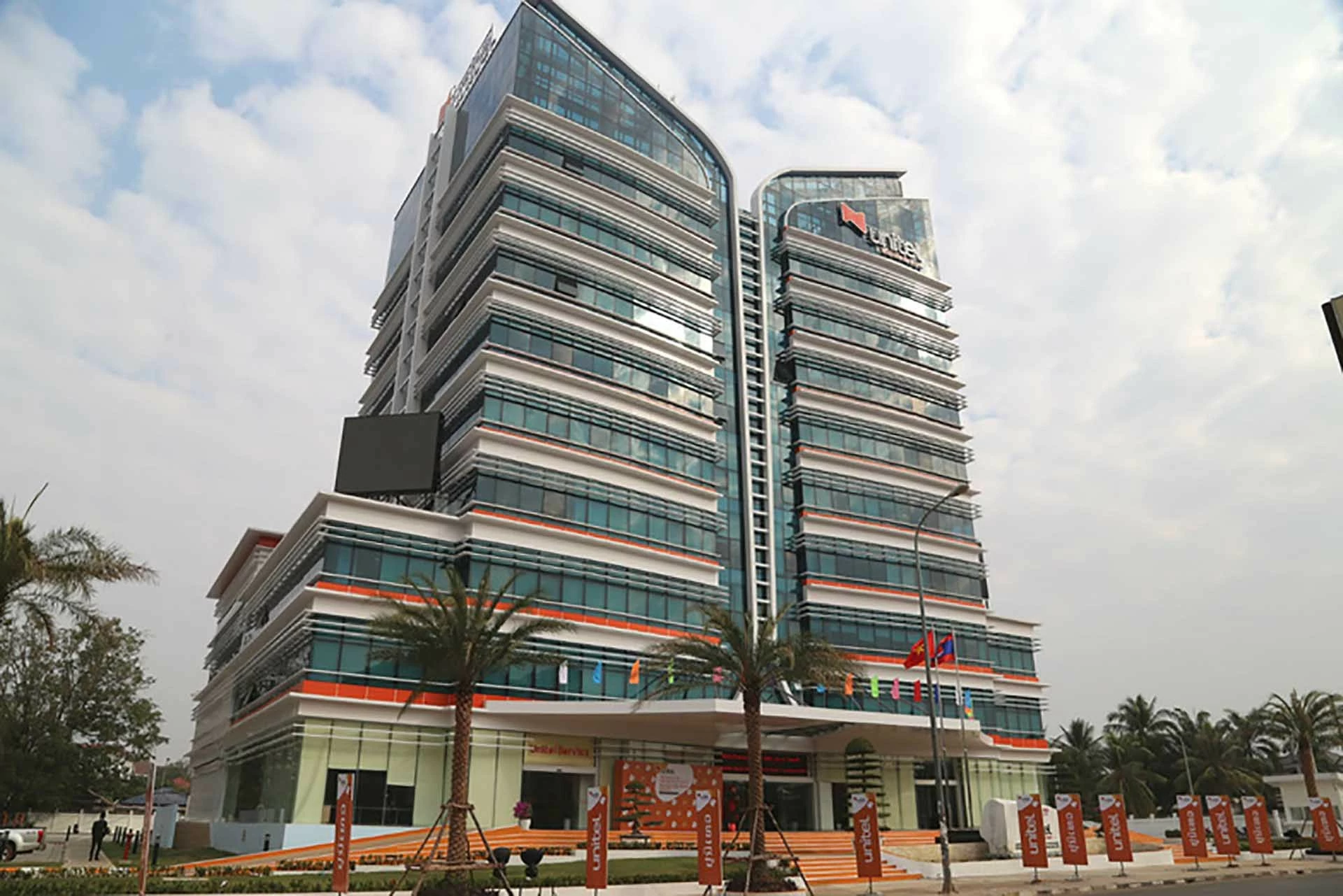 |
| The headquarters of Unitel - a mobile network joint venture between Viettel and Lao Asia Telecom - in Vientiane. (Source: ttdn.vn) |
Lao Party General Secretary and President Thongloun Sisoulith made the above statement at the National Conference of the Finance Sector in January 2024, in the context of an economy heavily dependent on external factors, such as imports to meet domestic consumption, and a factor that makes the economy fragile and vulnerable when faced with external shocks and disruptions.
Towards an independent and self-reliant economy.
In his report on the implementation of the national socio-economic development plan at the seventh session of the 9th National Assembly of Laos (June 10), Lao Prime Minister Sonexay Sipandone stated that, despite complex developments in the region and internationally, and continued economic difficulties, many opportunities have emerged and outstanding achievements have been made.
As a result, in the first six months of 2024, the Lao economy showed a stronger GDP growth trend, reaching 4.7% (approximately 148,043 billion Kip, equivalent to 6.8 billion USD), a decrease of only 0.1% compared to the same period in 2023 and achieving 50.4% of the annual target. This growth was mainly driven by increased activity in tourism and related services, transportation, wholesale and retail trade. The expansion of agricultural production, along with contributions from the construction and processing industries, also positively impacted the economy.
Since the beginning of 2024, the Lao government has been aggressively pursuing the goals in its national agenda to address economic and financial challenges, such as controlling inflation, exchange rates, commodity prices, and foreign debt.
Laos expects GDP growth to reach its target of 4.5% in 2024. At a recent national conference of the finance sector, Mr. Thongloun Sisoulith stated that the government will quickly introduce new policies to create momentum for a transformation in the economic system, moving from its current state of over-dependence towards independence and self-reliance, and becoming more self-sufficient. Importantly, the focus will be on ensuring that more Laotians participate in this process.
In outlining the concept of an independent and self-reliant Lao economy, the Lao leader requested economists, researchers, scholars, and organizations to examine, analyze, and shape this economic model to better suit the country's circumstances.
Affirming that the Lao economy needs to integrate more with the global economy, the Lao leader also emphasized the need to sustainably commercialize and capitalize on the country's natural resources and export products to a broader global market.
Considering that simply borrowing or selling bonds to repay debt is inappropriate as it would only increase debt, General Secretary and President Thongloun Sisoulith instructed the finance sector to make every effort to ensure efficient revenue and expenditure in order to strengthen the budget and reduce foreign exchange risks...
Ready for the digital economy
Analyzing the economic situation in Laos, Professor Phouphet Kyophilavong, Head of the Faculty of Economics and Business Administration at the National University of Laos, stated that external factors affecting Laos include the US Federal Reserve's interest rate hikes, rising oil and food prices, and geopolitical conflicts. Therefore, to achieve economic goals, the Lao government needs to develop various policies, particularly finding suitable solutions to address economic and financial issues. Increased investment in the energy sector, especially renewable energy, and special economic zones will help boost the growth of Lao industry. Meanwhile, to support economic recovery in the short and medium term, the government should focus on foreign exchange issues, raising interest rates, issuing more bonds, and controlling the money supply.
Meanwhile, in the long term, international analysts comment that the challenge facing the Lao economy today is finding a path to sustainable development. Therefore, the goal of "leveraging digital technology and innovation to promote development," as set forth by Prime Minister Sonexay Siphandone at the 80th Session of the Economic and Social Commission for Asia and the Pacific in Bangkok (July 2024), is a very worthwhile option.
Accordingly, Prime Minister Sonexay Siphandone called for strong action to utilize digital technology and innovation to accelerate the implementation of the Sustainable Development Goals (SDGs), while urging developed countries to help the developing world maximize the benefits of digitalization. He argued that leveraging digital innovation for sustainable development can help address challenges at the national, regional, and global levels.
According to the Vientiane Times , at this international event, the Lao leader stated that, in order to leverage digital technology in the country's context, the Lao government has adopted the 20-year National Digital Economy Development Vision (2021-2040), the 10-year National Digital Economy Strategy (2021-2030), and the 5-year National Digital Economy Development Plan (2021-2025).
This “digitalization campaign” is therefore closely linked to Laos’ national socio-economic development plans, aiming to promote socio-economic transformation while fostering sustainable development and balanced green growth. This strategic plan also emphasizes the need for high-quality human resources, modern information technology infrastructure, environmental protection, and robust cybersecurity.
To promote the realization of the aforementioned strategic plans, Prime Minister Sonexay Siphandone stated that Laos is building favorable conditions and infrastructure domestically by strengthening regional and international cooperation, while simultaneously attracting more foreign investment and the transfer of modern technology, as well as applying emerging scientific and technological achievements, innovations, and creative advancements, with the goal of promoting socio-economic development.
In fact, to develop the digital economy and integrate with global trends, Lao Minister of Technology and Communications Boviengkham Vongdara stated that Laos' telecommunications infrastructure, including high-speed internet services and networks, has covered major cities and economic zones nationwide, ready to serve the development of the digital economy. Among the seven telecommunications and internet service providers in Laos, the two leading providers, Lao Telecom and Unitel (a joint venture with Vietnam's Viettel), have successfully piloted 5G systems.
As Minister Boviengkham Vongdara stated, the Lao government is determined to increase the growth of the digital economy from its current level of less than 5% of GDP to 10% of GDP by 2040. In addition to developing and enacting relevant laws and regulations, Laos prioritizes training its workforce in this field to meet labor demands and realize its strategic vision for a digital economy.
Source: https://baoquocte.vn/lao-tim-co-hoi-tu-kinh-te-so-286027.html




![[Photo] General Secretary and President To Lam presides over a working session with the Central Policy and Strategy Committee on the development of the materials industry.](https://vphoto.vietnam.vn/thumb/1200x675/vietnam/resource/IMAGE/2026/05/21/1779359935432_a3-bnd-3129-1412-jpg.webp)
























































Comment (0)