

Rice prices have fallen sharply.
According to data from the Department of Agriculture and Environment, this year's winter-spring crop saw 76,752 hectares of rice sown throughout the province, reaching 102.34% of the plan; the estimated yield is 8 tons/ha (an increase of 0.3 tons/ha compared to last year); resulting in an estimated production of 614,020 tons, an increase of more than 29,500 tons. However, the sharp drop in rice prices is causing concern among farmers.
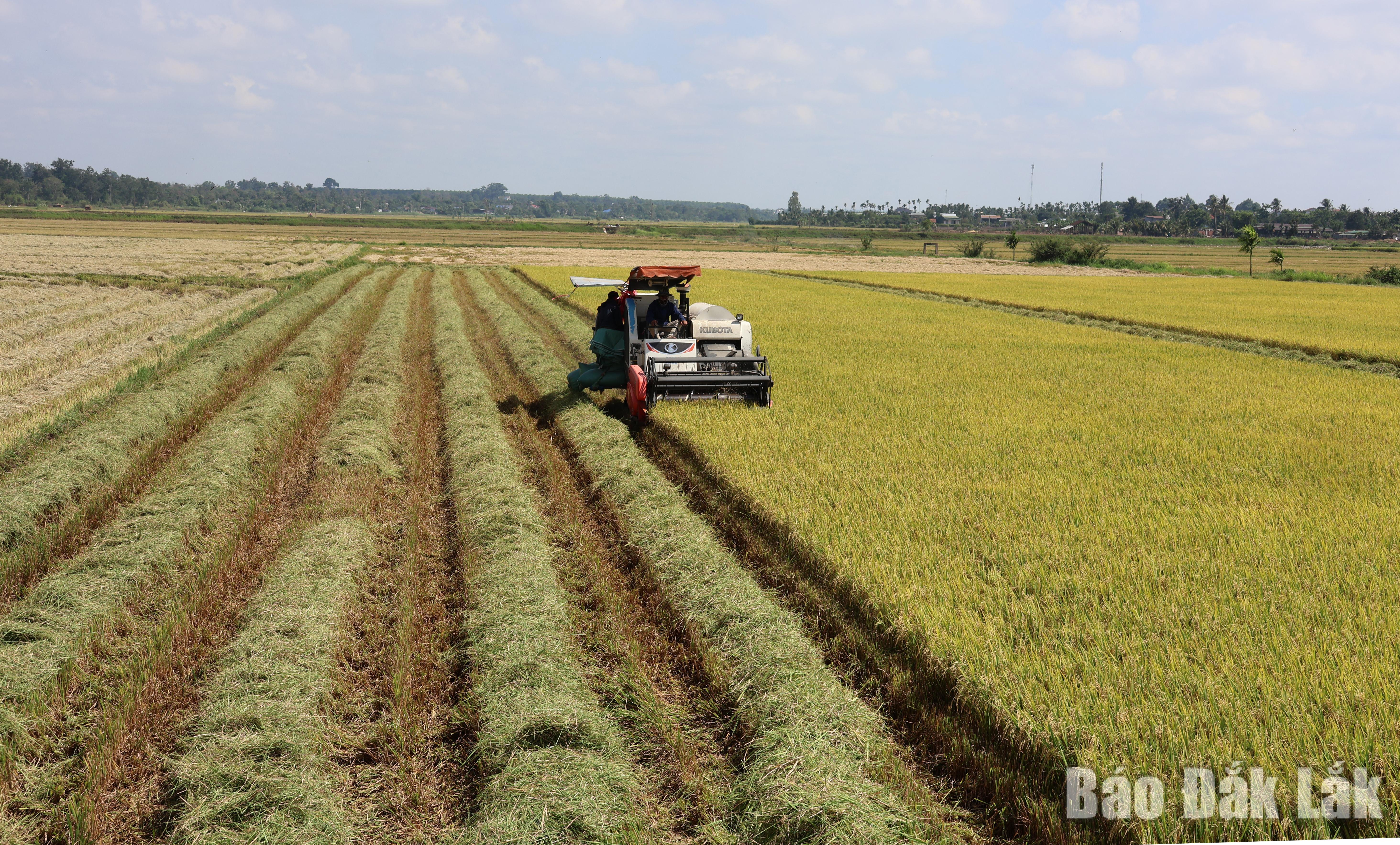 |
| Rice fields being harvested in Ea Kly commune. Photo: Minh Minh |
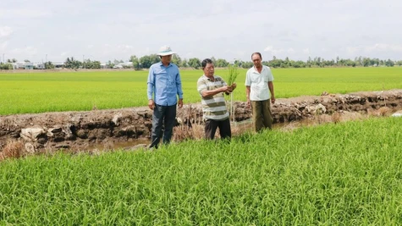
For the 2025-2026 winter-spring crop season, Ms. Duong Thi Lien's family (village 1, Binh Hoa, Krong Ana commune) planted 2 hectares of rice, with a yield of approximately 10 tons per hectare. However, the total expected revenue from the entire area is only about 120 million VND due to the extremely low rice prices. “Compared to years when rice prices were stable, on the same 2 hectares, my family earned nearly 200 million VND, with a profit of about 100 million VND. However, this year, rice prices have dropped sharply, even for ST24 and ST25 varieties. Traders are buying them at the field for only over 6,000 VND/kg, while last year farmers sold these varieties for 10,000-11,000 VND/kg,” Ms. Lien said sadly.
Mr. Ho Thanh Hung, Director of Quang Tan Agricultural Service Cooperative, said that this winter-spring crop, the cooperative sowed 665 hectares, mainly with the ST25 rice variety. Currently, the cooperative members have basically finished harvesting, with high yields and quality that is very popular in the market. However, the price of rice is currently too low; traders are buying ST25 rice at only 6,800 VND/kg (fresh rice), which is 3,000 VND/kg lower than in previous years; meanwhile, the price of input materials, labor costs, and harvesting machine costs have all increased by about 10% compared to last year. At this price, farmers are not making a profit.
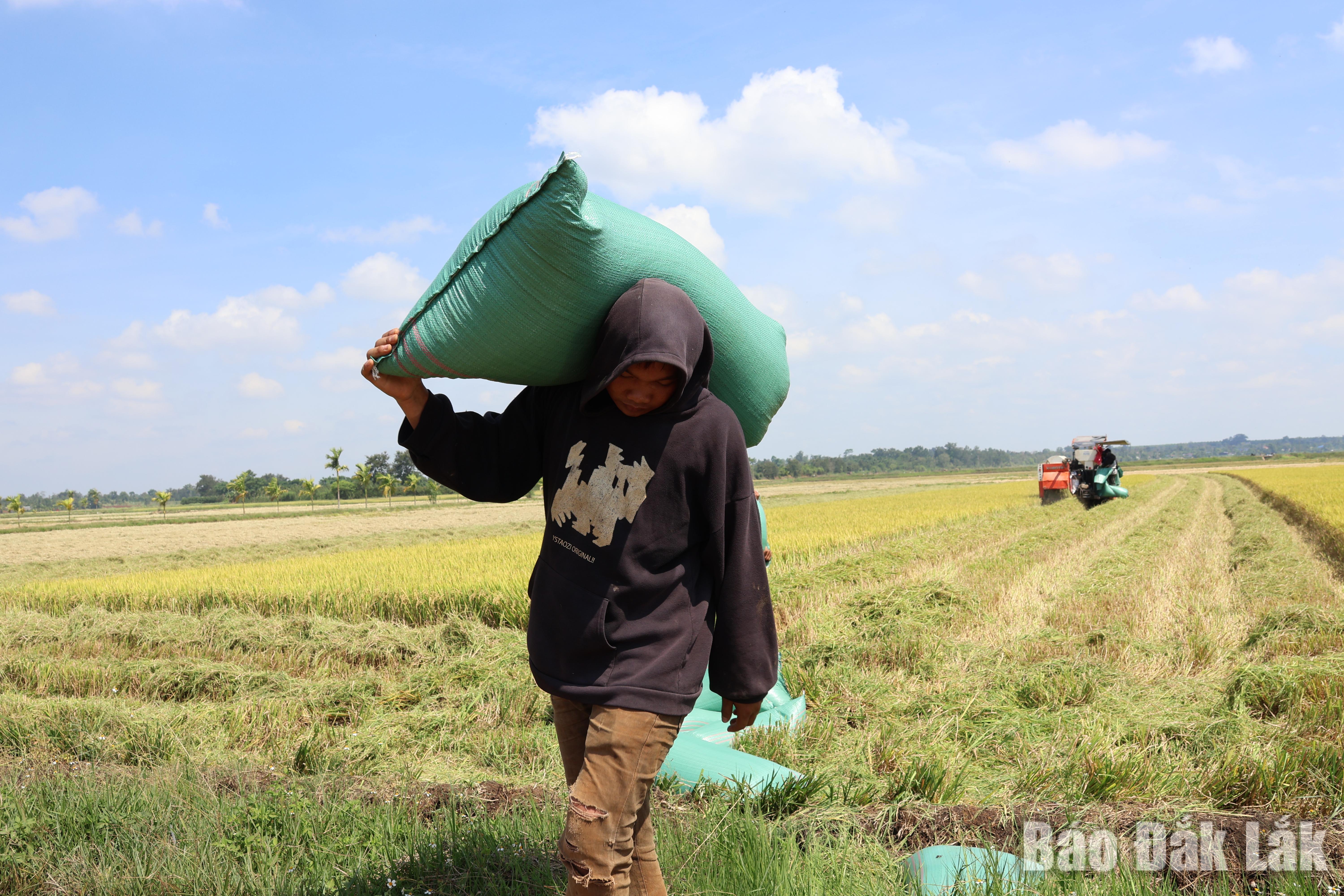 |
| Despite a good harvest, farmers suffered losses in the 2025-2026 winter-spring rice crop due to low prices. Photo: Minh Minh |
A similar situation is occurring in Dak Lieng commune – one of the province's key rice-growing areas with nearly 5,000 hectares of high-quality ST24 and ST25 rice varieties. Ms. Vu Thi Thu (Me Linh 1 hamlet, Triet village, Dak Lieng commune) lamented: "My family planted 2 hectares of ST24 rice, with a yield of about 10 tons/ha. Due to rising prices, production costs have increased to 40 million VND/ha, not including labor costs, an increase of about 10 million VND/ha. However, the price of rice is the lowest in about 10 years, fluctuating between 6,000 and 7,000 VND/kg. This means farmers are losing about 40 million VND per hectare."
Promoting a green production mindset.
Due to its unique climate and soil conditions, rice grown in the western part of Dak Lak province consistently yields high productivity (leading the Central Highlands region) and better quality compared to many other lowland areas. This gives Dak Lak rice a competitive advantage that few other regions possess. However, because there are no processing plants for export, most of the rice is purchased by traders from the Mekong Delta, making the price dependent on these traders.
According to Mr. Ho Thanh Hung, Director of Quang Tan Agricultural Service Cooperative, relying on this distribution channel exposes farmers to price manipulation, unfair competition, and a lack of sustainability. The cooperative's future direction is to strive to find solutions to sign contracts and establish direct distribution chains so that farmers can feel secure from planting to harvesting.
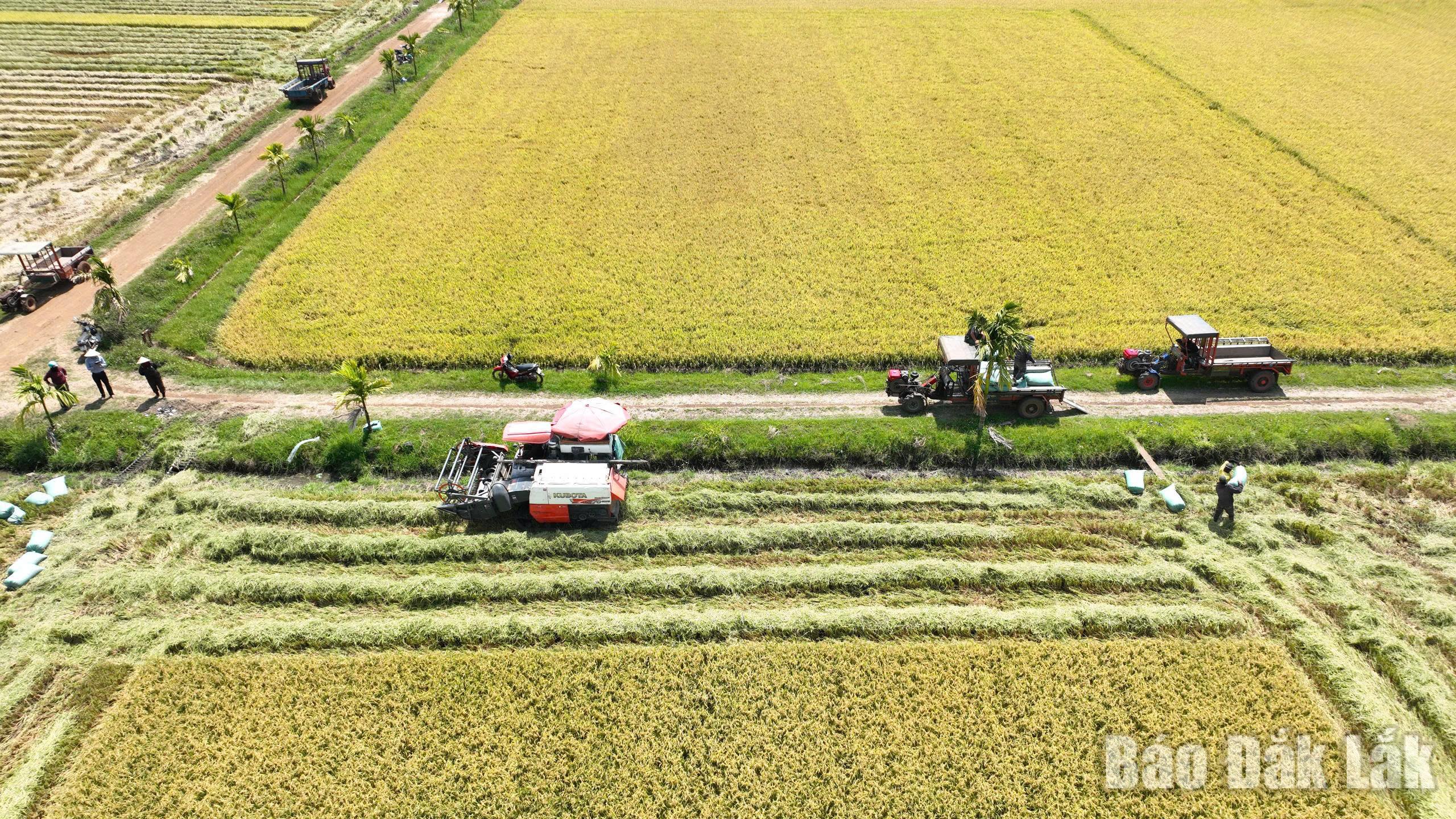 |
| Farmers are facing the dilemma of "bumper harvest, low prices," as rice prices have fallen to their lowest level in 10 years. Photo: Minh Minh |
In Dak Lak province, there are quite a few cooperatives operating in the rice production sector, but the majority of the linked value chains have not yet reached the scale expected. Most local milling factories only have the capacity to process common rice varieties, serving the market within the province or neighboring areas. For high-quality rice varieties like ST24 and ST25 – agricultural products targeting the high-end market – requiring rigorous processing, the locality lacks factories with sufficient capacity for deep processing. Local farmers only participate in the raw production stage, making the formation of a closed, sustainable value chain very difficult.
Currently, key rice-growing areas in the province are promoting the "four-party" linkage to solve the problem of "bumper harvests leading to price drops." Businesses are involved from supplying inputs to guaranteeing product sales, helping farmers feel secure in their production. In the long term, the province encourages and creates the best conditions for cooperatives and businesses to pilot clean rice and organic rice models on a concentrated scale, promoting a green production mindset to enhance the sustainable position of local rice.
Minh Thuan - Van Tiep - Minh Thong
Source: https://baodaklak.vn/kinh-te/202605/tim-huong-phat-trien-ben-vung-cho-cay-lua-6ca73f5/
![[Photo] Standing Committee member of the Party Central Committee Tran Cam Tu working with the Central Inspection Committee](https://vphoto.vietnam.vn/thumb/1200x675/vietnam/resource/IMAGE/2026/05/28/1779969579668_ndo_br_bnd-2495-jpg.webp)























































Comment (0)