

"Sustainable development of one million hectares of high-quality, low-emission rice cultivation linked to green growth in the Mekong Delta by 2030" is a project of great significance to farmers in the Southwest region and the Vietnamese rice industry. Dong Thap and Long An, two provinces in the Dong Thap Muoi region, have actively participated in the project and have initially recorded many positive results.

In reality, the government and farmers are reorganizing the production system along the value chain, applying sustainable farming practices to increase the value of rice, improve the lives of rice farmers, protect the environment, and adapt to climate change…
Good news
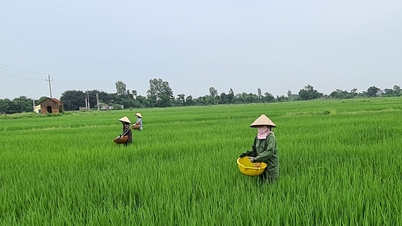
After more than three months of sowing, nearly 50 hectares of rice fields, part of the pilot project "Sustainable Development of One Million Hectares of High-Quality, Low-Emission Rice Cultivation Associated with Green Growth in the Mekong Delta by 2030" (hereinafter referred to as the Project), at Thang Loi Agricultural Service Cooperative, Lang Bien commune, Thap Muoi district, Dong Thap province, have been harvested.
Mr. Tran Tan Dang, one of more than 20 farmers participating in the pilot project in the 2024 autumn-winter crop, said: "I have 2 hectares participating in the pilot project. When harvested, the yield reached more than 7 tons/ha, about 500 kg/ha higher than traditional rice production. The rice quality met the standards stipulated in the project, and the profit was about 4.3 million VND/ha higher than the control rice area."
Many other farmers affirmed that they would continue to participate in the project in the next season. They believe that not burning straw, reducing fertilizer use, reducing the number of pesticide applications, and reducing the amount of seeds sown will reduce production costs, which in turn leads to profit…
Dong Thap is one of five provinces and cities in the Mekong Delta region selected by the Ministry of Agriculture and Rural Development to pilot the project. Thang Loi Agricultural Service Cooperative has pioneered the implementation of the model with nearly 50 hectares. The pilot project will be implemented starting from the autumn-winter crop of 2024 and lasting for three consecutive seasons.
Farmers participating in the model must keep production diaries, attend all training sessions, adhere to the guided procedures, and, importantly, must not burn rice straw in the fields. They receive training in rice cultivation techniques; weekly, technical staff visit the fields to provide timely solutions for pests and diseases, and support policies.
According to Tran Thanh Tam, Head of the Department of Crop Production and Plant Protection in Dong Thap province, the area participating in the pilot project reduced the amount of seeds used to only 70 kg/ha; reduced agricultural supplies; collected and processed straw; and established rice consumption links with businesses... Initial results show that the area participating in the project reduced production costs by more than 1.6 million VND/ha and earned nearly 4.3 million VND/ha more profit compared to the control rice area. Regarding greenhouse gas emissions, CO2 emissions were reduced by 4.92 tons/ha…
In Long An province, the provincial authorities have determined that, in order to successfully implement the Project, farmers must participate in cooperatives; 100% of the area of high-quality, low-emission rice must have linkages between businesses and cooperatives in production and product consumption.
According to Nguyen Thi Dieu Ngan, Director of Vinh Thuan Agricultural Cooperative in Vinh Hung district, Long An province, the greenhouse gas emission standards set forth in the Project have been implemented by the cooperative over three rice seasons and are being further expanded to more members and farmers affiliated with the unit.
For example, planting trees on the edges of rice fields; using biological products to prevent and control pests and diseases in rice... have been successfully applied by the cooperative for many years. To date, the cooperative has more than 1,150 hectares of rice fields applying high technology in production, of which about 100 hectares produce according to VietGAP standards for export to Europe; 50 hectares produce rice seeds; and the remaining about 1,000 hectares cultivate high-quality commercial rice that is purchased by businesses at a price about 3,000 VND/kg higher than the market price at the time of harvest.
Ms. Nguyen Thi Dieu Ngan further shared: "Growing clean rice that meets European standards yields a profit more than four million VND/hectare higher than traditional rice production. The cooperative has a contract with the enterprise for product consumption and quality management."
Farmers are responsible for sowing seeds, controlling snails and weeds, and fertilizing, while the spraying of biological pesticides is carried out periodically by the company. With this approach, farmers are very enthusiastic and it is spreading to many other specialized rice-growing areas in the locality."
With 83 members and partnerships with external farmers, the Vinh Thuan Agricultural Cooperative supplies businesses with approximately 1,000 tons of clean rice each season, meeting export standards for Europe. The cooperative is continuing price negotiations to sign more contracts with businesses to expand its production area…
Replicating the model
Mr. Dinh Quang Hieu, representative of the Institute of Agricultural Environment (Ministry of Agriculture and Rural Development), said that the Institute had monitored and calculated greenhouse gas emissions for nearly 50 hectares of rice fields belonging to farmers in Thap Muoi participating in the pilot project. Accordingly, in the 2024 autumn-winter rice crop, the average reduction in greenhouse gas emissions was 4.92 tons of CO2/ha, equivalent to a 43.4% reduction compared to traditional farming methods. This emission reduction rate exceeds the initial proposal (over 10%).
However, the pilot project also faced some difficulties and limitations, such as: uneven application of fertilizer; the impracticality of draining water from rice fields 12-21 days after sowing; difficulties in collecting straw during the rainy season; and the need for multiple solutions to collect and store large quantities of straw simultaneously.
For the rice production area of Thang Loi Agricultural Service Cooperative participating in the pilot project, the agricultural sector and local authorities will encourage more farmers with adjacent land (over 10 hectares) to join in order to facilitate and improve the efficiency of on-field irrigation. The goal is to increase the area participating in the project in the 2024-2025 winter-spring rice crop in Thap Muoi district to approximately 150 hectares.
According to Nguyen Van Vu Minh, Director of the Department of Agriculture and Rural Development of Dong Thap province, based on the results of the recent autumn-winter rice crop, in the 2024-2025 winter-spring rice crop, the province will have policies to encourage and support farmers to overcome limitations, improve cultivation processes, and better meet the criteria of the project such as: water control, early-season water drainage, pest control, etc.
The agricultural sector will refine solutions to reduce greenhouse gas emissions, such as straw collection and stubble treatment. It will also use practical results to introduce specific methods to farmers to ensure productivity and quality, reduce cultivation costs, increase profits, and contribute to reducing greenhouse gas emissions.
In the 2024-2025 winter-spring rice crop season, Dong Thap province will expand the program to the remaining eight districts with 11 models, covering a total area of over 1,300 hectares, implemented continuously over three seasons. The goal is to have approximately 50,000 hectares of rice participating in the project by 2025 and to increase this to about 161,000 hectares of high-quality, low-emission rice by 2030.
According to the Department of Agriculture and Rural Development of Long An province, by the end of 2025, the entire province will have 60,000 hectares of high-quality rice participating in the Project, and by 2030, this will reach 120,000 hectares. To realize this goal sooner, in the 2024-2025 winter-spring crop season, nine models under the Project will be implemented in localities in the Dong Thap Muoi region of Long An province, covering a total area of over 150 hectares.
In addition, a Japanese company will implement two pilot models at the Hoa Phu Agricultural Research and Service Farm (Chau Thanh district) and a farmer's household in Vinh Tri commune (Vinh Hung district), each model covering 0.5 hectares. These pilot models aim to determine the amount of greenhouse gas emissions from rice cultivation and the reduction in greenhouse gas emissions when applying the alternating flooding and drying method.
Through this, businesses provide in-depth knowledge and skills in sustainable agriculture and carbon credits, and are responsible for connecting farmers with funding from the Joint Crediting Mechanism (JCM), or voluntary carbon credits, to support farmers in promoting green transitions and securing financing for projects and measures to reduce greenhouse gas emissions.
According to Nguyen Minh Lam, Vice Chairman of the Long An Provincial People's Committee, building on the foundation of the High-Tech Agriculture Development Program linked to the restructuring of the agricultural sector towards improving quality and building product value chains over the past three years, Long An province is determined to contribute to the implementation of the "Sustainable Development of One Million Hectares of High-Quality and Low-Emission Rice Specialization Linked to Green Growth in the Mekong Delta by 2030" project as planned.
The province is paying more attention to reorganizing production, consolidating and improving the quality and efficiency of cooperative groups and cooperatives; establishing new cooperative groups, cooperatives, and enterprises that apply high technology in rice production...
Source

![[Image] Nearly 125,000 Hanoi students completed the Literature exam for the 10th grade entrance exam.](https://vphoto.vietnam.vn/thumb/1200x675/vietnam/resource/IMAGE/2026/05/30/1780117233041_ndo_br_thiet-ke-chua-co-ten-2-png.webp)











































































Comment (0)