

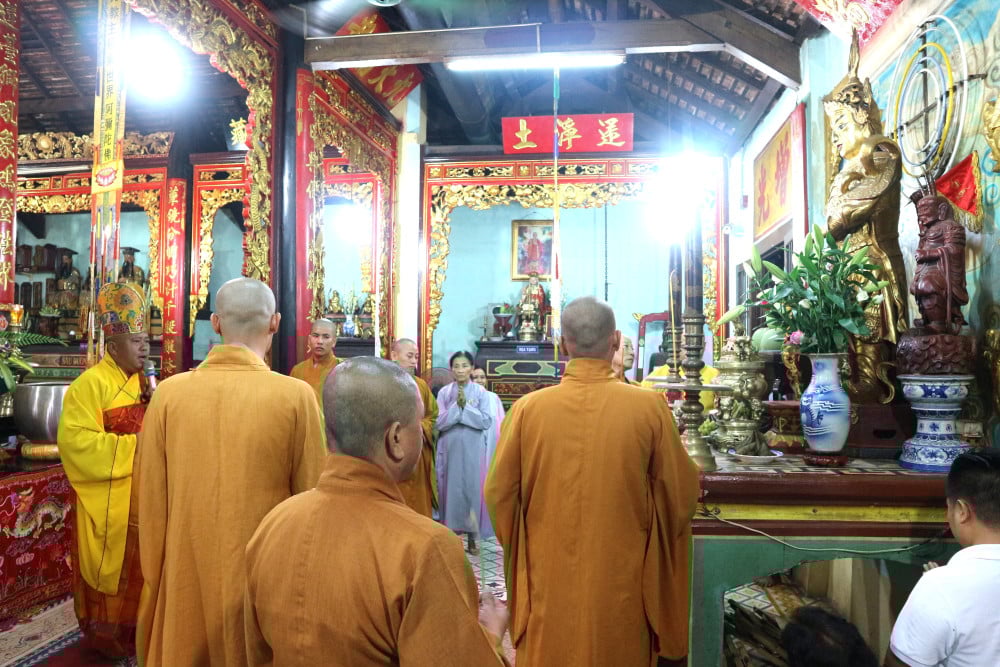
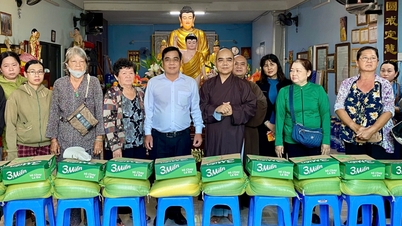
The ceremony of congratulating the king at Phuoc Luu Pagoda (Trang Bang Ward)
During the Nguyen Dynasty, on the first and fifteenth days of each lunar month, Buddhist monks would attend the royal court to pay homage to the emperor and preach Buddhist scriptures to the royal family. Monks residing in temples, unable to attend the court like the abbots, would set up altars to pay their respects to the emperor, which was also considered a form of homage. The altar tablets were inscribed with the name of the reigning emperor, signifying his reverence. The inscription read: "May the current Emperor live for ten thousand years" (上祝當今皇帝聖壽萬萬歲).
Traditionally, the ancestral tablet of the king was placed facing south, signifying the saying: "The sage looks south to hear the wishes of the people." In some temples, the ancestral tablet of the king is placed alongside the altar of the Guardian Deity in the main hall, facing the Buddha altar, as in Phuoc Luu Temple (Trang Bang Ward), Thoi Binh Temple, Chuong Phuoc Temple (Can Giuoc Commune),... Hiep Long Temple (Tan Ninh Ward) places the ancestral tablet of the king together with the ancestral tablets of the founding masters in the ancestral hall.
Furthermore, many temples in Tay Ninh worship the remains or images of King Tran Nhan Tong in the posture of a monk sitting in meditation in the ancestral hall, revered as "Tran Trieu Truc Lam Dau Da Dieu Ngu Giac Hoang Dai Thanh To Phat" or simply "Buddha Emperor".
The Buddhist ritual of offering prayers to the king is performed during the late-night prayers on the first and fifteenth days of each lunar month. After offering prayers at the Buddha altar, the monks carry trays of offerings to the altar containing the king's memorial tablet to perform the ceremony, with the abbot of the temple acting as the chief officiant.
According to the scriptures at Phuoc Luu Pagoda (Trang Bang Ward), during the ceremony, the chief officiant chanted: "May the Emperor enjoy eternal life and peace, may the Empress and her husband live long and prosperous lives, may the Crown Prince live a long and blessed life, may the civil and military officials all be blessed by the Emperor's virtue and ascend to high positions," and "Namo Amitabha Buddha, may the Emperor live for ten thousand years," accompanied by Buddhist ceremonial music including bells, wooden clappers, gongs, and drums. After the blessing ceremony at the altars was completed, the monks returned to the main hall to pay homage to the Four Blessings, including the phrase: "With a sincere heart, we respectfully bow to the King, the Land, and the blessings bestowed by Heaven and Earth."
In temples without ancestral tablets dedicated to the king, the monks perform the ritual in the main hall, offering prayers to Buddha before offering prayers to the king. During the three-month summer retreat, temples that organize retreats in the traditional way still preserve and perform the ancient ritual of offering prayers to the king twice a month.
Besides worship, the act of congratulating the king is also expressed on horizontal plaques and couplets in the temple architecture. In the front hall of Phuoc Luu Temple (Trang Bang ward), there is a horizontal plaque dating back to the year Quy Mao (1903) inscribed with Chinese characters by a Chinese calligrapher from the Cho Lon area named Mac Thien Trai, with the content: "Van Tho Vo Cuong" (萬壽無疆), implying a wish for Buddha and the king to live a long and prosperous life.
The worship of kings in ancient temples in Tay Ninh and throughout Southern Vietnam demonstrates the strong influence of kings and rulers on Buddhism, on the lives of the people, and the "reign" of the kings in this new land. This also reflects the spirit of Buddhist teachings in the principle of "Fourfold Gratitude": gratitude to parents and teachers; gratitude to the king and country; gratitude to the Three Jewels (Buddha, Dharma, Sangha); and gratitude to fellow human beings and humanity.
Through the belief in worshipping the king and the "Four Gratitudes" doctrine, Buddhist practitioners are educated to love their homeland and country; to remember the ancestors who contributed to building and defending the nation. As society becomes increasingly modern, traditional rituals are gradually fading away, but temples are the places that preserve these traditional values, including the custom of worshipping the king in Tay Ninh.
Phi Thanh Phat
Source: https://baolongan.vn/tin-nguong-tho-vua-o-chua-a198455.html

![[Photo] The courage of new recruits of Brigade 144 on the training ground.](https://vphoto.vietnam.vn/thumb/1200x675/vietnam/resource/IMAGE/2026/05/27/1779881651341_anh-man-hinh-2026-05-27-luc-18-32-52.png)
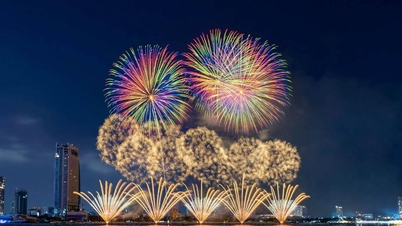
![[Photo] The heat at the fireworks display site on the opening night of the Da Nang International Fireworks Festival 2026](https://vphoto.vietnam.vn/thumb/1200x675/vietnam/resource/IMAGE/2026/05/27/1779889741485_ndo_br_z7872039145157-fecaba5112f39e8352544099d7ef4738-5140-jpg.webp)





































![[Photo] The courage of new recruits of Brigade 144 on the training ground.](https://vphoto.vietnam.vn/thumb/402x226/vietnam/resource/IMAGE/2026/05/27/1779881651341_anh-man-hinh-2026-05-27-luc-18-32-52.png)


















Comment (0)