

Dangerous consequences of the disease
In reality, many appalling incidents have occurred, typical examples of the "false reporting, impressive claims" syndrome. Some localities report to higher-level leaders during inspections that they have "reduced poverty rates to a very impressive figure...", but when requesting state support and funding, they report much higher figures for poverty and hardship than the actual situation. A newly awarded heroic enterprise is on the verge of bankruptcy the following year due to internal conflicts, self-examination of shortcomings, and serious disunity. Or a director who has just been awarded a prestigious medal is soon investigated by authorities for violating financial spending regulations. Recently, an official had his heroic title revoked for dishonest reporting, deliberately claiming achievements that he did not accomplish... These are typical examples of the "false reporting, impressive claims" syndrome.
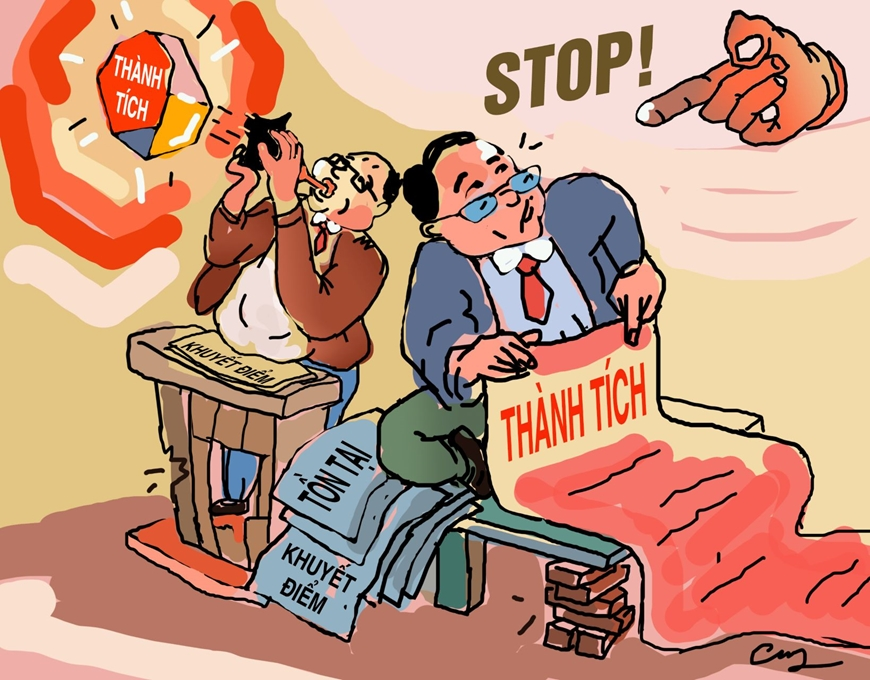 |
| Illustration: QUANG CUONG |
The "scam" of reporting achievements for the sake of appearances leads to many harmful consequences. Organizations and individuals who "scam and report achievements for the sake of appearances" do everything for the sake of achievement, readily resorting to dishonesty to gain praise. They intentionally inflate reports, falsely reporting one thing but reporting two, exaggerating results, and inflating achievements beyond what they actually accomplished. Some others (especially those in positions of power) use public funds and the name of the collective to create a sensation, transforming the achievements of their agency, unit, or locality into personal achievements. This obsession with achievements breeds countless harmful consequences in the lives of cadres and party members today. The consequences include moral decay, individualism, internal disunity, constant suspicion, envy, jealousy, and fear of others or other organizations being better than oneself, leading to a constant pursuit of superiority while shifting responsibility to others... all while their achievements are illusory and their prestige false. This is the root cause of the loss of democracy and the erosion of trust among cadres, party members, and the general public.
Even more dangerously, driven by the pursuit of achievements, they deliberately conceal their shortcomings by fabricating accomplishments, submitting false reports, and even resorting to deceptive tactics to mislead superiors and the public. Driven by ambition, they resent anyone who exposes their limitations and flaws. They use fabricated achievements to hide their weaknesses, enhance their reputation, create false prestige, and use them as a smokescreen for advancement and consolidation of their position and power.
In the work "Correcting Working Methods" (October 1947), under the pseudonym XYZ, President Ho Chi Minh seriously criticized and reminded about the habit of false reporting, a screen to hide frivolous work. He pointed out: "...false reporting. Little success is exaggerated. Shortcomings are hidden and not mentioned" (1) . He severely pointed out the disease: "Doing things just for the sake of doing them. Doing little is exaggerated to make a report for prestige, but upon closer examination, it is empty" (2) . In essence, his teaching was a warning about the dangers of dishonest reporting, "doing things wrongly, reporting well." It is a very dangerous disease. The consequence is that "superiors do not understand the situation clearly and set the right policies." The reminder and warning of President Ho Chi Minh about the disease of false reporting, false reporting, nearly eighty years ago, still retains its value today.
We must resolutely fight against and eliminate them.
The "sloppy reporting" syndrome, identified in the Party's Central Resolution No. 4, 12th Congress, as one of the manifestations of moral and lifestyle degradation, involves a focus on achievements, vanity, ostentation, concealing shortcomings, exaggerating accomplishments, and polishing one's image; a desire for praise and adoration; "chasing achievements," "chasing awards," and "chasing titles"... This "sloppy reporting" syndrome, driven by a desire for achievements to conceal shortcomings, has been causing serious consequences, leading to internal disunity, loss of trust, and ultimately destroying the prestige and honor of individuals and the strength of organizations. Furthermore, it harms the Party, the State, and the regime. Therefore, Party committees and organizations at all levels must resolutely fight against and eliminate the "sloppy reporting" syndrome used to conceal shortcomings; focusing on the following key areas:
Each Party committee, organization, cadre, and Party member needs to continue to thoroughly understand Resolution No. 4 of the 12th Central Committee on Party building and rectification, and Conclusion No. 01-KL/TW dated May 18, 2021, of the Politburo on continuing to implement Directive No. 05-CT/TW dated May 15, 2016, of the 12th Politburo "On promoting the study and emulation of Ho Chi Minh's thought, morality, and style"; organize and strictly maintain the Party's activities in agencies, units, and localities in accordance with the principles of democratic centralism and strong, thorough self-criticism and criticism. Party committees and branches need to develop regulations on self-criticism and criticism, overcome the tendency to be lenient, avoid confrontation, and protect those who are frank and courageous in their struggles; and at the same time, take specific measures to innovate the form and content of regular and thematic Party activities, constantly improving the quality of branch meetings. This is one of the effective measures to educate revolutionary ethics for cadres and Party members in particular, and to build and rectify the Party in general, contributing to strengthening the Party's fighting capacity. According to President Ho Chi Minh, when Party activities are organized effectively and efficiently, all the lies of cadres and Party members will be exposed, there will be no shady or self-serving actions, no instances of "doing things easily but giving up easily," or "doing things wrongly and reporting well." Emphasis should be placed on cross-checking within agencies, units, and localities to improve the quality of the award assessment process. Annually or periodically, agencies, units, and localities need close coordination between inspection, auditing, assessment, and evaluation of award results. Focus on detecting and eliminating individuals and groups who fabricate, inflate, or embellish achievements. Through inspection and auditing, we will identify and remove from the ranks those cadres and party members who deliberately and intentionally seek achievements and fame through dishonest means.
Party committees and organizations at all levels need to focus on expanding democracy and promoting the supervisory rights of political and social organizations and the masses in all matters. Expanding democracy will help uncover the schemes and tactics of opportunistic, fame-seeking, and morally corrupt officials and party members. This will help agencies, units, and localities avoid exploiting the masses to form factions and cliques, and prevent dishonesty in emulation and reward programs. Along with this, it is necessary to promote the exemplary role of "diligence, thrift, integrity, righteousness, and selflessness" in the performance of official duties by officials and party members, especially the heads of party committees and those in charge of managing agencies, units, and localities. Currently, a reality is that many grassroots party organizations have not concretized resolutions into practical leadership tasks. A common phenomenon is the creation of leadership regulations that are one thing, but implementation is another; there is even a phenomenon of simply copying leadership regulations for reporting purposes.
Strengthening education and enhancing self-respect, integrity, and honesty among cadres and Party members in their lives, studies, and work is crucial; resolutely saying "no" to concealing shortcomings and exaggerating achievements is essential. These are essentially acts of self-serving gain that erode the moral character of revolutionaries. Therefore, relevant agencies and those involved in emulation and reward work must uphold a high sense of responsibility and public service ethics, ensuring objectivity, impartiality, and accuracy in reviewing and evaluating reward proposals. They must proactively identify, detect, and promptly prevent and strictly handle cases of individuals and organizations with deviant motives and dishonest behavior in emulation and reward activities. Furthermore, the process and procedures for evaluating reward applications need to be tightened to ensure genuine results.
Achievements and awards are commendable, beautiful, and meaningful things. Achievements are one of the driving forces that motivate individuals and groups to strive for continuous growth and progress. However, "doing things wrong and reporting well" to conceal shortcomings is the enemy of genuine achievements and awards. Therefore, it is the responsibility of every cadre, Party member, and citizen to resolutely criticize and eliminate this malady.
Lieutenant Colonel, Dr. DO NGOC HANH, Deputy Head of the Department of Marxist-Leninist Philosophy, Political Officer Training School
(1). Ho Chi Minh: Complete Works, Volume 5, National Political Publishing House, Hanoi, 2011, p. 341.
(2). Ho Chi Minh: Complete Works, Volume 5, op. cit., p. 297.
 |
Source: https://www.qdnd.vn/phong-chong-tu-dien-bien-tu-chuyen-hoa/tinh-trang-lam-lao-bao-cao-hay-la-trong-benh-849788






















![[Photo] Reception to welcome General Secretary and President To Lam and his wife on their State visit to the Philippines](https://vphoto.vietnam.vn/thumb/1200x675/vietnam/resource/IMAGE/2026/06/01/1780295488620_vna-potal-chieu-dai-chao-mung-tong-bi-thu-chu-tich-nuoc-to-lam-va-phu-nhan-tham-cap-nha-nuoc-toi-philippines-8798060-7855-jpg.webp)
































































Comment (0)