

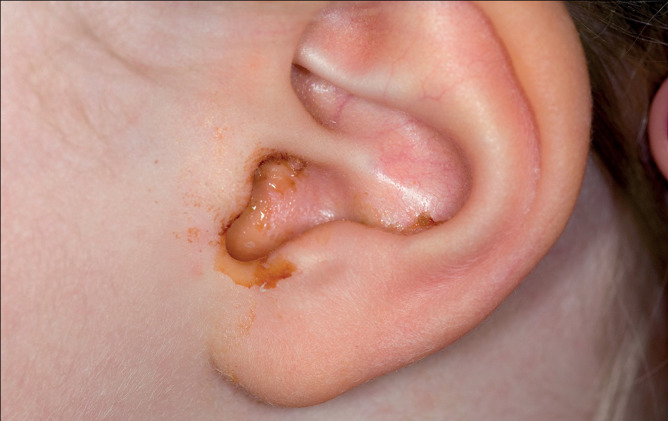
Middle ear infection is a common condition that occurs at all ages, but is most common in young children - Illustration.
According to Ms. Nguyen Thi Linh, Deputy Head of the Department of Tropical Diseases - Pediatric Gastroenterology ( Bac Ninh Obstetrics and Pediatrics Hospital), otitis media is a common disease that occurs at all ages, but is most common in children aged 6-36 months.
The ear is divided into three parts: the outer ear, the middle ear, and the inner ear. The middle ear is located behind the eardrum. It consists of the middle ear cavity, the Eustachian tube (a tube connecting the middle ear to the nasopharynx), and the mastoid process (the largest cell in the mastoid bone).
Acute otitis media is an inflammation of the lining of the middle ear.
What are the warning signs of the disease?
Acute otitis media is usually caused by bacterial or viral ear infections in the middle ear. Infections can also occur due to colds, flu, or allergies that cause blockage of the posterior nasal passages (adenoiditis), throat, and Eustachian tube.
According to Dr. Linh, acute otitis media manifests with different symptoms at each stage. The disease progresses in three stages. It usually occurs during or after an acute nasopharyngitis infection.
- Initial stage : Children exhibit mild tinnitus and ear pain. During this stage, ear examination reveals congestion of the eardrum.
- Stage 2 : This is the stage where pus accumulates in the middle ear. Older children may complain of severe ear pain, hearing loss, and tinnitus, while younger children are often fussy, irritable, and frequently rub their ears. During this stage, there are often additional systemic symptoms such as high fever and digestive disorders: vomiting, diarrhea, etc.
- Stage 3 : The pus in the middle ear swells and drains out, and the pus has a foul odor. At this point, the symptoms of tinnitus and ear pain decrease, but pus continues to drain out.
Often, perforations caused by acute otitis media heal spontaneously. If the perforation persists, it can develop into chronic otitis media.

If left untreated, middle ear infections can lead to dangerous complications - Illustration.
Be aware of the risk of complications.
Dr. Linh added that treatment for acute otitis media includes pain relief, symptomatic treatment, and treatment with systemic or topical antibiotics.
After examination, the doctor will decide whether to use antibiotics to treat acute otitis media depending on the stage and cause of the disease.
There are cases where antibiotics are needed from the outset. In cases where antibiotics are not yet necessary, treatment will focus on symptoms, with follow-up monitoring and reassessment after 48-72 hours.
Acute otitis media often occurs concurrently with nasopharyngitis. Therefore, patients need to be treated for nasopharyngitis as well.
Nowadays, with advances in medicine, acute otitis media, if diagnosed and treated early, rarely causes complications.
One of the complications of acute otitis media is acute mastoiditis. This complication often occurs in immunocompromised patients or those who have not received proper treatment.
"Improper treatment of acute otitis media can lead to prolonged subacute or chronic otitis media with effusion, and in many cases, it can leave perforations in the eardrum causing hearing loss and gradual degeneration of the middle ear mucosa. Therefore, if there are signs of acute otitis media, parents should take their children to the hospital for examination and treatment," Dr. Linh emphasized.
According to health experts, to prevent acute otitis media, children should be given a nutritious diet, kept warm in cold weather, their surroundings should be kept clean, and they should engage in healthy physical activity to boost their immune system.
Avoid exposure to polluted environments, including smoke and cigarette fumes.
Complete vaccination according to the expanded immunization program, including influenza and pneumococcal vaccinations, are essential to prevent acute respiratory infections in children.
Infants should be breastfed for at least the first 6 months and should not be given formula while sleeping to avoid choking and spitting up.
When symptoms appear, it is necessary to seek medical attention for appropriate treatment. Do not allow the disease to progress to a severe stage, as this will make treatment more difficult and recovery harder.
Source: https://tuoitre.vn/tre-bi-viem-tai-giua-cap-co-nguy-hiem-khong-20240923224851546.htm





![[Photo] General Secretary and President To Lam presides over a meeting on preparations for the review of one year of operation of the three-tiered government system.](https://vphoto.vietnam.vn/thumb/1200x675/vietnam/resource/IMAGE/2026/06/02/1780391821195_a1-bnd-4595-9717-jpg.webp)

































































































Comment (0)