

On January 29, Rodong Sinmun, the official newspaper of the Workers' Party of North Korea, reported on the activities of North Korean leader Kim Jong-un following Pyongyang's test launch of a cruise missile from a submarine the previous day.
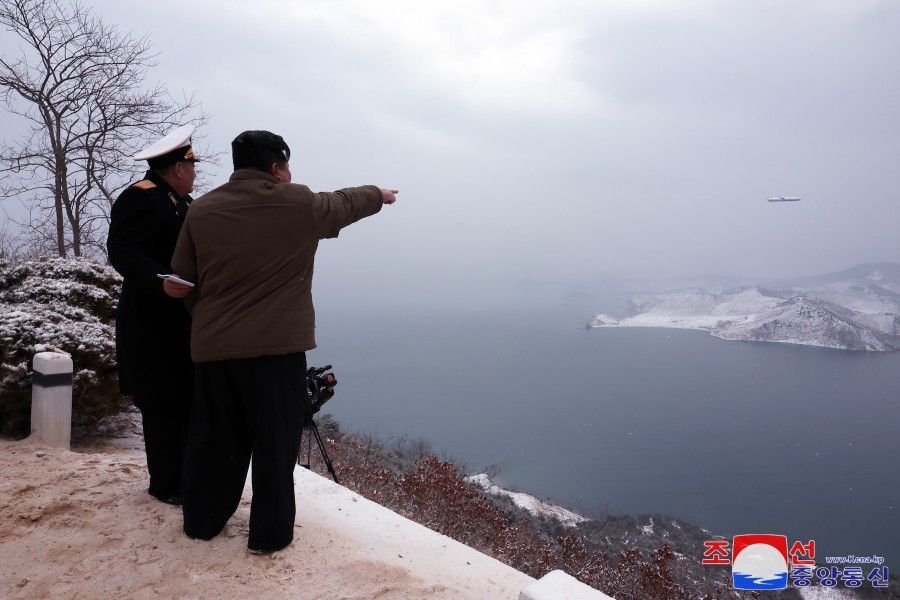 |
| North Korean leader Kim Jong-un inspects the launch of a cruise missile from a submarine on January 28. (Source: KCNA) |
Yonhap , citing the aforementioned news report, said that Kim Jong-un inspected the missile test launch.
The newspaper stated that on January 28, North Korea launched a Pulhwasal-3-31 strategic cruise missile from a submarine. The missile struck its predetermined targets on an island in the waters east of North Korea after a flight time of approximately 7,421 to 7,445 seconds.
However, Rodong Sinmun did not release any further information regarding the launch, such as the distance the missile traveled before hitting its target.
Meanwhile, the North Korean state news agency KCNA quoted Chairman Kim Jong-un as saying during an inspection tour that the current situation and future threats require the Northeast Asian nation to "further accelerate efforts to protect its maritime sovereignty ."
North Korea will also continue its military modernization plan aimed at building a powerful navy.
Furthermore, Kim Jong- un once again declared that arming the navy with nuclear weapons is an urgent task of the times and a core requirement in building a national nuclear strategic force to expand the operational scope of nuclear deterrence in various ways.
KCNA asserted that the missile test launch from the submarine "had no impact on the security of a neighboring country and was unrelated to the regional situation," adding that the North Korean leader was "extremely satisfied" with the results of the launch.
The South Korean military announced that it detected North Korea launching several cruise missiles at approximately 8:00 AM on January 28th (6:00 AM Hanoi time) towards the sea near the eastern port city of Shinpo.
On January 24, North Korea confirmed for the first time the test launch of its new Pulhwasal-3-31 cruise missile. According to Pyongyang, this was an effort to enhance its capability to carry tactical nuclear warheads.
Cruise missiles fly at low altitudes and have various guidance options, making them difficult to detect and intercept. Unlike ballistic missiles, testing of cruise missiles is not prohibited under current United Nations resolutions on North Korea.
Responding to North Korea's latest move, on January 28, a Pentagon spokesperson affirmed that the U.S. will continue to cooperate with South Korea and Japan to deter military threats.
The spokesperson stated: “We are closely monitoring Pyongyang’s actions. We have clarified the threat posed by North Korea’s military programs, our commitment to the defense posture of South Korea and Japan, and our commitment to maintaining peace and stability in the region.”
Source
![[Photo] Prime Minister Pham Minh Chinh presides over a meeting on private sector economic development.](/_next/image?url=https%3A%2F%2Fvphoto.vietnam.vn%2Fthumb%2F1200x675%2Fvietnam%2Fresource%2FIMAGE%2F2025%2F12%2F20%2F1766237501876_thiet-ke-chua-co-ten-40-png.webp&w=3840&q=75)









































































Comment (0)