


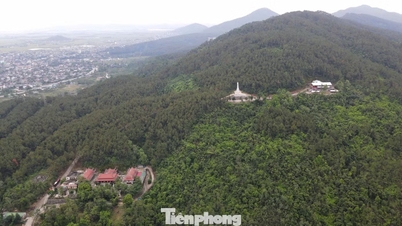
O Ta Soc is located on Dai Mountain. Photo: THANH CHINH
O Ta Soc is one of the famous revolutionary bases of An Giang province , located on the slopes of the large Dai Mountain (Ngoa Long Son) in the That Son mountain range. O Ta Soc served as the base of the An Giang Provincial Party Committee, directly leading and directing the resistance war against the US to success, contributing to the overall victory of the country, and bringing peace, independence, and freedom to the nation.
In 2002, the O Ta Soc revolutionary base was classified as a national historical relic. In Khmer, "O Ta Soc" means "Mr. Soc's stream," a gentle and simple name, reflecting the natural beauty of the place. But behind that name lies a fierce and heroic "history." During the years 1962-1967, O Ta Soc served as the base of the An Giang Provincial Party Committee, the center for revolutionary leadership in the entire region. Amidst the rugged mountains and forests, it housed all the necessary agencies, from military and security to civilian affairs and propaganda, becoming the "brain" of the struggle movement in the southwestern border region of Vietnam.
Deep within the historical site, a long, winding path of bamboo trees stretches endlessly. Two rows of straight, tall trees, slender yet sturdy, evoke images of the people of yesteryear—simple yet resilient. It was on these very paths, amidst bombs and dangers, that soldiers and messengers silently traversed the forest, transporting food and weapons, ensuring the lifeline of the base never ceased. Each step was not just a geographical journey, but also a journey of faith.
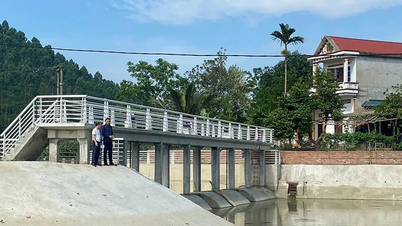
At the foot of the mountains, O Ta Soc Lake unfolds like a large mirror. Its clear, calm surface reflects the sky and the green of the surrounding mountains. Today, O Ta Soc Lake is an important irrigation project, providing water for agricultural production in the region, but during the war, it served as a hiding place and a base for many revolutionary activities. Standing by the lake's edge, watching the water gently ripple in the breeze, one easily feels time slowing down, allowing the past and present to intertwine.
During those brutal years, O Ta Soc was the target of numerous large-scale sweeps by the American military. Bombers, artillery, and tanks coordinated their efforts to wipe out the base. At times, the bombing was so intense that the area was nicknamed "O Ta Soc of Destruction." But amidst this siege, the revolutionary forces remained steadfast, holding firm to their leadership, preserving their strength, and continuing to direct the struggle. It was in this most severe trial that the courage and willpower of the people here were clearly demonstrated.
The central area of the historical site still features a large bas-relief depicting the battles and daily life of soldiers and civilians during those arduous years. The carved lines still seem to carry the rhythm of a time of war and bloodshed. Beside it is a memorial exhibition hall, preserving simple images and artifacts such as a hammock, a water canteen, and rudimentary medical equipment… All seem to recount a time when life and death were separated by only a hair's breadth. No lengthy explanations are needed; simply standing before these artifacts is enough to feel the harshness of war and the resilience of the people.
Following the trail up Ma Thien Lanh hill, I felt more acutely the harshness of the terrain. Jagged rocks, steep slopes, and rugged paths. During the war, this place was a site of fierce fighting, bombs and bullets ravaged the land, and the forest was burned to the ground. Many soldiers fell without even having the chance to leave behind their names. The story of six soldiers from the main army unit who were trapped by bombs and rocks blocking the cave entrance, ultimately all perishing on Ma Thien Lanh hill, reminds me of the verses by poet Nguyen Thi Tra Giang in her poem: "Sit a little longer, my friend / The incense is almost out, light another week's incense / Life is so vast, the smoke is so small / Will the wind carry it to where you lie?… I stand bewildered before the silent rock / Blocking the cave entrance, burying you within / Burying longing, burying memories / Eighteen, twenty, so young in life…" and I remember the souls that have merged with the mountain rocks.
From a high vantage point, the entire O Ta Soc landscape unfolds with a beauty that is both majestic and peaceful. Fields at the foot of the mountains stretch out in the sunlight, and low-lying houses peek through the green foliage. Once the site of the fiercest battles, today it is a place of life and harvest. Groups of students, officials, and others still return here to visit, to better understand what happened, and to appreciate the value of peace today.
Leaving O Ta Soc as the sun reached its zenith, I walked back along the bamboo-lined path. The shadows of the trees stretched long across the ground, the wind still blew, and my heart remained filled with a sense of longing… The peace of today, the wide-open roads, the fertile fields… all were bought with years that can never be repeated.
Source: https://baoangiang.com.vn/tro-lai-o-ta-soc-a481420.html
![[Photo] National Assembly Chairman Tran Thanh Man working with the Standing Committee of the National Assembly's Delegation Affairs Committee.](https://vphoto.vietnam.vn/thumb/1200x675/vietnam/resource/IMAGE/2026/05/20/1779294340023_ndo_br_1-1691-jpg.webp)
![[Image] "Journey of Hope" promotes the organ and tissue donation movement in Vietnam.](https://vphoto.vietnam.vn/thumb/1200x675/vietnam/resource/IMAGE/2026/05/20/1779294400833_1-8910-jpg.webp)
![[Photo] General Secretary and President To Lam works with the Party Committee of the Ministry of Health on the work of Vietnamese traditional medicine.](https://vphoto.vietnam.vn/thumb/1200x675/vietnam/resource/IMAGE/2026/05/20/1779294323718_a1-bnd-2978-3319-jpg.webp)
























































































Comment (0)