

China has just announced that the planned Chang'e-8 mission will include a completely new robot, acting as a construction worker to assist with the assembly and transportation of equipment after deployment.
Developed by the Hong Kong University of Science and Technology (HKUST), the robot weighs approximately 100kg and has four wheels to move across the rugged surface of the Moon.
Unlike previous lunar rover models, this new device is equipped with a pair of robotic arms for grasping and manipulating tools.
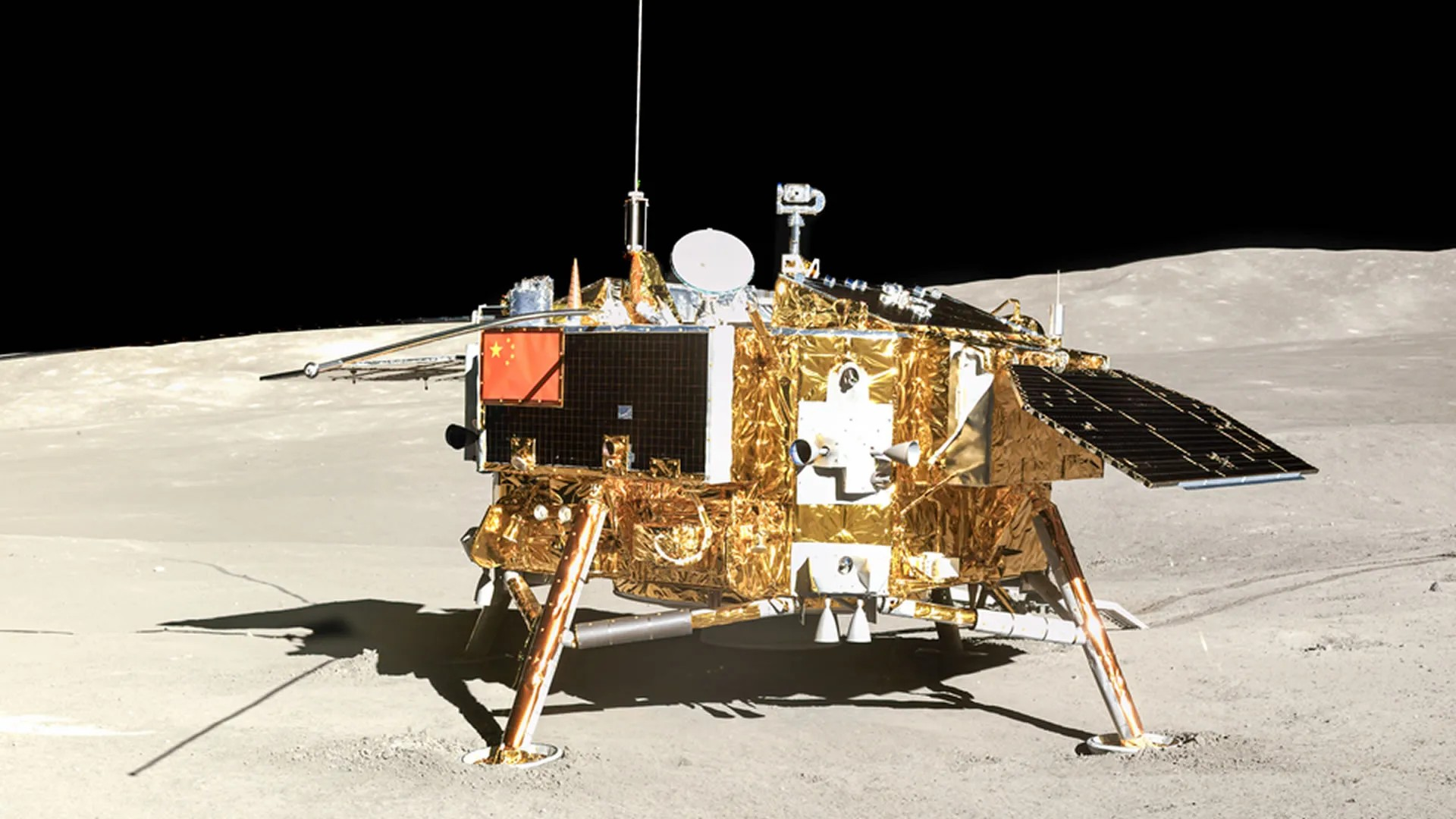
This is important because most of the tools and systems currently available for space programs are designed based on the workings of the human body, specifically the arms and hands of astronauts.
Therefore, instead of redesigning all these tools, creating robots capable of using them is a perfectly logical approach.
"We understand that the Chang'e-7 mission will most likely see the first humanoid robot landing on the Moon's South Pole. However, our robot will go to a different area of the South Pole, a very large region, and we want to explore it completely," explained Professor Gao Yang of HKUST.
According to the design team, the device also incorporates AI to enable semi-autonomous operation. The combination of rover wheels and humanoid robotic arms is designed to maximize the advantages of both mechanisms when operating on the Moon.
The wheel system will ensure superior reliability and energy efficiency when moving across the lunar surface, while the arms provide high dexterity for manipulating objects.
According to the research team, when the lander makes contact with the lunar surface, robots will be deployed to perform tasks such as carrying scientific equipment and placing sensors in specific locations.
It will also act as a "porter" to install equipment, assist in infrastructure construction, and collect soil and rock samples.
Accordingly, robots symbolize a shift in the goals of lunar missions, from purely observation and sample collection to a direct engineering project on the ground.
Future missions, such as Chang'e-8, will involve establishing limited infrastructure and deploying a network of sensors.
It will also be used as a testing ground for long-term residency and preparation for permanent bases.
China is targeting the South Pole because the area is believed to contain ice-filled craters. This part of the Moon also tends to receive almost constant sunlight.
If this is true, the craters, specifically the ice deposits, could be processed to provide drinking water for astronauts, oxygen for breathing, and simultaneously serve as a raw material for producing rocket fuel on-site.
This would turn the Moon's South Pole into an incredibly valuable resource.
In theory, these robot teams could then coordinate to build infrastructure for exploiting this resource, while also directly engaging in mining operations.
They could also be used to perform critical maintenance work on future lunar bases.
(According to Interesting Engineering)

Source: https://vietnamnet.vn/trung-quoc-dua-robot-xay-dung-len-mat-trang-tham-vong-lap-can-cu-2514470.html
![[Image] Hanoi's urban life under the challenge of a "scorching hot" environment](https://vphoto.vietnam.vn/thumb/1200x675/vietnam/resource/IMAGE/2026/05/25/1779706979265_nang-nong-t5-2026-minh-duy-7-4636-jpg.webp)
![[Image] Close-up view of the interchange connecting the two expressways and Long Thanh Airport.](https://vphoto.vietnam.vn/thumb/1200x675/vietnam/resource/IMAGE/2026/05/25/1779703378210_ndo_br_z7863716673926-224453a31600126cce10622af6290afd-4549-jpg.webp)

























































































Comment (0)