

Engaging technology classes
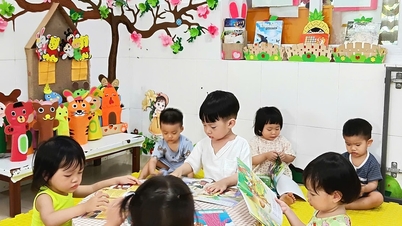
Class time at the 5-year-old A class of Hoa Chung Kindergarten, Tan Giang Ward ( Cao Bang ), became more lively when the children were introduced to the Vex 123 robot. On a colorful mat simulating a path, groups of children attentively selected command cards and then inserted them into the slots on the robot. Just a few seconds later, the little robot began moving along its pre-programmed route.
Cheers erupted as the robot reached the finish line. For the children, it was a fun game. But behind that learning experience was their first step towards logical thinking, science , and technology.

Teacher Ly Thi Diep, head teacher of 5-year-old kindergarten class A, shared: “The Vex 123 robot is controlled using symbol cards such as go straight, turn left, turn right. Children will observe the path, think, and then arrange the cards in the appropriate sequence to program the robot. Through this activity, the children get to play while developing logical thinking, problem-solving skills, and becoming familiar with technology from an early age.”
Hoa Chung Kindergarten is currently equipped with 3 Vex 123 robots, which take turns teaching in the 4-year-old and 5-year-old kindergarten classes. In addition to applying robots in teaching, the school is also promoting STEAM education , digital transformation, and the application of information technology and artificial intelligence (AI) in many educational activities.
Ms. Vu Thi Hang, Principal of Hoa Chung Kindergarten, said: “The school recognizes that digital transformation and STEAM education are not a temporary trend but an inevitable trend to improve the quality of preschool education. We organize training for all teachers on the application of STEAM, AI, and information technology; build an internal digital technology team; and innovate professional development activities towards digitalization so that teachers can practice regularly.”
According to Ms. Hang, at the beginning of the school year, the school invited experts from the Ministry of Education and Training to provide in-depth training on STEAM education for teachers. To date, the implementation has entered the practical application phase in teaching activities.
The school currently has 100% of its classrooms equipped with televisions and computers; 18 tablets for children to use directly; and a synchronized, digitized system for managing nutrition, industry databases, and educational records.
“100% of teachers have prepared lesson plans using digital signatures; approximately 90% of teachers are proficient in applying information technology in teaching. Digital learning videos and digital libraries are regularly developed to support childcare and education activities,” Ms. Hang said.
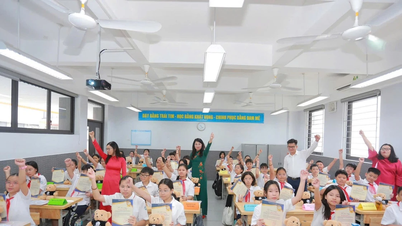
The atmosphere of technology-driven learning is also evident at De Tham Kindergarten, Thuc Phan Ward. During the "Shiitake Mushroom" discovery lesson taught by teacher Dam Thu in the 5-year-old B class, the entire class felt like they had stepped into a vibrant animated world.
On the large screen, shiitake mushrooms appear as vivid 3D models. Cute cartoon characters appear one after another, guiding children to explore the habitat and characteristics of shiitake mushrooms through AI-powered videos. Children observe and interact on tablets through jigsaw puzzles and multiple-choice games.
Tiny hands were constantly raised, eager to answer the questions. Laughter echoed throughout the classroom.
Teacher Dam Thu shared: “When AI is applied to lessons, children are much more focused and interested. Content that is difficult to visualize with just ordinary pictures now becomes intuitive and lively. Children can interact and explore, so they absorb knowledge more naturally.”
According to Ms. Thu, the application of AI helps teachers save time designing lesson plans and opens up many new forms of organizing activities suitable for the psychology of preschool children.
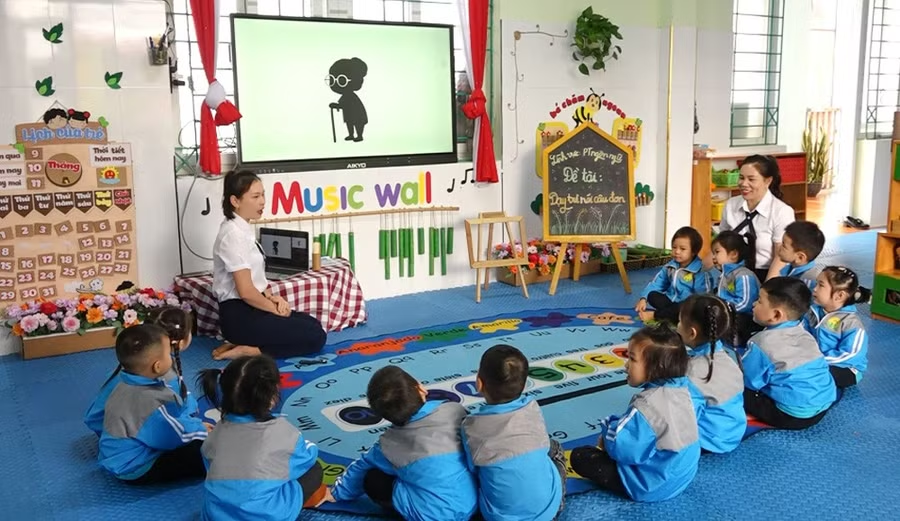
Ms. Nguyen Thi Quynh Hoa, Principal of De Tham Kindergarten, said that the school currently has 13 classes with 412 children. In recent years, the school has focused on applying AI and information technology in many activities such as exploring the surrounding environment, getting acquainted with mathematics, and developing language skills for children aged 3-5 years old.
"AI helps teachers innovate teaching methods and create more visual and engaging learning materials. Importantly, technology doesn't replace teachers but supports them in organizing more attractive and effective educational activities," Ms. Hoa emphasized.
Digital transformation from the frontier regions
Not only in Hoa Chung or De Tham, but many preschools in Cao Bang province are actively applying information technology, AI, and STEAM education in their teaching.
Despite being a mountainous border province facing numerous socio-economic challenges and uneven infrastructure, Cao Bang is gradually making positive progress in the digital transformation of education.
The province currently has over 170 preschools with more than 1,480 classrooms. In recent times, the Cao Bang Education Department has identified digital transformation as a key task to innovate management, improve the quality of teaching and learning, and build a smart and modern education system.
The Department of Education and Training of Cao Bang province has issued numerous guiding documents on implementing the set of indicators to assess the level of digital transformation in educational institutions; and has implemented a plan for carrying out scientific and technological tasks, innovation, and digital transformation across the entire sector.
Looking ahead to the 2025-2026 school year, the Cao Bang Education Department aims for 100% of educational institutions to adopt digital management systems; and to strengthen the application of advanced technologies, AI, and big data suitable to local conditions.
In addition, investment in digital infrastructure continues. The Department of Education and Training has developed the Zalo OA platform to provide information on admissions, exam score lookup, and quick updates on industry news for the public; it has also deployed online software to manage entrance exams and student competitions, reducing administrative procedures.
100% of the sector's administrative documents are now processed on an electronic document management system using digital signatures. Student, teacher, and facility data have also been synchronized within the smart education ecosystem.
Many schools are using the vnEdu software to enhance the connection between schools and parents. Teachers are gradually applying e-learning lectures and platforms such as Zoom, Microsoft Teams, and Google Meet in teaching and professional development.
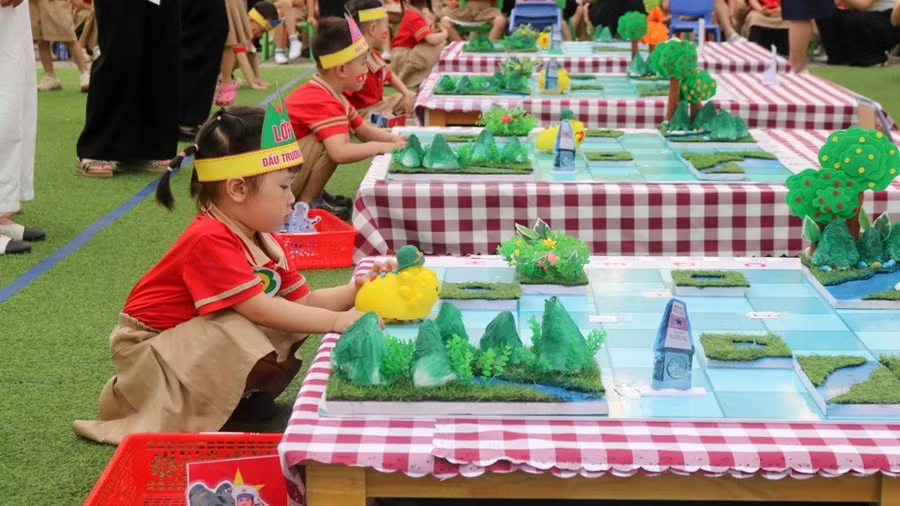
Alongside digital transformation, STEAM education is also gaining attention in many preschools, aiming for holistic child development through experiential activities and exploration of science, technology, engineering, art, and mathematics.
From small activities like model making, assembling, exploring nature, and controlling robots to brain-stimulating games, children are trained in observation, creativity, communication, and cooperation skills.
However, the digital transformation process in mountainous localities like Cao Bang still faces many difficulties. Information technology infrastructure is uneven, many schools in remote and mountainous areas lack equipment, and internet connections are unstable. A segment of teachers still have limited digital skills and are hesitant to embrace innovation.
The Bo Vai branch school, part of Thuong Ha Kindergarten in Co Ba border commune, is one example. The branch school is perched precariously on a mountain, nearly 20km away from the main school along a difficult road. Despite this, teacher Hoang Thi Hanh still strives to integrate technology into the classroom.
"Despite the limited resources, we still try to apply information technology to our lessons. The classroom has computers and screens so students can become familiar with digital technology. Lessons include visual images and videos to make them more engaging for students," Ms. Hanh shared.
Ms. Dam Thi Trung Thu, Deputy Director of the Department of Education and Training of Cao Bang province, said: “The digital transformation process in Cao Bang has faced many difficulties due to uneven terrain, infrastructure, and technological capabilities. However, with the determination of the entire sector, the consensus of localities and the teaching staff, the digital transformation has achieved many positive results. In the future, the sector will continue to invest in infrastructure, improve the digital capacity of the staff, and promote the application of AI, STEAM, and information technology to improve the overall quality of education.”
From urban classrooms to remote border schools, digital transformation and STEAM education are gradually opening up new learning spaces for children in Cao Bang. These "digital seeds" of today will be the foundation for them to confidently step into the future of the technological age.
Source: https://giaoducthoidai.vn/truong-hoc-cao-bang-uom-mam-so-post779748.html

























![[Photo] Reception to welcome General Secretary and President To Lam and his wife on their State visit to the Philippines](https://vphoto.vietnam.vn/thumb/1200x675/vietnam/resource/IMAGE/2026/06/01/1780295488620_vna-potal-chieu-dai-chao-mung-tong-bi-thu-chu-tich-nuoc-to-lam-va-phu-nhan-tham-cap-nha-nuoc-toi-philippines-8798060-7855-jpg.webp)

























































Comment (0)