

 |
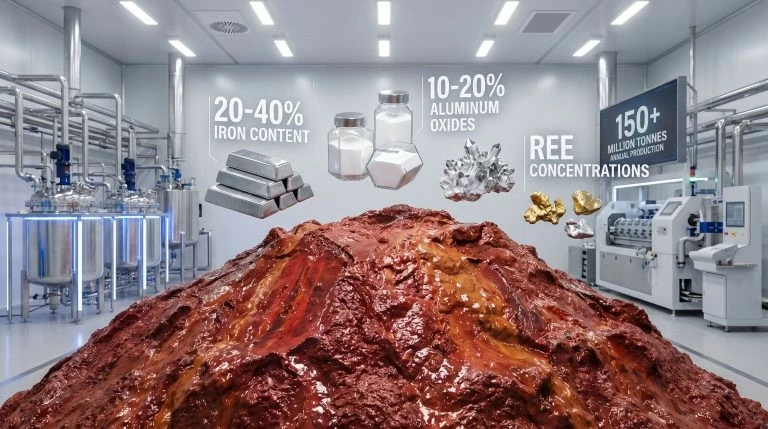
| The global aluminum industry generates over 150 million tons of red mud annually. (Source: Discovery Alert) |
In today's technological competition, a nation's advantage lies not only in the final product such as chips, satellites, radar, or defense equipment. Behind these products is a less-noticed but crucial foundation: materials.
Without suitable materials, even advanced designs are difficult to bring into production. Without a stable supply, a high-tech production line can be disrupted. Therefore, critical metals like gallium, scandium, and certain rare earth elements are increasingly seen as part of economic and industrial security.
Why are gallium and scandium important?
Gallium and scandium are not metals familiar to the general public, but they play a special role in high-tech manufacturing chains.
Gallium is used in semiconductor compounds, particularly gallium arsenide and gallium nitride, materials with applications in electronics, telecommunications, LEDs, solar cells, and many other high-tech systems. In some applications, gallium compounds outperform traditional silicon due to their ability to operate at high frequencies, high power, or harsh environments.
Scandium is once again gaining attention in the alloying field. When combined with aluminum, scandium creates a lightweight, strong alloy with great potential in aerospace and applications requiring a high strength-to-weight ratio. Notably, according to the Discovery Alert website, global scandium oxide production currently stands at only 10-15 tons per year, a very small figure compared to rapidly increasing demand, creating a structural supply shortage. The value of scandium therefore lies not in its large consumption volume, but in its ability to improve material properties and its irreplaceable scarcity.
This is a common characteristic of many strategic minerals: they may not be used in enormous quantities, but they are difficult to replace. A small amount of material can determine the performance of an entire system. For industries such as semiconductors, telecommunications, clean energy, and defense, the stability of the material supply is a fundamental condition.
Supply chain bottlenecks
For the U.S., the major problem is that some critical materials lack sufficiently strong domestic supply. With gallium, global supply is heavily concentrated in China. With scandium, the U.S. also lacks significant domestic mining or commercial recovery capacity.
This dependence is not just an economic issue. In the context of technological and trade competition between major powers, mineral supply can become a tool for exerting pressure. When a critical material is subject to export controls, businesses dependent on it face the risk of price increases, shortages, or having to find alternative sources in the short term.
For many years, globalization led to cost-optimized supply chains. But as geopolitical competition increased, that approach became insufficient. A cheap but overly concentrated supply source could become risky. An efficient supply chain dependent on a single country could be vulnerable when policies change.
For the US, the challenge isn't just finding more ore. The harder part is building the entire chain: recovery, refining, processing, standardization, and integrating the materials into industrial systems. Without resources and processing capabilities, a nation remains dependent on external sources.
In this context, red mud, a waste product generated during the refining of alumina from bauxite ore, is being re-evaluated by the US, as it could become a secondary source of several strategic metals such as gallium and scandium.
From waste to potential supply
Red mud is a byproduct of alumina production, an intermediate raw material for aluminum production. Due to its complex composition and high alkalinity, red mud is typically stored in specialized reservoirs or disposal sites.
For decades, red mud has been primarily viewed as an environmental problem: it must be managed safely, preventing leaks and avoiding soil and water pollution. The global aluminum industry discharges approximately 150 million tons of red mud annually, but the reuse rate currently stands at only about 2%.
But red mud is not simply waste. Inside it may also contain the very metals that the U.S. is lacking. In an interview with the information ecosystem AL Circle ... In May, Professor Greeshma Gadikota of Columbia University stated that gallium in red mud is typically at levels of 50–80 ppm (meaning that in 1 ton of red mud...). It will contain approximately 50 to 80 grams of metal (Gallium), scandium 70–120 ppm, and rare earth elements ranging from 400 to 2,000 ppm depending on the bauxite source.
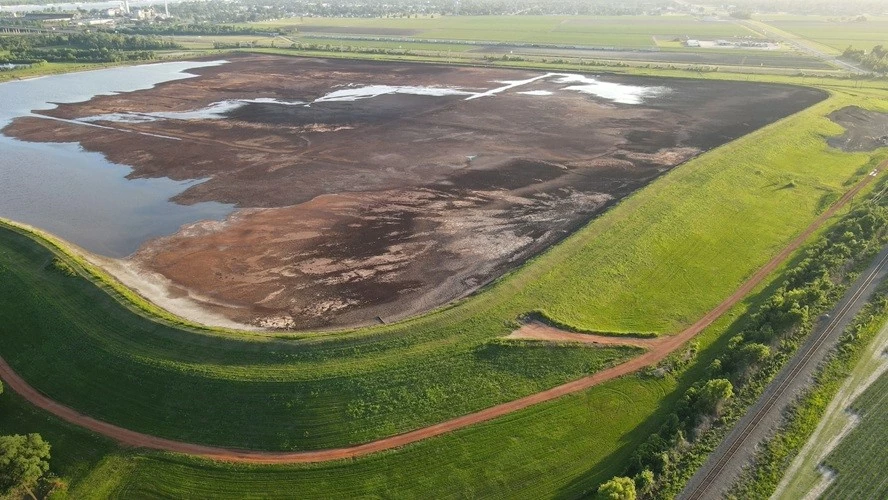 |
| Red Mud Pond 4 at the Atalco alumina refinery in Gramercy, Louisiana, USA. (Source: Louisiana Illuminator) |
Independent studies have also indicated that scandium concentrations in red mud can reach 100-800 ppm, exceeding most primary deposits currently mined worldwide. Titanium dioxide ranges from 1-10%, while scandium has been identified as accounting for up to 95% of the total economic value of rare earth elements in red mud.
Instead of just searching for new deposits, American researchers and businesses are beginning to look at existing secondary sources. According to Professor Gadikota, the Gramercy waste dump in Louisiana, the only alumina refinery in the US, contains more than 30 million tons of red mud. If the scandium content there reaches approximately 80 ppm, the total amount of scandium stored could reach 2,400 tons. The estimated potential titanium oxide content is 0.6 million tons, equivalent to 40–60% of the US's total annual titanium dioxide demand.
This is also why the US Department of Defense has invested $29.9 million in the mining and mineral processing company ElementUSA to build a pilot plant in Gramercy, while the company has announced plans to build an $850 million commercial facility.
In January, Atlantic Alumina, an alumina producer and refiner, announced a $450 million strategic partnership with the federal government to build America's first large-scale gallium production plant. These are clear signals that the red mud story has moved beyond the laboratory.
Recovering metals from red mud has two simultaneous implications: it reduces environmental pressure if some of the waste can be processed and reused, and it opens up the possibility of supplementing domestic supply for high-tech industries without relying entirely on new mining, which often takes many years and faces environmental requirements, permits, and public backlash.
Of course, secondary sources like red mud cannot completely replace traditional mines, but they can become part of a diversification strategy. However, not all red mud deposits are the same. Composition depends on the bauxite source, refining technology, and environmental conditions. Research projects need to start with sample analysis, determining content, evaluating extraction potential, and calculating costs before addressing the question of whether the recovered product meets industry standards and is competitive with imported sources.
Expectations should not be inflated.
It's crucial not to treat the red mud story as a ready-made solution. From idea to commercial production is a long journey, with at least four major challenges.
From a technological standpoint, recovering metals from red mud requires a complex process. If strong chemicals are used, secondary waste treatment is necessary; if too much energy is consumed, the environmental effectiveness may be questioned.
Economically, low metal content and high extraction costs could make the product more expensive than imported sources, hindering the project's commercialization.
In terms of scale, a successful experiment with a few kilograms of sample does not guarantee success with millions of tons of red mud. Industrial scale requires completely different equipment, capital, and safety standards.
In terms of the market, even if the metal is recovered, businesses still need industrial customers, quality standards, and long-term contracts.
Therefore, the appropriate perspective is to view red mud as a potential resource, not a "guaranteed treasure." It can contribute to reducing supply chain risks, but it cannot yet replace the entire current mineral system.
The story of material competition
From red mud, we can look more broadly at the competition for materials among major economies. In the high-tech era, materials not only serve a single industry, but are at the intersection of many fields: clean energy, electronics, telecommunications, aviation, defense, and artificial intelligence.
This changes the understanding of resources. Previously, oil and gas were central to energy security. Today, lithium, cobalt, rare earth elements, gallium, scandium, and many other materials have become part of technological security, not replacing traditional energy sources, but adding a new layer of competition.
The US, Europe, Japan, and South Korea are all seeking to reduce their reliance on highly concentrated sources of supply through recycling, recovery, stockpiling, developing alternative materials, and establishing partnerships with countries that have reliable resources. In this context, red mud is a prime example of this new thinking: Don't overlook secondary resources.
The red mud story illustrates a paradox of the high-tech age: the most advanced industries can depend on materials once considered waste. As gallium, scandium, and other critical metals become bottlenecks in the supply chain, red mud is no longer just an environmental issue but could become part of a materials strategy. However, this direction remains to be seen.
Source: https://baoquocte.vn/tu-chat-thai-cong-nghiep-den-khoang-san-chien-luoc-396981.html



![[Image] Nearly 125,000 Hanoi students completed the Literature exam for the 10th grade entrance exam.](https://vphoto.vietnam.vn/thumb/1200x675/vietnam/resource/IMAGE/2026/05/30/1780117233041_ndo_br_thiet-ke-chua-co-ten-2-png.webp)



















![[Photo] Admire the coral "masterpiece" amidst the million-year-old heritage of Dak Lak province.](https://vphoto.vietnam.vn/thumb/1200x675/vietnam/resource/IMAGE/2026/05/30/1780107638639_y25-jpg.webp)




































































Comment (0)