

 |
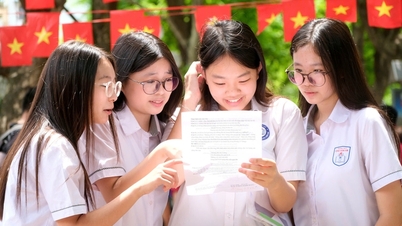
Hanoi students during a reading session at the library. Photo: Dinh Ha. |
A seemingly simple Vietnamese riddle has left many scratching their heads: "Which word, when missing its beginning, is a question, and when missing its end, is an answer?"
The answer is the word "Ear".
According to the Vietnamese Dictionary (Hoang Phe Dictionary) , "ear" is an organ on either side of the head of a person or animal, used for hearing. The word can also refer to a part of certain objects that protrudes like an ear.
The word "tai" (ear) when the first letter (the "t") is removed becomes "ai". This is an interrogative word, often used to ask about people. For example: "Who is that?", "Who did this?".
The word "tai" (ear) with the last letter (the "i") removed leaves "ta," which signifies confirmation of the subject, and is therefore understood as "to answer."
The Vietnamese dictionary defines "ta" as a personal pronoun used when speaking to others, usually in a superior capacity. For example: "I'm telling you all so you know."
In addition, the word "ta" (I/me) can be used as a self-referential pronoun when speaking intimately to an equal or when speaking to oneself. For example: "When you go home, will you remember me? / When I go home, I will remember your smile."
This word is also used to refer to oneself and the person being spoken to in a friendly, intimate way (implying that they are considered as one). For example: "You and I, let's go together."
Vietnamese people also use the word "ta" to refer to things belonging to their nation or country, distinguishing them from Western or Chinese products. For example: Tet ta (Vietnamese New Year), thuoc ta (Vietnamese medicine).
Additionally, the word "ta" (I/me) is also used in dialogue to refer to someone who has been mentioned before, in a way that shows disrespect. For example: He, her, her...
Source: https://znews.vn/tu-nao-mat-dau-la-hoi-mat-duoi-tra-loi-post1654756.html
![[Image] A brilliant symphony and explosive power in the skies of Da Nang.](https://vphoto.vietnam.vn/thumb/1200x675/vietnam/resource/IMAGE/2026/05/31/1780193150738_anh-bia-copy-jpg.webp)

![[Video] Sunset at Lap An Lagoon – Where the sun sets over the fishing nets](https://vphoto.vietnam.vn/thumb/1200x675/vietnam/resource/IMAGE/2026/05/31/1780192137701_beach-landscape-sea-water-nature-grass-745871-pxhere-com.jpeg)







![[Video] Sunset at Lap An Lagoon – Where the sun sets over the fishing nets](https://vphoto.vietnam.vn/thumb/800x450/vietnam/resource/IMAGE/2026/05/31/1780192137701_beach-landscape-sea-water-nature-grass-745871-pxhere-com.jpeg)































![[Video] Sunset at Lap An Lagoon – Where the sun sets over the fishing nets](https://vphoto.vietnam.vn/thumb/402x226/vietnam/resource/IMAGE/2026/05/31/1780192137701_beach-landscape-sea-water-nature-grass-745871-pxhere-com.jpeg)
































Comment (0)