

The proportion of the workforce with formal training is still low.
Reporter:
Associate Professor, Dr. To Thi Mai Huong: Vietnam's high-quality human resources currently possess great potential, especially in the younger generation: intelligent, quick learners, and adept at adapting to new technologies, but they still do not fully meet the requirements of a knowledge-based economy . We still lack a truly capable workforce ready to lead science and technology and innovation.
According to statistics, the percentage of trained workers with degrees and certificates in Vietnam will only reach 29.2% in 2025 and 29.6% in the first quarter of 2026. This figure shows that the proportion of the workforce trained according to professional and skill standards is still modest compared to the needs of a modern economy heavily reliant on knowledge, technology, and productivity.
PV:
Associate Professor, Dr. To Thi Mai Huong: In my opinion, the most common weakness of many candidates today is the gap between their academic knowledge and their ability to work in a business environment. Along with that are limitations in foreign languages, work ethics, and especially adaptability. In the context of rapidly changing technology, businesses not only need people with existing knowledge but also people who can learn new things, update quickly, and develop with the job. This is a very important condition, but it remains a weakness for many young people.
 |
| Associate Professor, Dr. To Thi Mai Huong. Photo provided by the subject. |
Furthermore, the lack of a common standard between schools and businesses is also a major obstacle. Schools typically develop programs based on training standards and academic logic, while businesses recruit based on job performance, execution capabilities, and adaptability. These two approaches are not contradictory, but without a clear standard connecting them, a gap will arise between training and employment.
Human resource training needs to be closely aligned with practical realities.
PV:
Associate Professor, Dr. To Thi Mai Huong: To achieve effective collaboration among the "three stakeholders," we must shift from formal coordination to joint design and shared responsibility. The State should not only manage but also create sufficiently clear mechanisms to encourage businesses to participate in training, such as commissioning training, supporting internships, providing shared laboratory facilities, or offering incentives for businesses to invest in human resource development.
From the school's perspective, the most significant change needed is in curriculum design thinking. Schools shouldn't just start with the question "what do we have to teach?", but rather with the question "what does the local community need, what do businesses lack, and what do students need to enter the future labor market?" This requires increasing practical training time, increasing the number of courses involving businesses, increasing internship semesters, and increasing the number of real-world problems in projects and theses.
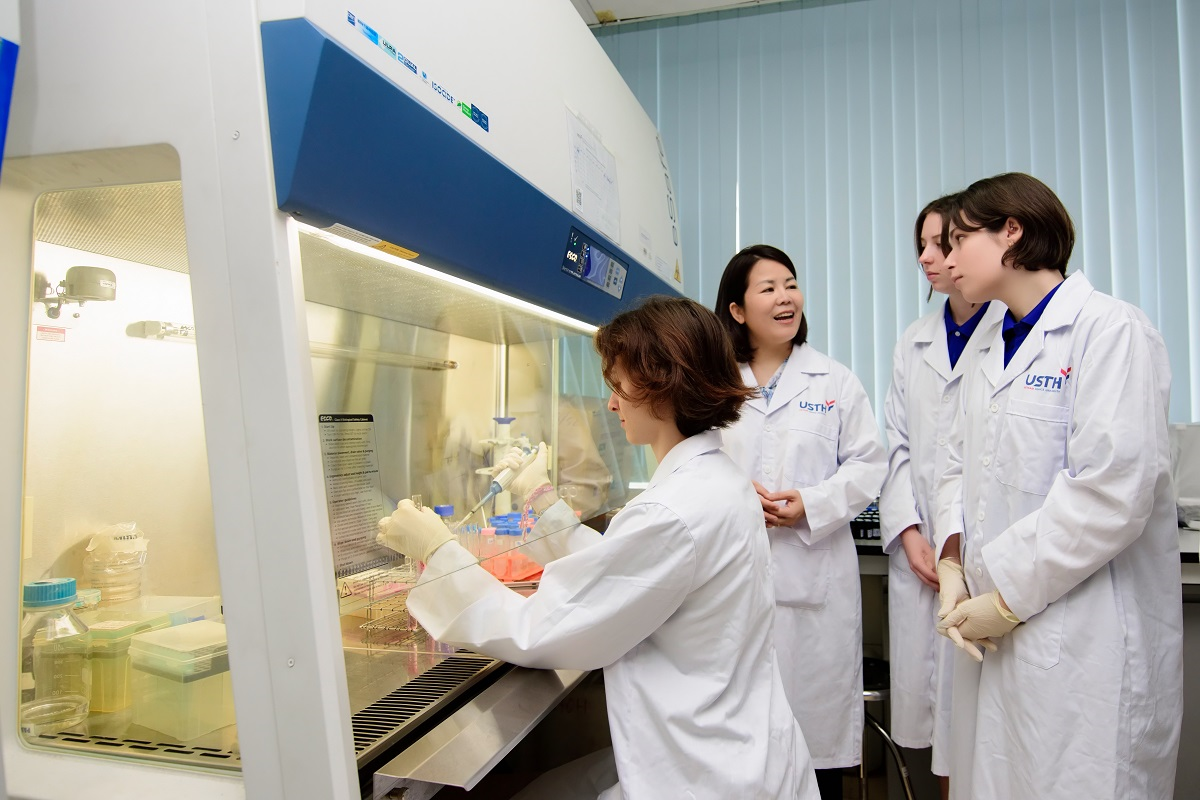 |
| Training activities at Hanoi University of Science and Technology. Photo provided by the subject. |
From the business perspective, there needs to be deeper and earlier involvement in the training process. Businesses can work with schools to define competency standards, send experts to teach specialized subjects, accept student interns, assign real-world problems, co-supervise projects, and participate in evaluating outcomes.
PV:
Associate Professor, Dr. To Thi Mai Huong: In my opinion, there are five important groups of solutions. First is to innovate the training program towards a more open, interdisciplinary, and practical approach. Innovating the program is not just about adding a few courses on artificial intelligence or entrepreneurship, but requires a change in the entire training logic: reducing passive learning and increasing project-based learning, problem-based learning, practical application, research-based learning, and learning aligned with the needs of the labor market.
Secondly, it is important to strengthen the connection between training and businesses, laboratories, and real-world projects so that learners can gain early exposure to a real-world work environment.
Thirdly, it's crucial to improve foreign language proficiency, digital skills, soft skills, and self-learning abilities, as these are key factors determining long-term adaptability.
The fourth solution is to invest in faculty and instructors. We cannot have a high-quality workforce if the training staff themselves are not regularly exposed to new technologies, modern research, and the practical needs of businesses.
Finally, it is necessary to strengthen the culture of innovation in schools and in society. High-quality human resources are not only those with good professional skills but also those who know how to ask questions, dare to experiment, have critical thinking skills, possess the ability to collaborate, and have the courage to learn from failure. If the education system only trains people to follow procedures without encouraging creativity, it will be very difficult to create a workforce that can lead major changes.
PV:
Source: https://www.qdnd.vn/giao-duc-khoa-hoc/cac-van-de/doi-moi-dao-tao-de-nang-cao-chat-luong-nhan-luc-1042080

![[Photo] The General Secretary, President and his wife begin their state visit to the Philippines.](https://vphoto.vietnam.vn/thumb/1200x675/vietnam/resource/IMAGE/2026/05/31/1780230559452_anh-man-hinh-2026-05-31-luc-19-28-11.png)
![[Photo] Admire the coral "masterpiece" amidst the million-year-old heritage of Dak Lak province.](https://vphoto.vietnam.vn/thumb/1200x675/vietnam/resource/IMAGE/2026/05/31/1780221235105_anh-man-hinh-2026-05-31-luc-16-53-27.png)

![[Photo] Solemn bathing ceremony and Buddha procession in Hue](https://vphoto.vietnam.vn/thumb/1200x675/vietnam/resource/IMAGE/2026/05/31/1780228263543_1-jpg.webp)



















![[Video] Sunset at Lap An Lagoon – Where the sun sets over the fishing nets](https://vphoto.vietnam.vn/thumb/340x192/vietnam/resource/IMAGE/2026/05/31/1780192137701_beach-landscape-sea-water-nature-grass-745871-pxhere-com.jpeg)





































![[Photo] Admire the coral "masterpiece" amidst the million-year-old heritage of Dak Lak province.](https://vphoto.vietnam.vn/thumb/402x226/vietnam/resource/IMAGE/2026/05/31/1780221235105_anh-man-hinh-2026-05-31-luc-16-53-27.png)
































Comment (0)