
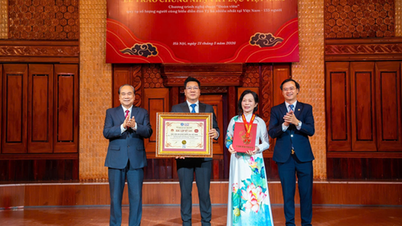
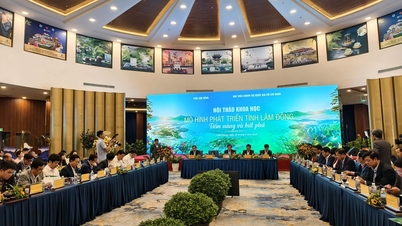
The seminar was organized to commemorate the 100th anniversary of the birth and the 30th anniversary of the death of ethnologist Nguyen Tu Chi.
Numerous scholars and scientists attending the conference commemorated and honored his achievements.
Ethnologist Nguyen Tu Chi (full name Nguyen Duc Tu Chi, pen name Tran Tu) was born on December 17, 1925, in Dong Hoi (formerly Quang Binh province, now Quang Tri province).
His ancestral family is the Nguyen Duc family from Ich Hau commune, Can Loc district, Ha Tinh province, a renowned Confucian scholarly family.
He grew up and matured in Hue. In 1945, just as he passed his full high school graduation exam in Philosophy and Literature at Pellerin High School in Hue, the August Revolution broke out.
Faced with many choices, he chose the path of going into the jungle to join the Viet Minh, then heading south to Military Zone 5 to resist the French.
In 1953, after participating in rent reduction and land reform, he was discharged from the army and transferred to Viet Bac to work at the Vietnam News Agency.
He returned to Hanoi in 1954, enrolled at Hanoi University in 1957, and then went to Guinea in 1961 to work as an education expert until 1963.
Upon returning to Vietnam, he worked at several organizations, most notably as an editor for the Culture and Arts Magazine.
Upon returning to Vietnam, he focused his research on the villages of the Vietnamese and Muong people. His work, " The Structure of Traditional Vietnamese Villages in Northern Vietnam, " is undeniably a masterpiece.
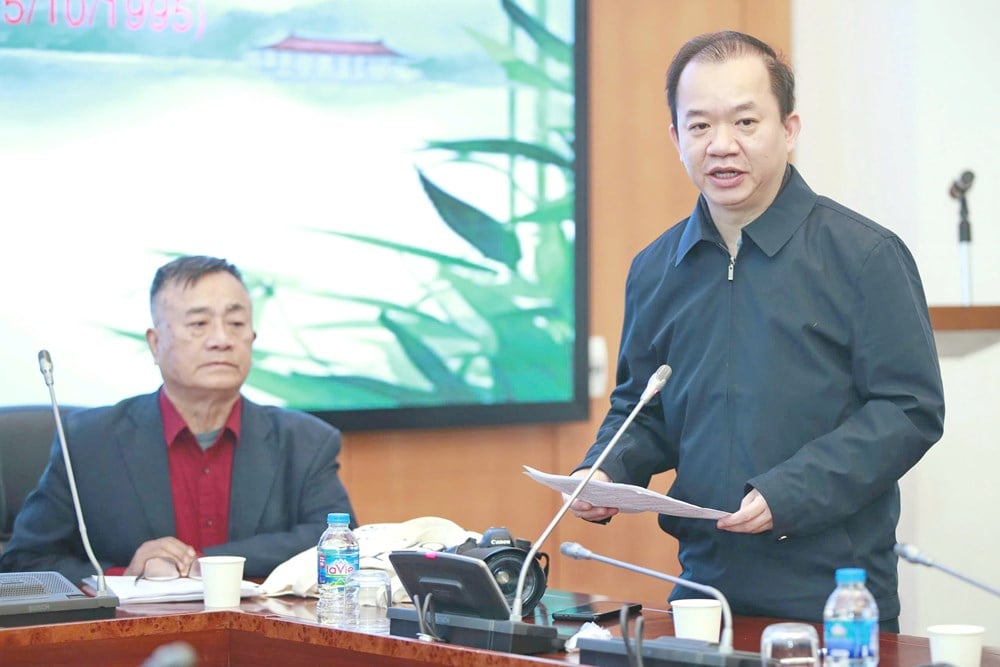
Associate Professor Bui Hoai Son, Standing Member of the National Assembly's Committee on Culture and Education, stated that the conference is a significant scientific and cultural event to honor a scholar who dedicated his entire life to scientific research.
Approaching from a structural theory perspective, with the rich field data he gathered from his keen observation and meticulous work in the field, and under his "magical" pen, the traditional Vietnamese village, from its overall structure to its constituent parts and their functions, was vividly depicted.
His major discovery regarding traditional Vietnamese villages was the issue of the Giap (district/commune). Nguyen Tu Chi clearly identified the constituent parts of the Giap, and moreover, the functioning of this social organization.
He also clearly pointed out the relationship between the administrative institution (the five-village system) and the self-governing unit—the "Giap"—to form a fascinating multi-dimensional Vietnamese village structure.
With his structural thinking, keen observation skills, and meticulous field research, Nguyen Tu Chi was very successful in his studies of the Muong people.
In his work "Muong Skirt Patterns ," Nguyen Tu Chi recognized that the pattern motifs expressed by contemporary Muong people on fabric using weaving techniques and the pattern motifs expressed by ancient people using bronze casting techniques on Dong Son bronze drums are all of the same type.
In his work "The Realm of Life and Death in the Traditional Beliefs of the Muong People ," Nguyen Tu Chi depicted the three-tiered, four-world universe of the Muong people.
In his work * Around the Forms of Exploiting Communal Land* , Nguyen Tu Chi described how the Lang-Dao social system, based on communal land, was established and operated.

Professor Tran Lam Bien emotionally expressed his admiration for the talent and virtue of ethnologist Nguyen Tu Chi.
Nguyen Tu Chi was not only a brilliant scientist, but he also always upheld professional ethics and was a man of great compassion...
He had a powerful influence and inspired the social science research community in general, and the ethnology/anthropology research community in particular.
In his speech at the opening ceremony of the Vietnam Museum of Ethnology (1997), French President Jacques Chirac stated that, along with Nguyen Van Huyen, he (Nguyen Tu Chi) was a great scholar and a role model.
For his professional achievements, ethnologist Nguyen Tu Chi was awarded the Ho Chi Minh Prize by the President of the Socialist Republic of Vietnam.
At the workshop, all participants expressed their wish that the authorities in Hanoi would choose a street to name after him: Nguyen Duc Tu Chi.
At the conference, Associate Professor Bui Hoai Son, Standing Member of the National Assembly's Committee on Culture and Education, stated that the conference was a significant scientific and cultural event to honor a scholar who dedicated his entire life to traveling, living, observing, reflecting, and writing about the cultures of Vietnamese ethnic groups with all the care, humanity, and tireless passion.
According to Mr. Bui Hoai Son, mentioning the ethnologist Tu Chi is not only mentioning a brilliant scholar but also a true cultural figure.
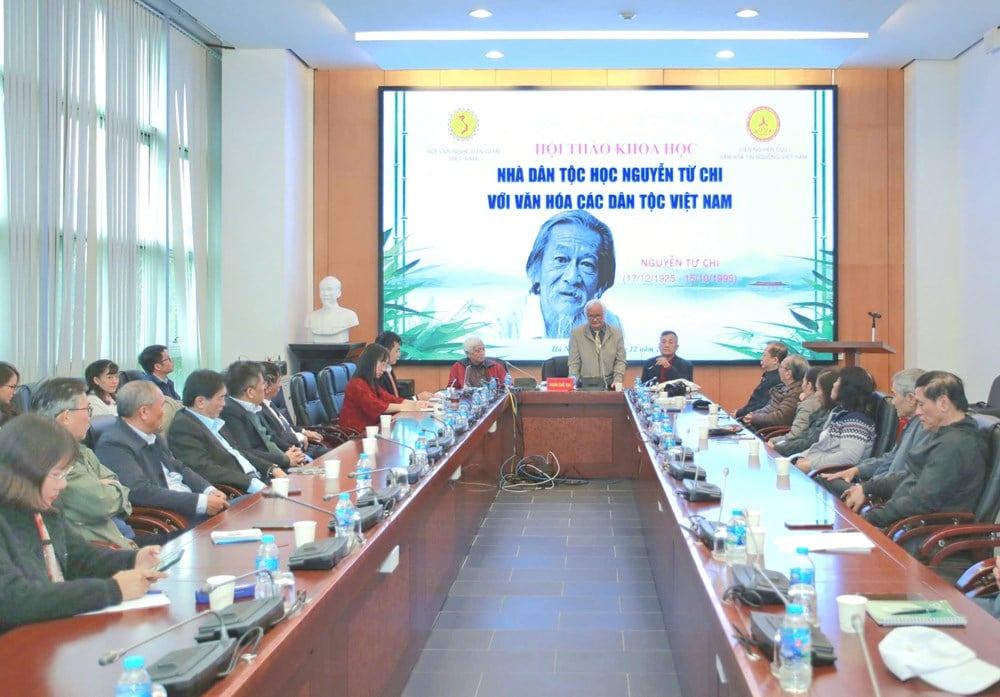
Numerous scholars and scientists attending the conference commemorated and honored the achievements of ethnologist Nguyen Tu Chi.
He didn't conduct research remotely or observe from the sidelines; instead, he approached the community with respect, with a spirit of engagement, and with a desire to understand and share.
That is why each of his works possesses a unique cultural and anthropological depth.
Among these valuable contributions, the outstanding research works of ethnologist Nguyen Tu Chi have become milestones in Vietnamese ethnology.
Mr. Bui Hoai Son stated that, in the context of the country entering a new era of development, the Party and the State have always affirmed that culture is the spiritual foundation of society, an intrinsic strength, and a regulating system for the sustainable development of the country.
At this time, the academic values of ethnologist Tu Chi are becoming even more relevant.
He reminded us that we must understand and respect the culture of each ethnic community, because every custom, every symbol, every traditional institution embodies the history, meaning, and adaptive experience of many generations. Ignoring this will make it difficult for policies to be effectively implemented.
"Today, urbanization, climate change, labor migration, and digital transformation are having a profound impact on the cultural lives of ethnic groups."
"It is serious, empathetic research like that of ethnologist Tu Chi that will help us preserve and promote cultural identity in a vibrant way, without extremism, without museumization, and without separating ourselves from the community," said Mr. Bui Hoai Son.
Mr. Bui Hoai Son also stated that he supports naming a street after the ethnologist Nguyen Tu Chi.
At the conference, scientists and researchers expressed their admiration and respect for ethnologist Tu Chi, not only for his scientific achievements but also for his character, including humility, honesty, and humanism.
Professor Tran Lam Bien emotionally stated that ethnologist Tu Chi was a giant of intellect hidden behind a simple frame and humble belongings.
Historian Duong Trung Quoc expressed his admiration and affirmed that people like ethnologist Tu Chi were a "golden generation" who accomplished many miracles in the revolutionary cause, and who were dedicated and inspiring to future generations.
Source: https://baovanhoa.vn/van-hoa/tuong-nho-ton-vinh-nha-dan-toc-hoc-nguyen-tu-chi-193204.html




![[Video] Sunset at Lap An Lagoon – Where the sun sets over the fishing nets](https://vphoto.vietnam.vn/thumb/1200x675/vietnam/resource/IMAGE/2026/05/31/1780192137701_beach-landscape-sea-water-nature-grass-745871-pxhere-com.jpeg)

![[Image] A brilliant symphony and explosive power in the skies of Da Nang.](https://vphoto.vietnam.vn/thumb/1200x675/vietnam/resource/IMAGE/2026/05/31/1780193150738_anh-bia-copy-jpg.webp)













![[Video] Sunset at Lap An Lagoon – Where the sun sets over the fishing nets](https://vphoto.vietnam.vn/thumb/800x450/vietnam/resource/IMAGE/2026/05/31/1780192137701_beach-landscape-sea-water-nature-grass-745871-pxhere-com.jpeg)


































![[Video] Sunset at Lap An Lagoon – Where the sun sets over the fishing nets](https://vphoto.vietnam.vn/thumb/402x226/vietnam/resource/IMAGE/2026/05/31/1780192137701_beach-landscape-sea-water-nature-grass-745871-pxhere-com.jpeg)


































Comment (0)