


On Yas Island, Abu Dhabi's upscale strip of land famous for Formula 1 races, a miniature model of a data center complex with rows of servers surrounded by greenery and solar panels sits on the desk of Talal Al Kaissi, interim CEO of Core42, a subsidiary of G42 Group.
In a small corner of the model, two flags are planted side-by-side: the UAE flag and the American flag. In May 2025, Al Kaissi will display this model to President Donald Trump. This is seen as a declaration of a future that the UAE is wholeheartedly working to build, according to Bloomberg .
According to the Microsoft AI Diffusion Report for Q1 2026, the rate of AI adoption in the UAE workforce reached 70.1%, nearly four times the global average of 17.8%. Gulf News reported that the UAE is the first economy on the planet to surpass the 70% mark, after a continuous acceleration in just a few quarters.
Amr Kamel, General Manager of Microsoft UAE, stated that this is the result of “years of sustained focus from governments , businesses, and individuals on building the right foundations.”
These foundations stem from a bold strategy. On May 1, 2026, the UAE officially leaves OPEC after more than five decades as a founding member, a decision that many observers call the “final chapter” of the alliance that once shaped the global energy market, according to Semafor .
The interesting paradox is that leaving OPEC doesn't mean the UAE isn't giving up oil; in fact, it wants to extract more, aiming for 5 million barrels per day by 2027, with a plan to invest $145 billion before 2030.
Natural gas, once considered a byproduct of the extraction process, has now become a cheap energy source to power massive AI data centers. This is Abu Dhabi's strategic cycle: maximize oil and gas production during the remainder of the fossil fuel era, use that revenue to build AI infrastructure, and then enter the post-oil era as a technological powerhouse.
Reuters noted that the alliance with Washington is an indispensable leverage for this strategy. In January 2026, the UAE joined the Pax Silica program, a US-led initiative aimed at securing the supply chain for semiconductor chips and AI.
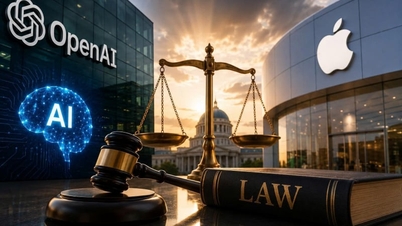
In return, the UAE committed to investing more than $1.4 trillion in the US over a decade, including OpenAI's Stargate project. Leading that strategy is G42, a technology conglomerate that Pablo Chavez, a senior fellow at Georgetown University's Center for Security and Emerging Technologies, described as the "ADNOC of AI," according to Bloomberg .
The UAE's ambitions extend even further: to become a technological bridge for the Southern Hemisphere through a "data embassy" model that allows countries to lease server space in Abu Dhabi and operate AI services under their own laws.
Al Kaissi described it as “a modern version of the Vienna Convention but for data centers,” according to Bloomberg . This is a subtle geopolitical move: the UAE is both attracting Western investment and expanding its influence southward, positioning itself as the architect of a new global technology order.
Source: https://baodanang.vn/uae-tu-vuong-quoc-dau-mo-den-cuong-quoc-ai-3337129.html

![[Photo] The courage of new recruits of Brigade 144 on the training ground.](https://vphoto.vietnam.vn/thumb/1200x675/vietnam/resource/IMAGE/2026/05/27/1779881651341_anh-man-hinh-2026-05-27-luc-18-32-52.png)


![[Photo] The heat at the fireworks display site on the opening night of the Da Nang International Fireworks Festival 2026](https://vphoto.vietnam.vn/thumb/1200x675/vietnam/resource/IMAGE/2026/05/27/1779889741485_ndo_br_z7872039145157-fecaba5112f39e8352544099d7ef4738-5140-jpg.webp)



















































![[Photo] The courage of new recruits of Brigade 144 on the training ground.](https://vphoto.vietnam.vn/thumb/402x226/vietnam/resource/IMAGE/2026/05/27/1779881651341_anh-man-hinh-2026-05-27-luc-18-32-52.png)

























Comment (0)