

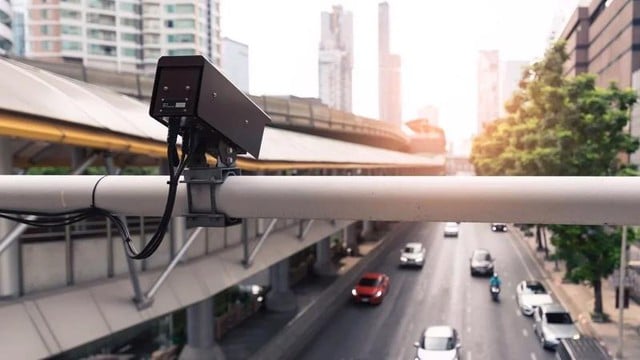
AI-powered cameras are being used to improve security and traffic management. (Illustrative image)
Optimizing traffic flow is just one of the applications of AI in intelligent transportation systems. Currently, Hanoi is implementing AI-based solutions in traffic control and piloting intelligent transportation models.
Introduced on a pilot basis in 2024, the Hanoi Urban Traffic Management Center, with its management software system and peripheral equipment, has 12 basic functions including: Traffic monitoring; traffic information provision; traffic control; support for handling traffic safety violations; public transport management; parking management; incident management; traffic infrastructure management; public transport electronic ticket payment management; transport management; traffic demand management; and traffic simulation in the management, operation, and control of transportation.
AI will be gradually applied to these functions to provide effective solutions, contributing to improved efficiency in urban traffic management and operation.
According to transportation experts, intelligent transportation systems optimize traffic flow, making traffic smoother. This saves travel time, reduces fuel costs, and decreases the number of vehicles on the road. Simultaneously, it contributes to reducing environmental pollution from emissions and decreasing the likelihood of traffic accidents.
Contributing to improving the effectiveness of monitoring and handling violations.
Hanoi currently has hundreds of traffic surveillance cameras operating 24/7, recording violations on its roads. Data from the cameras is transmitted directly to the Traffic Command Center (Hanoi Traffic Police Department) for monitoring, analysis, and processing by relevant authorities.
With smart surveillance cameras, traffic conditions on many streets and intersections, as well as traffic conflicts and collisions, are continuously updated to the central monitoring center. License plates of cars and motorcycles are clearly recorded by the cameras in real time.
In addition, the city is expanding the deployment of smart surveillance camera systems, integrated with AI, to support more effective security and traffic monitoring.
Specifically, the City Police are expanding their surveillance network with four projects to install an additional 3,700 AI-powered cameras to enhance security, public order, and traffic management. The new system will be capable of facial recognition and license plate recognition, helping to verify identities in security-related incidents.
Simultaneously, the system monitors and detects traffic violations, providing real-time warnings of potential safety hazards. Furthermore, this camera system will integrate with intelligent operational data, enabling rapid response in emergency situations…
A representative from the Hanoi Traffic Police Department stated that with the current camera system, if people do not voluntarily comply with traffic regulations, or only comply when traffic police are present, the cameras will record the incident and notify the checkpoints on the road for appropriate action.
The excuses of forgetting or losing documents to avoid being impounded are unconvincing, as a simple lookup on current applications will provide the name, age, vehicle owner's information, and violation history, allowing traffic police to take appropriate action according to regulations.
Furthermore, the installation of AI cameras allows the city to apply them to many other areas, such as detecting sidewalk encroachment and littering to maintain a cleaner urban environment; supporting security and detecting incidents on the roads to ensure the safety of citizens; and providing data for urban planning, helping Hanoi develop in a more systematic and scientific way. This is the foundation of a smart city.
It is evident that the application of science and technology is a noteworthy trend. This trend not only helps improve the efficiency of monitoring and handling violations but also contributes to the transparency of the task enforcement process, minimizing disputes between law enforcement and road users when issuing warnings or penalties.
Thanks to advanced modern technology, violation data is accurately recorded, fully stored, and can be extracted so that people can review their violations in a realistic way. This not only supports the quick and accurate handling of violations but also raises awareness of traffic law compliance and spreads the message of responsible traffic behavior among the public.
Dieu Anh
Source: https://baochinhphu.vn/ung-dung-ai-de-quan-ly-giao-thong-thong-minh-103250401161503081.htm
![[Photo] Prime Minister Pham Minh Chinh attends the Conference on the Implementation of Tasks for 2026 of the Industry and Trade Sector](/_next/image?url=https%3A%2F%2Fvphoto.vietnam.vn%2Fthumb%2F1200x675%2Fvietnam%2Fresource%2FIMAGE%2F2025%2F12%2F19%2F1766159500458_ndo_br_shared31-jpg.webp&w=3840&q=75)






















































































Comment (0)