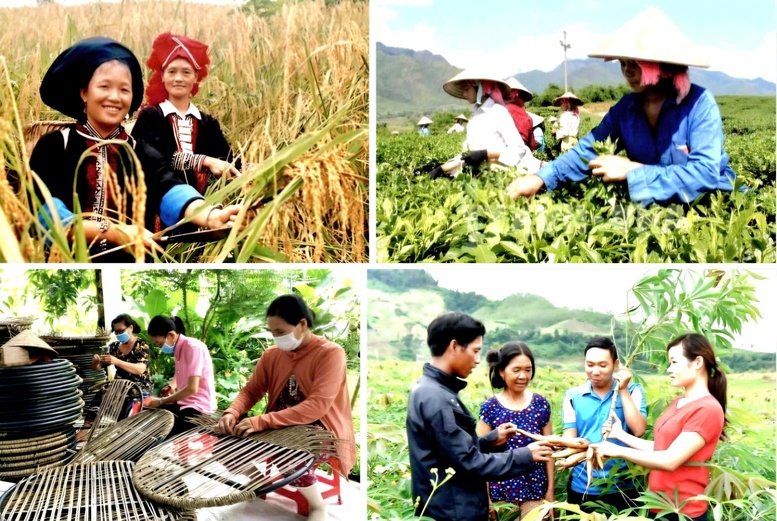
Prioritize allocating the highest level of funding to disadvantaged regions.
The Government Office issued Notice No. 209/TB-VPCP summarizing the conclusions of Deputy Prime Minister Ho Quoc Dung at the meeting on the National Target Program for building new rural areas, sustainable poverty reduction, and socio-economic development in ethnic minority and mountainous regions.
According to the Announcement, the National Target Program for building new rural areas, sustainable poverty reduction, and socio -economic development in ethnic minority and mountainous areas for the period 2026-2035 was approved by the 15th National Assembly in Resolution No. 257/2025/QH15 dated December 11, 2025. This is the Program. This is of great importance, contributing to poverty reduction, building new rural areas, and promoting socio-economic development, especially in ethnic minority and mountainous regions.
The Ministry of Agriculture and Environment , the Ministry of Ethnic Minorities and Religions, and several other relevant ministries and agencies have actively and promptly submitted to competent authorities for promulgation, and issued within their authority, regulations and guidelines for the implementation of the Program. Local authorities have issued documents specifying the central government's regulations and guidelines; reviewed and assessed the current situation in their areas to determine objectives, tasks, and the ability to balance, allocate, and mobilize resources; and developed plans for the implementation of the Program.
Despite the achievements, the implementation of the Program still faces some shortcomings and limitations: The progress of the National Target Program remains slow; some regulations and guidelines under the responsibility of ministries and agencies are still incomplete; the disbursement of funds for 2025 has been extended into 2026 and is still very slow, while the volume of transitional work is large; coordination between ministries and sectors is not truly decisive and synchronized, affecting the progress of implementation and the organizational plan at the local level.
Ensuring that national target programs are truly implemented and yield tangible results.
The Deputy Prime Minister affirmed that the effective implementation of the National Target Program will contribute to changing the face of rural and mountainous areas, improving the lives of people, especially poor households and ethnic minorities. Ministries, sectors, and localities must urgently and decisively implement the assigned tasks, ensuring that the National Target Program truly comes to life and brings tangible results.
To expedite the implementation of the program, the Ministry of Agriculture and Environment, the Ministry of Ethnic Minorities and Religions, and other ministries, sectors, and localities must proactively direct and promptly address difficulties and obstacles during implementation within their assigned authority and responsibilities; promptly propose and report to competent authorities for guidance on handling issues beyond their authority; continue to review and promote decentralization and delegation of power; reduce and simplify administrative procedures as much as possible in the implementation of the Program, while strengthening supervision, inspection, and prevention of corruption, waste, and negative practices. In the coming period, it is requested that the ministries, Agencies should enhance their responsibility, regularly monitor and closely follow the situation to improve the effectiveness of the Program according to the mechanisms and policies issued, ensuring the progress and results of implementation.
Develop a Handbook on Building New Rural Areas and Modern New Rural Areas.
In this regard, the Ministry of Agriculture and Environment, in coordination with the Ministries of Ethnic Minorities and Religion, the Ministry of Interior, and other relevant agencies, will urgently submit to the Prime Minister a proposal to establish a Central Steering Committee in April 2026, and simultaneously guide localities in establishing Steering Committees at all levels in accordance with regulations.
Simultaneously, the Ministry of Agriculture and Environment is responsible for monitoring, urging, and compiling the implementation of the Program, promptly resolving difficulties and obstacles, and reporting emerging issues to the Government and the Prime Minister; guiding and supporting localities to accelerate the implementation of the Program; leading and coordinating with the Ministry of Ethnic Minorities and Religions and relevant agencies to strengthen inspection, supervision, monitoring, and evaluation of the Program's implementation; and promptly reporting emerging issues to competent authorities for handling.
The Ministry of Planning and Investment will chair and coordinate with relevant agencies to develop a Handbook on building new rural areas and modern new rural areas for the period 2026-2030 in the second quarter of 2026; prioritize allocating maximum resources to localities, ensuring sufficient recurrent expenditure for ministries and sectors, clearly defining priority tasks and items, focusing on definitively resolving essential needs of the people (production land, housing land, clean water, healthcare, education), especially clean water and electricity in 2026 and 2027, giving maximum priority to disadvantaged areas, ethnic minority areas and mountainous regions, avoiding scattered investment, and not selecting easy-to-implement items that do not meet the actual needs of the people.
Ministries and agencies: Construction; Science and Technology, Finance, Education and Training, Justice, National Defense; Vietnam Women's Union and related agencies are urged to promptly issue guiding documents for the implementation of criteria within their respective sectors in April 2026 and issue legal documents guiding the implementation of the Program in May 2026.
Promptly resolve procedural obstacles to prevent capital stagnation.
The Ministry of Agriculture and Environment, the Ministry of Ethnic Minorities and Religion, and the Ministry of Finance, according to their assigned functions, tasks, and authority, shall continue to guide (if necessary) and urge ministries, central agencies, and localities to focus on disbursing funds from the 2021-2025 period carried over to 2026 (especially in cases where there are no longer any expenditure tasks); promptly resolve procedural obstacles, and prevent the situation of funds remaining idle or being withdrawn, affecting disadvantaged localities.
Ministries, relevant agencies, and localities using state budget funds may decide to adjust funding from other contents and activities, ensuring that the total amount does not exceed the allocated limit and does not change the structure of investment and recurrent expenditures already assigned by competent authorities. In cases where there are no longer any expenditure tasks or the remaining tasks cannot be implemented, the remaining funds may be used to implement the contents, tasks, and investment projects under the Program.
The Ministry of Finance, in coordination with the Ministry of Agriculture and Environment and other agencies, will urgently handle the allocation of central government budget funds for 2026 to implement the Program; and will coordinate with the Ministry of Agriculture and Environment to issue a Circular regulating the management, use, and settlement of state budget funds for the Program in May 2026.
The State Bank of Vietnam is responsible for implementing the task of developing preferential credit policies at the Social Policy Bank to carry out the Program as assigned in Resolution No. 424/NQ-CP dated December 30, 2025 and Decree No. 358/2025/ND-CP dated December 31, 2025 of the Government.
Prioritize resource allocation for specific regions.
The People's Committees of provinces and cities should proactively implement the policies and mechanisms that have been issued. If any difficulties or obstacles arise during implementation, they should promptly report them to the competent authorities for consideration and resolution.
Implement and allocate central government budget funds and local counterpart funds for each project and sub-project, ensuring that the funds are allocated to the correct beneficiaries and according to the prescribed limits as stipulated in Decision No. 16/2026/QD-TTg dated April 15, 2026; prioritize resources for specific regions, focusing on allocating the highest level of capital to particularly disadvantaged communes and villages, ethnic minority areas, and mountainous regions. Prioritize investment in essential infrastructure, ensuring focused and targeted investment to maximize efficiency and avoid scattered spending. Finalize the implementation plan for the Program for the 2026-2030 period and the local plan for 2026; focus on accelerating the disbursement of 100% of the central government budget funds for 2025, which have been extended to 2026, and strengthen the mobilization of non-budgetary capital sources. Clearly define objectives and create breakthroughs in rural and mountainous development, especially promoting digital transformation linked to tourism development, thereby improving people's lives. Expeditiously review and address unfinished tasks and projects, and review tasks that no longer have beneficiaries or budget needs from the three national target programs for the 2021-2025 period that have been extended to 2026, in order to adjust them to implement the program's contents, tasks, and projects in accordance with the authority and regulations.
Strengthen inspection, supervision, and periodic review and evaluation; thoroughly review the implementation process to ensure the use of public funds is transparent and for the intended purpose; use output results, implementation progress, disbursement rate, efficiency of capital use, and the degree of improvement in people's lives as the main basis for evaluation in 2026, and as a basis for guidance and management in subsequent years.
Phuong Nhi
Source: https://baochinhphu.vn/uu-tien-phan-bo-von-muc-cao-nhat-cho-vung-kho-khan-102260424173916284.htm




![[Image] Hanoi's urban life under the challenge of a "scorching hot" environment](https://vphoto.vietnam.vn/thumb/1200x675/vietnam/resource/IMAGE/2026/05/25/1779706979265_nang-nong-t5-2026-minh-duy-7-4636-jpg.webp)


![[Image] Close-up view of the interchange connecting the two expressways and Long Thanh Airport.](https://vphoto.vietnam.vn/thumb/1200x675/vietnam/resource/IMAGE/2026/05/25/1779703378210_ndo_br_z7863716673926-224453a31600126cce10622af6290afd-4549-jpg.webp)














































































Comment (0)