

 |
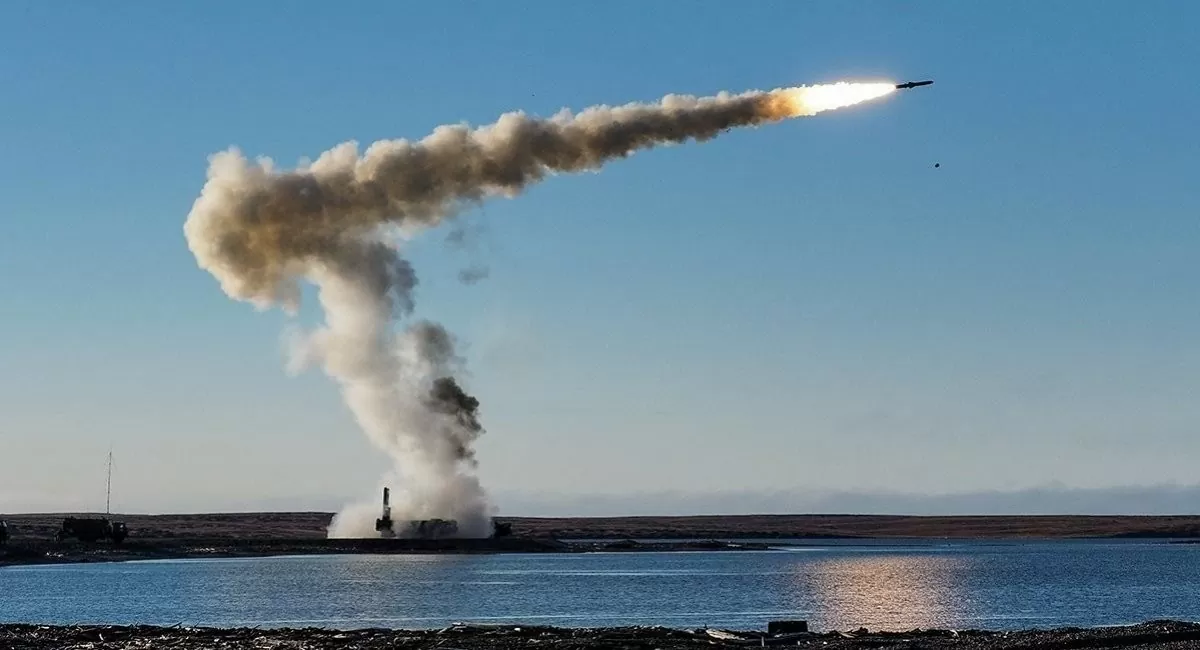
| The Russian military's P-800 Oniks supersonic cruise missile. (Source: TASS) |
The P-800 Oniks missile began development in 1987 under the Soviet Union, when the manufacturer aimed to create an advanced missile capable of neutralizing aircraft carriers and heavily protected warships of the enemy military.
Designed to perform a variety of missions, Oniks can attack warships and land targets. The integration of advanced guidance systems, supersonic engines, and compatibility with flexible launch platforms has increased its versatility.
Manufactured by NPO Mashinostroyeniya, the P-800 Oniks missile is still in production today. Its combat effectiveness has been proven in numerous conflicts, including the Syrian civil war and the Russia-Ukraine conflict. With the ability to be deployed from warships, submarines, coastal systems, and aircraft, the P-800 Oniks is a core component of Russia's missile arsenal.
According to Sputnik, citing sources from the Russian military- industrial complex: The missile has a powerful aerodynamic design, with a length of 8.3 meters, a diameter of 67 cm, and a launch weight of approximately 3,000 kg, featuring stabilizing fins and a propulsion engine for initial acceleration.
Operating in two distinct flight modes: at high altitude, the missile reaches a height of up to 14 km, and at low altitude, it maintains an altitude of approximately 10-15 meters during the approach phase to the target, in order to avoid detection.
The P-800 Oniks has various warhead types to adapt to different mission requirements. Domestic versions are equipped with 250 kg armor-piercing warheads, capable of penetrating heavily armored targets such as warships. Export versions typically use 200 kg high-explosive warheads. Both warhead types ensure high destructive effectiveness against sea and land targets.
The missile is equipped with a supersonic ramjet engine using kerosene fuel, which operates after the solid-fuel engine's initial acceleration phase is complete, allowing the missile to reach speeds of up to 750 m/s at high altitudes. At low altitudes or during the final phase, the missile reaches a maximum speed of 680 m/s.
According to Sputnik, the missile's range depends on its flight path. When flying at high altitude, it can travel up to 300 km, while at low altitude the range decreases to 120 km.
This type of weapon is a real threat to enemy warships, combining supersonic speed with extremely low flight altitude.


![[Photo] Prime Minister Pham Minh Chinh attends the Conference on the Implementation of Tasks for 2026 of the Industry and Trade Sector](/_next/image?url=https%3A%2F%2Fvphoto.vietnam.vn%2Fthumb%2F1200x675%2Fvietnam%2Fresource%2FIMAGE%2F2025%2F12%2F19%2F1766159500458_ndo_br_shared31-jpg.webp&w=3840&q=75)



































































































Comment (0)