

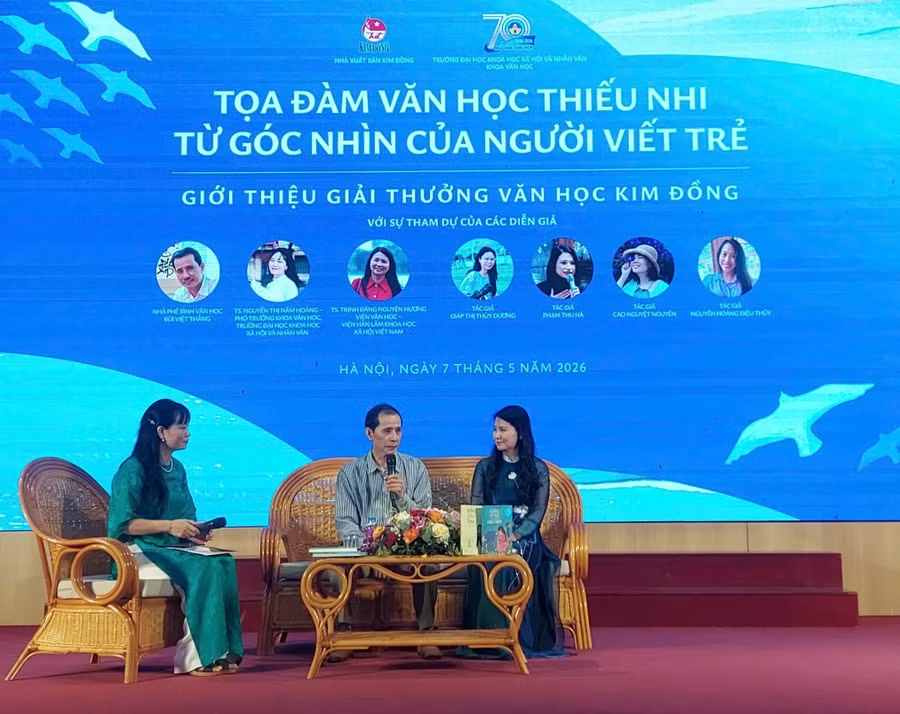
Children today read less despite the abundance of beautiful and engaging children's literature – this was the concern of the speakers at the seminar "Children's Literature from the Perspective of Young Writers".
There are quite a few concerns.
Literary critic Bui Viet Thang expressed concern about reader reception, noting that many people are losing interest in books, or even have lost the habit of reading altogether.
"According to official figures, the average Vietnamese person reads 4 books per year, but 2.8 of those are textbooks. Meanwhile, the average Japanese person reads 20 books per year, and countries like Israel, Germany, the US, and Russia are all reading powerhouses," Mr. Thang stated.
Based on her observations over the years, Dr. Trinh Dang Nguyen Huong has noticed that children today have too little physical (time) and psychological space. Specifically, their time is allocated to extra classes, skills development, and the regular curriculum, leaving them with almost no time to pick up a literary work to read.
Furthermore, these children lack moments of quiet reflection where they can immerse themselves deeply in a book, completely becoming one with the world of literature. That was the era of the 70s and 80s, with their incredibly happy years of being completely absorbed in books, reading, being captivated, feeling sadness and joy along with the sentences and verses.
"Children today lack psychological space, time, and all of that, coupled with the generally fast-paced lifestyle of society, means that when they get home they are often very tired and unable to read, not because there is a lack of beautiful or interesting books," Ms. Huong emphasized.
From a writer's perspective, author Pham Thu Ha stated that when she started writing for children, she recognized it as a battle she... lost. Her reason for losing was quite honest: "Because how could I possibly win against the incredibly engaging content on social media? From a very young age, children are already using their phones to browse TikTok and are accustomed to short content, so it's difficult to get them to sit alone with a book full of black and white text."
Parental support is needed.
Discussing solutions to bring books to young readers, author Thu Ha believes there is still hope in the support from publishers and adults. However, she also worries that instilling a love of books is never easy, as this is something that 60-70% of parents fail to achieve. This is because it's much easier to be a lazy and indulgent parent than a disciplined parent who guides their children in good manners.
She cited the example of feeding a child; giving them a phone makes it much easier than trying to talk to them and nurture them according to their natural desire to eat. “For works to be successful, they really need parental support because they are the ones who will guide and choose what their children should and shouldn't read. Therefore, in addition to the author's efforts, parental involvement is always necessary,” author Thu Hà expressed.
Agreeing with this viewpoint, Dr. Nguyen Thi Nam Hoang, Deputy Head of the Literature Department, Hanoi University of Social Sciences and Humanities, believes that this is a common story of family and society, not just the writer's story.
"Because it's true that it's much easier to be a lazy parent and a lazy child these days because there are so many attractive things, but it also hides the risk of losing reading ability, especially when reading long, useful things that require patience, like literature," said Ms. Nam Hoang.
By emphasizing that children's literature always contains many values and is a beautiful, bright land where both adults and children can immerse themselves to find happiness and fascination, Dr. Trinh Dang Nguyen Huong hopes to create spaces for children to read, learn, and absorb works of children's literature.
More specifically from a school perspective, Ms. Huong assessed that current lessons tend to focus on analyzing and dissecting literary works. For example, "The Adventures of Cricket" is a classic work of Vietnamese literature, but the way it is taught in secondary schools is not appropriate, especially the excessive analysis, to the point that children feel... "bored".
"For secondary schools, we need to create more practical activities such as encouraging students to engage in critical thinking and debate, fostering diverse and varied perspectives, and providing more free time along with a happy reading environment. This will encourage them to love and care more about children's literature," suggested Dr. Nguyen Huong.
“From this seminar, we will look back at the landscape of children's literature, and at the same time, engage in dialogue between experts, critics, young writers, and readers, to help us gain a multifaceted perspective on children's literature. Simultaneously, we will listen to the thoughts, explorations, and creative efforts of the new generation of authors, as well as understand the feelings and needs of today's young readers,” said Ms. Vu Thi Quynh Lien, Deputy Director and Editor-in-Chief of Kim Dong Publishing House.
Source: https://giaoducthoidai.vn/van-hoc-thieu-nhi-mo-canh-cua-cho-tre-buoc-vao-post779595.html
![[Photo] General Secretary and President To Lam presides over a meeting on preparations for the review of one year of operation of the three-tiered government system.](https://vphoto.vietnam.vn/thumb/1200x675/vietnam/resource/IMAGE/2026/06/02/1780391821195_a1-bnd-4595-9717-jpg.webp)






































































Comment (0)