

.jpg)
Reading should not be just a chore.
- In the context of children becoming increasingly attached to screens and digital devices, how do you view the current state of reading culture among children? Why do many children fail to develop a sustainable reading habit?
- I believe the biggest paradox today is that children don't lack books, in fact, they have an "excess" of them, but they lack truly in-depth reading experiences. They are exposed to a huge amount of information every day through social media, short videos , and digital devices, but their ability to sit still with a book, patiently follow a story, and think along with the characters is noticeably declining.
In my opinion, the cause lies not only in technology but also in the increasingly hectic pace of adult life. Screens provide instant stimulation and feedback, while reading requires concentration, slowness, and imagination. Unfortunately, adults have less and less time to accompany children in this process. Parents are busy, children have packed schedules with extracurricular activities, skill development, etc. In many families, phones or computers have inadvertently become the quickest "babysitter" tools.
A child accustomed to having all their entertainment needs met instantly on a screen will find it difficult to be patient with reading. Furthermore, academic pressure and the pursuit of achievement often turn reading into a chore: having to read a certain number of pages, retell the content, or achieve a specific goal. For children, however, reading should first and foremost be an emotional experience. They can only truly love reading when they find joy, empathy, and a feeling of being heard and understood in the book. But developing this requires time, repetition, and a sufficiently peaceful reading environment.
- As the founder of the Language and EQ (Emotional Intelligence) Club, do you think we are currently teaching children more about "reading" than "reading emotions"?
- I think that's quite evident. Often, we train children to read very quickly but have very little empathy. They can analyze texts, answer questions, or do assignments well, but they struggle to name their own emotions, empathize with others, and find inner peace more easily.
In my opinion, reading ability and emotional intelligence are very directly related. A child who reads literature well is usually better able to put themselves in other people's shoes. When reading a story, children learn to understand human sadness, loneliness, hope, or hurt. This is also the foundation of emotional intelligence.
The worrying issue today is that many children are exposed to a huge amount of information but lack the ability to listen to their own emotions. They are used to watching quickly, reacting quickly, and moving on quickly, but lack moments of quiet reflection to think more deeply about a story or an emotion.
I also believe we often confuse encouraging children to read with forcing them to read. If reading is only linked to pressure from tests or achievements, it's very difficult for children to develop a natural love for books. Some children read a lot but view reading as a duty they must fulfill.
However, from a certain perspective, initial guidance and discipline in reading are still essential. Because any habit needs to be nurtured with perseverance. The important thing is that adults have the right methods and a suitable roadmap so that reading gradually becomes a source of joy for children. The ultimate goal is not to read a lot, but for children to feel happy when reading.
"Touching" the psychological world of children.
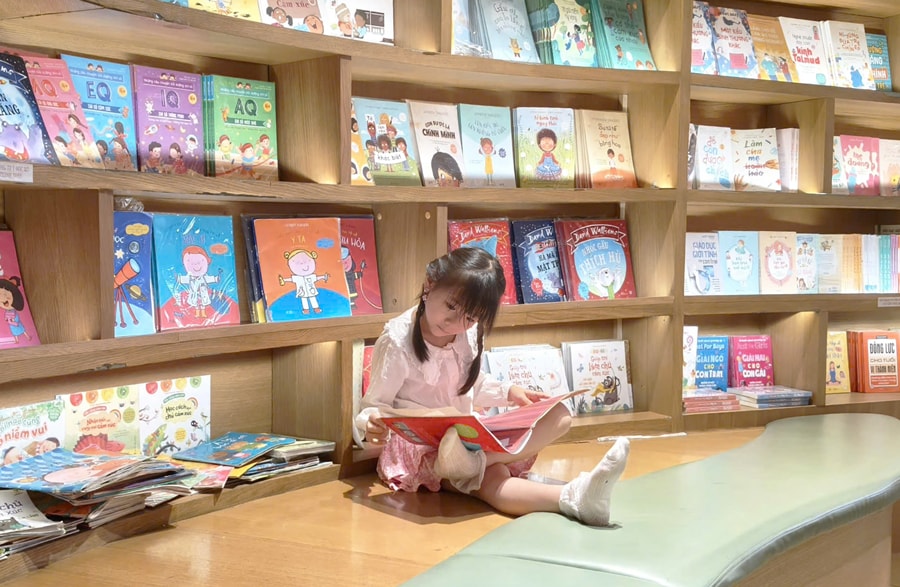
- From the perspective of an educator and children's book publisher, what criteria do you think a good children's book should meet today?
In my opinion, a good children's book needs to have three elements: a compelling story, beautiful language, and genuine emotion. But if I had to choose the most important, I would choose emotion. Children are very sensitive. They can immediately recognize whether a story is written with genuine love or is just a package of moral lessons. A good children's book shouldn't be overly didactic, but rather open up opportunities for children to experience emotions, use their imagination, and discover for themselves.
Language in children's books is also very important. Children deserve to be exposed to the beauty of the Vietnamese language from an early age. A sentence rich in rhythm, imagery, and emotion can nurture a child's soul for much longer than many dry lessons. In my opinion, the biggest problem with children's books today is not necessarily that they are "not good," but rather that they need to be "suitable for the right audience." There are books that adults think children will like, but in reality, they fail to touch the psychological world of children today. Writing for children is a very difficult task, because the writer not only needs to understand children but also needs to retain a part of their own childlike spirit.
- To what extent is Vietnamese culture and contemporary life being incorporated into children's books today?
- In recent years, there have been many commendable efforts to incorporate Vietnamese culture into children's books, from customs, festivals, rural life, food, to family life. Some works have also begun to clearly reflect the spirit of contemporary Vietnam. For example, recently, during Tet (Vietnamese New Year), I've seen quite a few interesting books, such as "Fleeting to Tet" or "Loving Horse Tet" by the Ladybug group. However, in my opinion, today's children not only need to read stories that are "culturally accurate" but also need to see their own lives reflected in them: city children, academic pressure, technological changes, feelings of loneliness, or the desire for connection... Vietnamese culture is not only found in memories or the past but also in the rhythm of life today. I think every generation needs memories of its time, the voice of its time, and stories that accurately reflect the mood of its generation. Children's literature, in a sense, is the repository of those memories. So, literature, just try to fulfill your mission. I think everything will happen... naturally.
- If reading is considered the foundation for character development and self-learning abilities, what changes, in your opinion, do families, schools, and the publishing industry need to make to "nurture" a generation of young readers?
-In my opinion, the first thing that needs to change is how adults view reading. We shouldn't see reading as just a tool to improve academic performance or achieve better results. Reading is primarily about self-understanding, understanding others, and improving the quality of life. Families need to create quiet time for children to read and converse. A child will find it difficult to love books if no one in their home reads, tells stories, or shares their feelings about a book. I think children's reading culture always begins with adults' reading culture. Schools also need to transform reading into a life experience instead of just a learning task. This could include free reading sessions, conversations about characters, creative activities based on books, etc., so that children feel reading is natural and familiar. As for the publishing industry, I believe there needs to be more serious investment in Vietnamese children's books, from authors, editors, illustrators to distribution strategies. Vietnamese children need books that are both modern and engaging, while also possessing cultural depth and humanistic emotions. A generation of readers cannot be created simply by having more books, but by books that truly touch the hearts of young children.
Thank you for the conversation!
Source: https://hanoimoi.vn/tien-si-dieu-lan-phuong-van-hoa-doc-cua-tre-em-luon-bat-dau-tu-van-hoa-doc-cua-nguoi-lon-976489.html






















![[Photo] Reception to welcome General Secretary and President To Lam and his wife on their State visit to the Philippines](https://vphoto.vietnam.vn/thumb/1200x675/vietnam/resource/IMAGE/2026/06/01/1780295488620_vna-potal-chieu-dai-chao-mung-tong-bi-thu-chu-tich-nuoc-to-lam-va-phu-nhan-tham-cap-nha-nuoc-toi-philippines-8798060-7855-jpg.webp)






















































Comment (0)