

Over time, the Red River deposited alluvial soil, forming a fertile land area, including the capital city of Hanoi .
It can be said that the Red River is not only a symbol of the rice-farming civilization of the Northern Delta region, but also brings many unique and valuable cultural values to the Vietnamese people.
The Red River civilization was formed in ancient times; although it did not develop as early or spread as widely as other major civilizations, it possessed many valuable and distinctive characteristics.
Ms. Le Minh, a researcher at the Vietnam National Institute of Culture and Arts, shared: "The rice-farming civilization played a crucial role in shaping and developing world history."
Around the world, when people talk about rice-based civilizations, they often immediately think of rice-growing plains formed by rivers such as Mesopotamia in the Middle East, the Ganges in India, and the Nile in Egypt.
But when discussing the history of rice cultivation and the origins of rice-growing civilizations in the plains, one must mention the lands in Southern China, now known as Southeast Asia.
"And the Northern Delta of Vietnam is one of the first cradles of rice civilization. And how did it form such a delta region? It's because of the Red River; it's also the water source that nourishes our unique delta region."
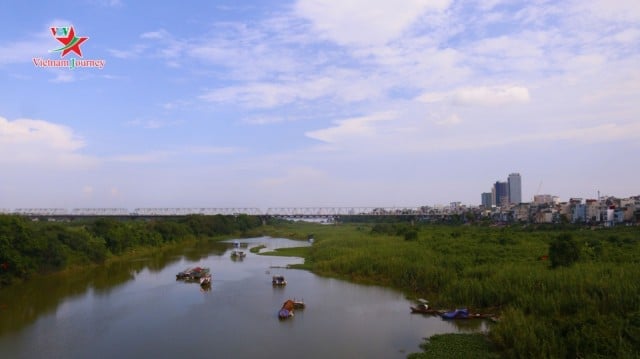
View of the Red River, a section flowing under Long Bien Bridge looking towards Chuong Duong Bridge - Photo: truyenhinhdulich.vn
Everywhere the Red River flows, it leaves behind unique traditional cultural values, the most prominent of which is the culture of Thang Long.
Although the section flowing through Hanoi is only a short part of the Red River's total length, the imprint of riverine culture and customs is clearly reflected there.
According to Ms. Le Minh: "The Red River is not only the cradle that nurtured the rice civilization, but it is also the cradle that nurtured Vietnamese culture. The Red River is also the origin of the settled lifestyle and the birthplace of village culture, which still influences Vietnam today."
If we travel along the Red River, we will see many temples, pagodas, and remaining historical sites, the most prominent of which are the temple dedicated to the Two Trung Sisters in Me Linh, Vinh Phuc, or the Co Loa Citadel with its nine arches built around the 3rd century.
If Co Loa is the oldest citadel on the Red River, then the most famous citadel associated with the Red River is Thang Long, which we now call Hanoi.
Not only is Thang Long Citadel situated between mountains and overlooking a river, but it is also where the Red River flows through. Hanoi's Thang Long Citadel is also closely associated with the Red River through an ancient legend: King Ly Cong Uan stepped onto a dragon boat and looked up at the sky, seeing a dragon flying up.
Hanoi is often described as a city within a river, with nine major and minor rivers flowing around it: the Red River, the Da River, the Duong River, the Ca Lo River, the Cau River, the To Lich River, the Nhue River, the Day River, and the Tich River.
The Red River forms the boundary separating the inner and outer areas of Hanoi. Researcher Le Minh added: "Hanoi can be said to be a city within a river, and the Red River is the largest river flowing through this city."
The Red River provides Hanoi with wealth and material resources such as rice and waterway transportation, but it also nourishes the spirit of the capital's people with songs and melodies, reflecting a thousand years of culture and civilization, and the rich history of the imperial city.
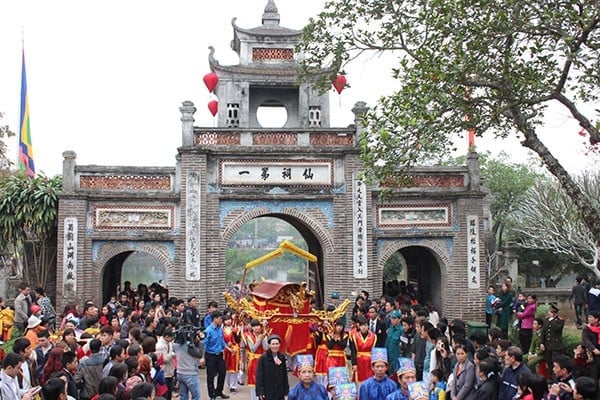
The Co Loa Festival in Hanoi (formerly in Dong Anh district) takes place annually - Photo: hoangthanhthanglong.vn
In Hanoi, most cultural architectural structures are located along rivers, near water sources. Structures such as communal houses, temples, and palaces were formed by the Red River, all clearly reflecting the culture of Thang Long.
For example, there are many temples and shrines built along the shores of West Lake.
Along with that are the imprints of poetry, festivals, and beliefs deeply rooted in the Red River civilization. Traditional craft villages from all over the country converged here, leaving behind many wonderful cultural values that are still present in the daily lives of Hanoi residents, such as pottery making and soy sauce making.
Nguyen Thi Tra, a former student of Hanoi University of Culture, shared: "Based on my major in the field of Vietnamese culture, I see the Red River as a representative, a living testament to the culture of Hanoi."
Even today, although Vietnam has adopted many cultures from around the world, I feel that the traditional identity originating from the Red River is still being preserved intact.
I believe these values should be preserved, cherished, and promoted to a wider audience, from Vietnamese people to foreign friends who come to Vietnam to live, work, or travel .”
To this day, the values brought about by the Red River civilization remain extremely evident in many aspects of the capital's culture and society, from architecture and traditional crafts to music and beliefs, demonstrating the enduring vitality of cultural values and beauty on the land of Thang Long - Hanoi.
Source: https://danviet.vn/van-minh-song-hong-dau-an-trong-van-hoa-thang-long-d1431225.html











![Transforming from Resolution 57: [Part 1] 'Digital Field' in the Heart of the City](https://vphoto.vietnam.vn/thumb/402x226/vietnam/resource/IMAGE/2026/06/01/1780313803412_2848-htx-nong-nghiep-tuan-ngoc-8-173833_249-173836.jpeg)










![[Photo] Reception to welcome General Secretary and President To Lam and his wife on their State visit to the Philippines](https://vphoto.vietnam.vn/thumb/1200x675/vietnam/resource/IMAGE/2026/06/01/1780295488620_vna-potal-chieu-dai-chao-mung-tong-bi-thu-chu-tich-nuoc-to-lam-va-phu-nhan-tham-cap-nha-nuoc-toi-philippines-8798060-7855-jpg.webp)














































Comment (0)