

 |
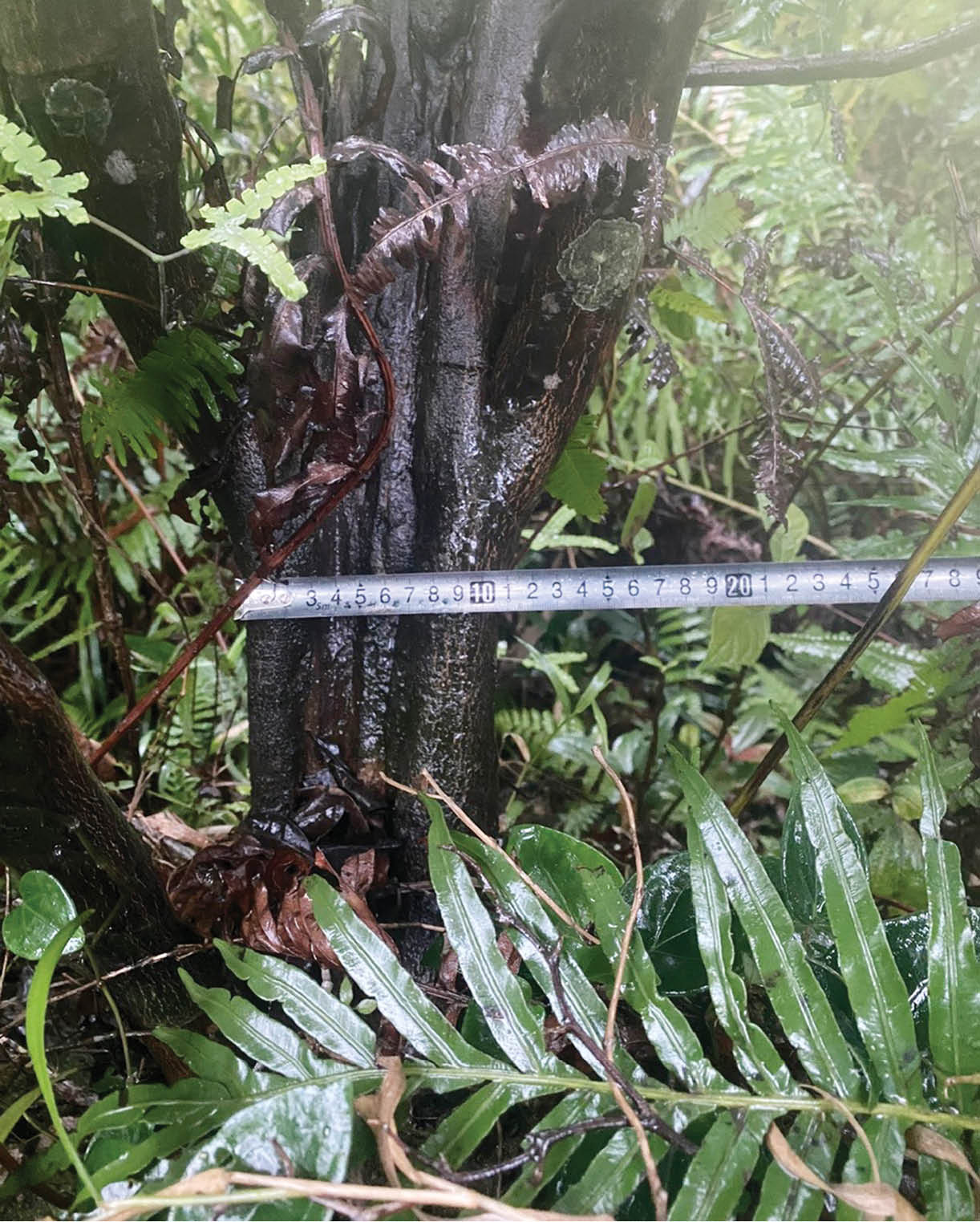
| The trunk of an ancient tea tree at Doc Che - photo taken on September 1, 2025. |
Shan Hue Tea
Thus, in less than a month since implementing the directives of the Hue City People's Committee, the Hue Department of Agriculture and Environment has performed its duties very well. From initial information, it has been determined that Hue has Shan tea; however, the quality will require further sample analysis. As the person who facilitated this, I am extremely pleased with these initial results.
Without a doubt, both practice and science prove that the mountainous upstream region of the Perfume River is home to wild Shan tea – a premium product that we have only recently become aware of thanks to the reputation of Ha Giang's Shan snow tea.
Mu Nu is a place located upstream of the Huu Trach branch of the Perfume River. The Hai Nhanh River is located upstream of the Ta Trach branch. During the war, thanks to not being devastated by bombs and chemical weapons, many pristine forests remained.
I first heard the story of "Mụ Nú tea" from the humorous anecdotes of journalist Ngô Kha and his comrades on the battlefield, and later from Mr. Hồ Viết Lễ, the former Director of the old Department of Commerce. Mr. Lễ confirmed to me, based on his account in the book "Mother's Tears," that here, when the Lunar New Year of 1966 was approaching, the unit members went to cut tea plants in the Mụ Nú area (a place in the old Hương Nguyên commune famous for its abundant tea) and then burned them at night to boil. The tea concentrated into a paste, about 3 kg per batch. When drinking, you only need to take out a small amount, like a corn kernel, put it in a cup, add boiling water, and if you add ginger, you will have a cup of fragrant and delicious tea."
I forwarded Mr. Ho Viet Le's account verbatim to Mr. Le Ngoc Tuan, Head of the Hue Forest Protection Department, for verification. About a week later, I received good news: in Mu Nu, forest rangers on patrol discovered two locations with wild tea plants. The tea plants growing there had trunks with a circumference of over 31cm and were up to 6m tall.
Interesting discovery
For me, the discovery and confirmation of wild tea in Mu Nu is undeniable. It proves that the entire Eastern Truong Son mountain range, stretching from North to South through Hue, has had wild Shan tea. This is evidenced by the discovery of the first ancient wild tea tree in the Doc Che area, within the Phong Dien Nature Reserve.
Please note that the discovery of wild tea plants in these two areas occurred within less than ten days, from August 25th to September 4th, 2025. All of this was carried out by the Hue Forest Protection Department after the City People's Committee assigned the "Department of Agriculture and Environment to lead and coordinate with relevant units to research, survey, collect, and analyze wild tea samples based on information from articles by author Pham Huu Thu published in Hue Today Newspaper," following a request from former Provincial Party Secretary Ho Xuan Man.
To bring great joy to Hue, I am merely the person connecting one person's aspirations with the memories of many, a coincidence stemming from a fleeting story shared by cultural and historical researcher Pham Duc Thanh Dung, when he and Professor Nguyen Quoc Vong and his wife recently visited A Luoi.
Professor Nguyen Quoc Vong was born in Phuoc Yen village, Quang Dien commune. After graduating from the Saigon University of Agriculture and Forestry in 1969, he studied in Japan and received his PhD in agricultural science from the University of Tokyo in 1977. After working in Japan for a short time, and after getting married, he and his wife settled in Australia in 1980, where they have lived ever since.
He became a research fellow at the Gosford Horticultural Institute and a member of the RIRDC advisory board for the Australian Federal Government; he was also a visiting professor at Western Sydney University and an adjunct professor at RMIT University. In Vietnam, he taught at Can Tho University, Hue University of Agriculture and Forestry, and Hanoi University of Agriculture and Forestry, and since 2007 has been a senior advisor to the Vietnam Academy of Agricultural Sciences; he also consulted for many international organizations.
Thanks to his participation in two projects funded by AFD - the French Government Development Agency and ADB - the Asian Development Bank, he was able to access and conduct in-depth research on "Vietnamese Shan forest tea" and initially conclude: "Shan snow tea has high medicinal quality index (catechin, tannin, amino acids and caffeine), far superior to ordinary green and black teas both domestically and internationally."
As someone deeply knowledgeable about the value of Vietnamese Shan tea, Professor Vong always expressed his wish to transplant the Shan tea variety from Ha Giang to Hue whenever he met friends. However, we all agreed that this was impossible for two reasons: firstly, Professor Vong was already advanced in age, and even if the transplant were successful, it would take at least 50 years for the tea plant to become an ancient tree.
I circled the words "Hong Van" because I knew that during the war, there was a place here called Doc Che, so I immediately sought out former Provincial Party Secretary Ho Xuan Man to recount the story.
Having led the 9th Regiment under former General Secretary Le Kha Phieu from Hue to Laos after the Spring Offensive of 1968, and having guided the late Party Secretary of the 6th Regiment Vu Thang and the late Party Secretary of Phong Dien District (formerly) Le Sau to meetings in the Military Region, Mr. Ho Xuan Man was intimately familiar with the Che Pass, a slope over 1,000 meters high, on numerous occasions. He recounted that in late 1991, when he was the District Party Secretary, the office's landscape was still very desolate due to the recent separation. So, he and his colleagues returned to Che Pass hoping to find some ancient camellia trees to transplant and renovate. However, upon directly examining the tree by taste, everyone confirmed that the tree currently in bloom, which they initially thought was a camellia, was actually a wild tea tree.
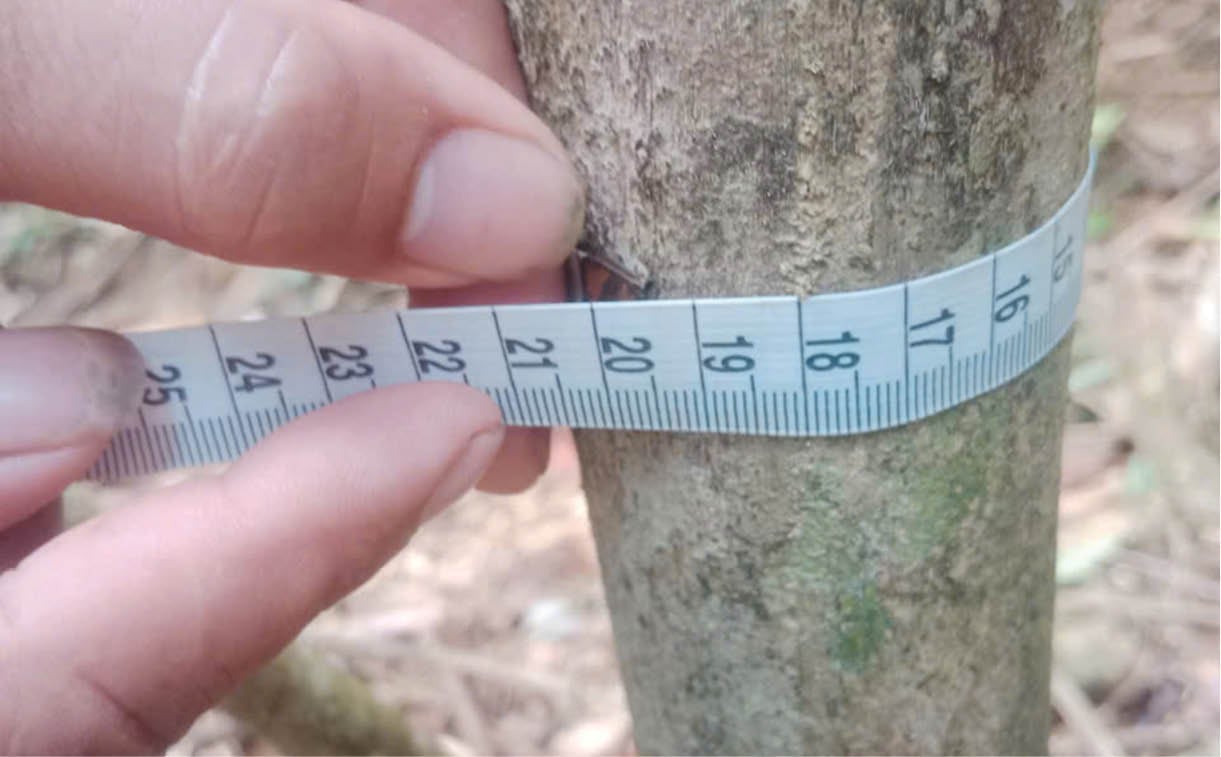 |
| Wild tea tree trunks in Mu Nu - photo taken on September 3, 2025 |
Early quality testing
It took more than thirty years, based on information I gathered and published in the Hue Today Newspaper, and following the directives of the Hue City People's Committee, the Department of Agriculture and Environment assigned the Hue Forest Protection Department to collect evidence. After nearly half a month of implementation, the results were surprising: Hue now has Shan tea.
The person who informed me, "We've found the ancient tea tree!" was Mr. Le Ngoc Tuan, Head of the Hue Forest Protection Department. Following Mr. Le Ngoc Tuan's introduction, I spoke directly with forest ranger Ho Van Kiem at the A Luoi Regional Forest Protection Unit.
Mr. Ho Van Kiem said that, following the request of the Head of the Sub-Department, he and his colleague, Ho Van Mom, patrolled and took those photos right at "Doc Che" - the area bordering A Luoi 1 commune and Phong Dien ward today.
Interestingly, at an altitude of 1,069 meters, this ancient tea tree is approximately 5 meters tall, and its location along Highway 71 makes it easy to find. Further inland, there are likely to be taller and larger trees. As predicted, after venturing deeper, on September 1, 2025, the A Lưới Forest Protection Unit discovered a second ancient wild tea tree. This tree was larger than the first; excluding the trunk, its circumference reached nearly 35cm. Expanding the area, on September 4, 2025, the A Lưới Forest Protection Unit discovered another wild tea tree in Hồng Kim. Images show that the circumference of this ancient wild tea tree trunk reached nearly 44cm.
Undoubtedly, in the A Lưới mountain region, the Forest Protection Department has found at least some wild tea plants in the mountainous areas of the former Hồng Vân and Hồng Kim communes, now A Lưới 1 commune. Meanwhile, upstream of the Hữu Trạch river, the Forest Protection Department has discovered two locations in Mụ Nú where wild tea plants are found. Measurements indicate that the plants are 6 meters tall, with a trunk circumference of over 31 cm. The head of the Huế Forest Protection Department also stated that samples are being sent for testing after collection.
After being asked if they had already drunk it, forest ranger Ho Van Kiem confirmed: "We have brewed and drunk it!" Compared to garden tea, forest tea has a lighter color but a more astringent taste.
The intensity of the tea's color depends on chlorophyll. The bitterness and astringency depend on the compounds within the tea. While Shan tea from Ha Giang, grown at an altitude of approximately 600m, has become a renowned tea, Shan tea from the forests of Hue, grown at an altitude of over 1,000m, would undoubtedly offer even greater expectations. More astringent! That's wonderful! But to know whether that astringency contains medicinal properties that contribute to the high or low value of Hue Shan tea, we must wait for the results of quality analysis.
For Professor Nguyen Quoc Vong, the recently discovered ancient Shan tea trees are proof that has helped alleviate his long-standing concerns. He is not only delighted to know that the Hue City government has gotten involved, but also happy to know that Hue has seen the photos he recently took in Hong Van and Hong Kim communes (formerly) and in Mu Nu - upstream of the Huu Trach river - which his friend Pham Duc Thanh Dung had just sent him.
Now, Shan forest tea from Hue is available. With his enthusiasm, Professor Nguyen Quoc Vong suggested that the Hue City government should organize the harvesting of leaves in the spring and process them into green tea. Afterward, samples should be analyzed for quality indicators, including Catechin and Epigallocatechin gallate (EGCG); Tannins and Theaflavin (TFs); Caffeine and amino acids… These are substances with many valuable medicinal properties, as recent research shows that Shan forest tea has the ability to help fight oxidation, prevent atherosclerosis, lower blood pressure, lower blood lipids, support the treatment of diabetes, and prevent cardiovascular diseases… all of which are essential for supporting human health care.
Based on the new analysis results, which compare the quality of standard tea with that of Thai Nguyen green tea, Shan Ta Xua Son La green tea, Chinese green tea, Japanese green tea, etc., Professor Nguyen Quoc Vong's recommendations are very much in line with the plan that the Department of Agriculture and Environment is seeking the opinion of the Hue City People's Committee to implement.
Once the quality of Shan tea from Mu Nu forest and Hai Nhanh river in Hue is established, the true value of Hue's cuisine will be enhanced through the hands of Hue's artisans.
What could be better than waking up in the morning and enjoying a cup of Shan Hue tea infused with white lotus blossoms from Tinh Tam Lake!
Source: https://huengaynay.vn/kinh-te/vang-xanh-cua-hue-158004.html















































































Comment (0)