

To see Yang Plút, even villagers cannot simply go about their business. Only during major ceremonies, when the sound of gongs echoes through the mountains and forests, does this ivory-ivory deity appear before the community.
THE LEGEND OF THE IVORY THAT "CHOSES" THE VILLAGE
Around November 2024, people finally had the opportunity to visit the communal house of Le village to witness the unique harvest festival of the Rơ Mâm people after many years of absence. At the communal house in the heart of the Mô Rai forest that day, everyone awaited the moment when the god Yang Plút would be carried out of the sacred basket. According to the villagers, the communal house has no doors, but no one dared to enter to see it, for fear of the god Yang Plút.
Elder A Blong (70 years old) recounts that the deity Yang Plút has been associated with Le village for hundreds of years. The village may move, the fields may change, but the sacred elephant tusk will never leave the villagers. Legend tells of a Rơ Mâm man who was hunting in the forest with his dog. At a strange spot, the dog stopped and barked loudly, and throughout the day it kept trying to return to that spot. Curious, the man parted the bushes and discovered an elephant tusk buried deep in the ground. The tusk was brought back and hidden on the edge of the village, then the village chief was informed. That night, the village chief dreamt that the deity Yang Plút appeared and instructed him: "I want to stay with this village and bless the villagers. But if you want me to come, you must let me drink the blood from the hearts of buffalo, goats, pigs, and chickens…"

White buffaloes are chosen for the harvest festival and their blood is offered as a sacrifice to the elephant tusk god.
PHOTO: PHAM ANH
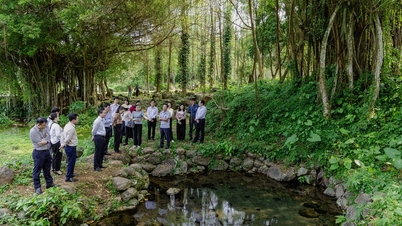
The next morning, the village council of elders and villagers gathered, following the deity's instructions. From then on, Yang Plút was worshipped in the communal house, the most sacred place of the Rơ Mâm community. No one was allowed to make noise or disturb the space so that the deity could "rest." Every year during the New Rice Festival (the biggest festival of the Rơ Mâm people), the villagers would offer sacrifices to the deity with blood from the hearts of buffaloes, goats, pigs, and chickens, along with rice wine (traditional rice wine), praying for Yang Plút's blessings for the villagers to have enough food and clothing, and to be free from disasters and fires. After the funeral ceremony, every Rơ Mâm tomb had a tomb statue with an elephant horn on top. In the sacred forest of Le village, we saw that under the dense canopy of kapok and bamboo trees, both old and new tombs had the symbol of elephant tusks on their tomb statues.
WHEN THE WHOLE VILLAGE WALKED ALONG WITH THE GOD
For the Rơ Mâm people, the New Rice Festival is not only a celebration of the harvest but also the most important occasion for offering sacrifices to Yang Plút. For each major festival, the entire village prepares for many days. The afternoon before the sacrifice, the villagers perform a "land-seeking" ceremony, erecting three ceremonial poles in the middle of the communal house. A white buffalo and a white goat are tied up, while the pig is hung on the largest pole. Village elder A Reng leads the gong and drum ensemble into the communal house, inviting Yang Plút out to "celebrate" with the villagers.
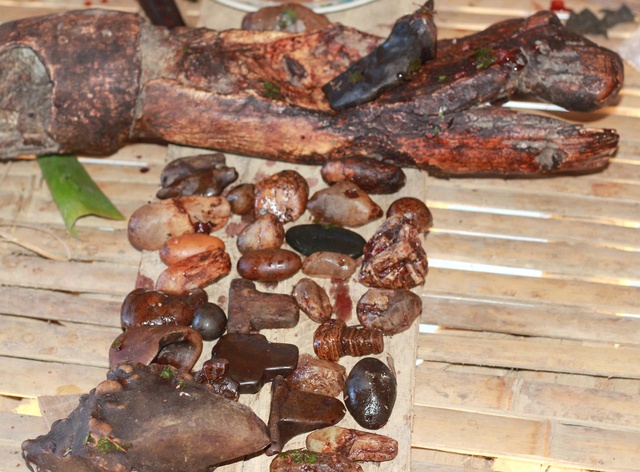
Fossilized ivory and its "offspring"
As the sun set behind the mountains, each family brought out rice to scatter around the ceremonial pole, throwing it while praying and asking the gods to bear witness. As night fell, the fire blazed, rice wine was passed from hand to hand, and the sound of gongs echoed incessantly. Throughout the night, the villagers danced and drank rice wine until they were intoxicated. The sound of the gongs and the moonlight seemed to blend with the atmosphere of the sacred sacrifice – the god of the Rơ Mâm people. "That's the night Yang Plút stays awake with the village," said elder A Blong.
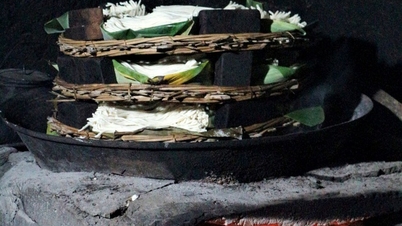
The following morning, the official ceremony took place. Blood from the hearts of buffaloes, goats, pigs, and chickens was extracted and mixed together in a large basin for the ritual "bathing" of the deity. To the solemn sound of gongs, the village elder A Reng solemnly carried Yang Plút from the sacred basket and placed it in the center of the communal house. For the first time, the form of Yang Plút was revealed: a fossilized elephant tusk, about half a meter high, almost as thick as an adult's thigh, heavier and colder than ordinary stone. The village elder bathed the tusk with blood, whispering prayers, hoping the deity would "eat" it and continue to protect the Rơ Mâm community.
DOUBTS SURROUNDING THE IVORY GOD
Yang Plút is also associated with a series of strange stories that the Rơ Mâm people have yet to explain. Elder A Blong recounts that in the past, there was a sacred medicinal plant in front of the communal house. Every time a sacrifice was made, the village elder would pick the leaves of this plant to boil water for bathing Yang Plút. Then, due to war and turmoil, the medicinal plant disappeared, but Yang Plút itself remained intact.
During the years of resistance against the Americans, the communal house of Le village was repeatedly burned down by bombs and bullets. However, incredibly, the pillar of the communal house where the basket containing Yang Plút was hung never burned, even though only ashes remained around it. "One night I saw the communal house brightly lit, I thought it was on fire again. But when I ran over, everything was still intact," recalled elder A Blong.
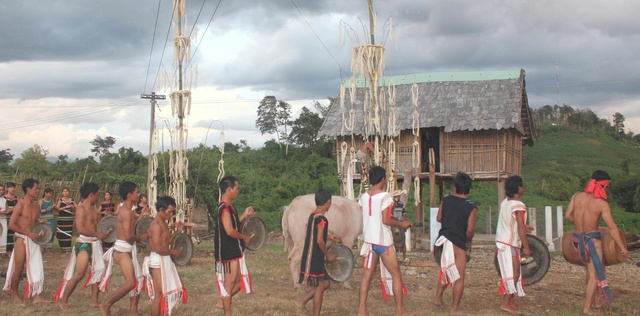
The Rơ Mâm people dance before performing the ritual of sacrificing a white buffalo.
PHOTO: PHAM ANH
Strangely enough, before Yang Plút was born, the village of Le worshipped a sacred stone as big as an arm. When the elephant tusks were brought to live alongside the sacred stone, dozens of smaller stones suddenly appeared in the offering basket. Some were as big as a fist, others flat like a "heavenly hammer." To this day, there are dozens of stones believed to be the "children" of Yang Plút and the sacred stone. Elder A Blong recounts that after each bloodbath, these stones... "give birth" to more.
According to officials from the Department of Culture, Sports and Tourism of Quang Ngai province, at the end of 2024, after nearly a decade, the Rơ Mâm people once again held a large sacrificial ceremony for Yang Plút. The communal house was renovated, and the offerings were fully prepared. Over time, although the sacred space and mystique of the ritual have somewhat faded, for the Rơ Mâm people of Le village, the god Yang Plút remains the soul of the smallest ethnic community in Vietnam. (to be continued)
Source: https://thanhnien.vn/vat-thieng-cua-lang-than-nga-voi-cua-nguoi-ro-mam-185260301210604778.htm
![[Photo] General Secretary and President To Lam presides over a meeting on preparations for the review of one year of operation of the three-tiered government system.](https://vphoto.vietnam.vn/thumb/1200x675/vietnam/resource/IMAGE/2026/06/02/1780391821195_a1-bnd-4595-9717-jpg.webp)


![[Megastory] The journey of young doctors in challenging lands](https://vphoto.vietnam.vn/thumb/402x226/vietnam/resource/IMAGE/2026/03/26/1774537751919_megastory_thay_thuoc_tre_thumbnail_20260326214103.jpeg)



![[Photo Gallery] Spring Volunteer Program - Working Together for the Community](https://vphoto.vietnam.vn/thumb/402x226/vietnam/resource/IMAGE/2026/01/31/1769810662260_5t_20260130154816.jpeg)























































Comment (0)